Volume 32, Number 5—May 2026
Research Letter
Probable Bartonella clarridgeiae Prosthetic Valve Endocarditis and Aortic Root Abscess, Australia, 2020
 and Sarah Coghill
Cite This Article
Citation for Media
Abstract
We describe a case of endocarditis and aortic root abscess caused by Bartonella clarridgeiae bacteria in a patient in Australia. The patient initially sought care for leg pain and was found to have bilateral tibioperoneal trunk mycotic aneurysms. 16S rRNA PCR on excised aneurysm tissue identified the cause as B. clarridgeiae.
Bartonella species are gram-negative, fastidious, facultative intracellular bacteria (1). They are a cause of blood culture–negative endocarditis, infective endocarditis with negative blood cultures resulting from antibiotic exposure or fastidious pathogens (2). B. clarridgeiae is an emerging pathogen in the genus, first identified in 1995 and attributed as a human pathogen in 1997 (3,4). Tibioperoneal trunk (TPT) aneurysms are a rare clinical phenomenon; causes include trauma, vasculitis, and infective endocarditis or mycotic aneurysm (5). We describe a case of bilateral TPT aneurysms, prosthetic valve infective endocarditis, and aortic root abscess in a patient in Australia in 2020 that was caused by B. clarridgeiae, identified on 16S ribosomal RNA of aneurysm tissue samples.
A man in his 80s sought care at a local emergency department for pain in his left calf for 1 month. He had aortic stenosis requiring a transcatheter aortic valve implantation 2 years earlier. He had sought care several times over the previous 8 months with calf pain, chest pain, and lethargy. On examination, he was noted to have a swollen and tender left calf, a pansystolic murmur, 2 splinter hemorrhages, and a temperature of 37.9°C. He initially received intravenous cefazolin for possible cellulitis, later changed to amoxicillin/clavulanate.
Computed tomography (CT) angiogram demonstrated a hematoma in the left calf associated with a TPT pseudoaneurysm and a right TPT thrombus. The left TPT aneurysm was surgically repaired. Transesophageal echocardiography (TOE) showed no valvular incompetence or vegetations.
Figure
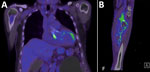
Figure. Positron emission tomography/computed tomography images from study of patient with Bartonella clarridgeiaeprosthetic-valve endocarditis and aortic root abscess, Australia, 2020. A) Fluorodeoxyglucose activity at ventricular end of the transcatheter...
CT positron emission tomography scan demonstrated focal intense fluorodeoxyglucose activity at the transcatheter aortic valve implantation (SUVmax = 5.9) (Figure, panel A), postsurgical changes involving the left lower leg (Figure, panel B), and focal moderate activity at the right tibioperoneal trunk, indicating another mycotic aneurysm. We reviewed TOE findings again and identified an echolucent space at the sinus of Valsalva, consistent with an aortic root abscess. Therapy was switched to intravenous ceftriaxone and vancomycin. The patient was deemed not to be a cardiac surgery candidate.
Four sets of blood cultures were negative for bacteremia. Operative tissue culture tested negative for bacterial growth using standard media; we sent the tissue samples for 16S rRNA PCR. We conducted serologic testing for Brucella spp., Coxiella burnettii, syphilis, and HIV. We tested for Bartonella spp. using FOCUS Diagnostics Indirect Immunofluorescence Assay IgG kit for B. henslae and B. quintana IgG (http://focusdiagnostics.in). 16S rRNA PCR detected B. clarridgeiae DNA in operative tissue samples. Serology results for B. henslae bacteria were strongly positive (IgG >1:2,048 [<128]); all other serology results, including B. quintana testing, were negative. We performed PCR testing of blood with primers and probe targeting a conserved portion of the citrate synthase gene; results for Bartonella spp. DNA were negative.
We switched treatment to intravenous gentamicin with oral doxycycline (100 mg 2×/d). The patient experienced ongoing fevers and elevated C-reactive protein levels. Because of concern for treatment failure, we added oral ciprofloxacin for 6 weeks; repeated TOE showed stable changes. After 6 weeks, the patient continued oral doxycycline (100 mg 2×/d) for suppression; he remained well at a 2-year follow-up visit.
Early reports for bartonellosis associated B. clarridgeiae with cat-scratch disease (6). Cats are a reservoir for B. clarridgeiae and B. henslae (4,7); the patient we report kept multiple cats at home, although he recalled no preceding cat bite or scratch. A case of endocarditis and aortic root abscess caused by B. clarridgeiae diagnosed in 2019 was treated successfully with ceftriaxone, doxycycline, and heart valve replacement (7).
Serology has traditionally been a method for diagnosing bartonellosis; however, cross-reactivity can occur (8), as in this case. Molecular diagnostics are a valuable tool in accurate diagnosis of Bartonella endocarditis; emergence of pathogens such as B. clarridgeiae may be related to their increasing use (1,8). A limitation of our report is that the average nucleotide identity percentage is unavailable to confirm distinction between Bartonella species.
At the time of this case in 2020, the recommended treatment for Bartonella endocarditis was gentamicin for 2 weeks with doxycycline for 6 weeks (3). Because Bartonella endocarditis has been associated with infection-related glomerulonephritis (9), newer recommendations suggest doxycycline or azithromycin for 12 weeks and rifampin for 6 weeks (2). Other suggested therapies for Bartonella infections have included trimethoprim/sulfamethoxazole and ciprofloxacin (3). Because of concerns for treatment failure in our patient, we added ciprofloxacin empirically, without strong evidence available to guide treatment.
Delay in diagnosis of endocarditis is an unfortunate theme in mycotic aneurysm with low-medium virulence organisms (10). Our patient had a protracted manifestation over months, with nonspecific symptoms before diagnosis. This case reinforces the need for suspicion of endocarditis in patients seeking care for TPT aneurysms and highlights the pathogenicity of B. clarridgeiae bacteria in this context. Suspicion of and investigation for causes of blood culture–negative endocarditis including Bartonella spp. is therefore warranted in patients with TPT aneurysms, should initial microbiologic investigations be negative. Molecular diagnostics including 16S rRNA PCR can aid diagnosis.
Dr. Cribb is a resident doctor at Lismore Base Hospital in New South Wales, Australia. His primary interests are in infectious diseases and medical microbiology.
References
- McCormick DW, Rassoulian-Barrett SL, Hoogestraat DR, Salipante SJ, SenGupta D, Dietrich EA, et al. Bartonella spp. infections identified by molecular methods, United States. Emerg Infect Dis. 2023;29:467–76. DOIPubMedGoogle Scholar
- DeSimone DC, Garrigos ZE, Marx GE, Tattevin P, Hasse B, McCormick DW, et al.; American Heart Association Council on Lifelong Congenital Heart Disease and Heart Health in the Young. Council on Clinical Cardiology; and Council on Quality of Care and Outcomes Research. Blood culture–negative endocarditis: a scientific statement from the American Heart Association. J Am Heart Assoc. 2025;14:
e040218 . DOIPubMedGoogle Scholar - Rolain JM, Brouqui P, Koehler JE, Maguina C, Dolan MJ, Raoult D. Recommendations for treatment of human infections caused by Bartonella species. Antimicrob Agents Chemother. 2004;48:1921–33. DOIPubMedGoogle Scholar
- Kordick DL, Hilyard EJ, Hadfield TL, Wilson KH, Steigerwalt AG, Brenner DJ, et al. Bartonella clarridgeiae, a newly recognized zoonotic pathogen causing inoculation papules, fever, and lymphadenopathy (cat scratch disease). J Clin Microbiol. 1997;35:1813–8. DOIPubMedGoogle Scholar
- Akers DL Jr, Fowl RJ, Kempczinski RF. Mycotic aneurysm of the tibioperoneal trunk: case report and review of the literature. J Vasc Surg. 1992;16:71–4. DOIPubMedGoogle Scholar
- Logan JMJ, Hall JL, Chalker VJ, O’Connell B, Birtles RJ. Bartonella clarridgeiae infection in a patient with aortic root abscess and endocarditis. Access Microbiol. 2019;1:
e000064 . DOIPubMedGoogle Scholar - Margileth AM, Baehren DF. Chest-wall abscess due to cat-scratch disease (CSD) in an adult with antibodies to Bartonella clarridgeiae: case report and review of the thoracopulmonary manifestations of CSD. Clin Infect Dis. 1998;27:353–7. DOIPubMedGoogle Scholar
- Pinheiro Santos J, Sousa R, Santos A, Laranjeira Santos Á, Fragata J. Infective endocarditis due to Bartonella quintana in a patient with biological aortic prosthesis. Rev Port Cir Cardiotorac Vasc. 2019;26:59–61. DOIPubMedGoogle Scholar
- Shrestha NK, Kanyo EC, Nakhoul GN, Herlitz LC, Gordon SM. Association between causative pathogen and occurrence of infection-related glomerulonephritis in infective endocarditis. Clin Infect Dis. 2024;78:1551–3. DOIPubMedGoogle Scholar
- González I, Sarriá C, López J, Vilacosta I, San Román A, Olmos C, et al. Symptomatic peripheral mycotic aneurysms due to infective endocarditis: a contemporary profile. Medicine (Baltimore). 2014;93:42–52. DOIPubMedGoogle Scholar
Figure
Cite This ArticleOriginal Publication Date: May 01, 2026
Table of Contents – Volume 32, Number 5—May 2026
| EID Search Options |
|---|
 Advanced Article Search – Search articles by author and/or keyword.
|
 Articles by Country Search – Search articles by the topic country.
|
 Article Type Search – Search articles by article type and issue.
|
Please use the form below to submit correspondence to the authors or contact them at the following address:
Mark Cribb, c/o Lismore Base Hospital, 60 Uralba St, Lismore, NSW 2480, Australia
Top