Skip directly to site content Skip directly to page options Skip directly to A-Z link Skip directly to A-Z link Skip directly to A-Z link

Disclaimer: Early release articles are not considered as final versions. Any changes will be reflected in the online version in the month the article is officially released.

Volume 32, Number 6—June 2026

Dispatch

Concurrent Detection of Swine-Origin Influenza A(H1N1) Virus in Pigs and Farmer, Switzerland

Jonas Steiner1, Mike Mwanga1, Larise Oberholster, Matthias Licheri, Manon F. Licheri, Heiko Nathues2, Ronald Dijkman2, and Jenna N. Kelly2Comments to Author 
Author affiliation: University of Bern Multidisciplinary Center for Infectious Diseases, Bern, Switzerland (J. Steiner, M. Mwanga, L. Oberholster, M. Licheri, M.F. Licheri, H. Nathues, R. Dijkman, J.N. Kelly); University of Bern Vetsuisse Faculty, Bern (J. Steiner, M. Mwanga, H. Nathues, J.N. Kelly); University of Bern Faculty of Medicine, Bern (M. Mwanga, L. Oberholster, M. Licheri, M.F. Licheri, R. Dijkman); Institute of Virology and Immunology, Bern and Mittelhäusern, Switzerland (M. Mwanga, J.N. Kelly)

Main Article

Figure 2

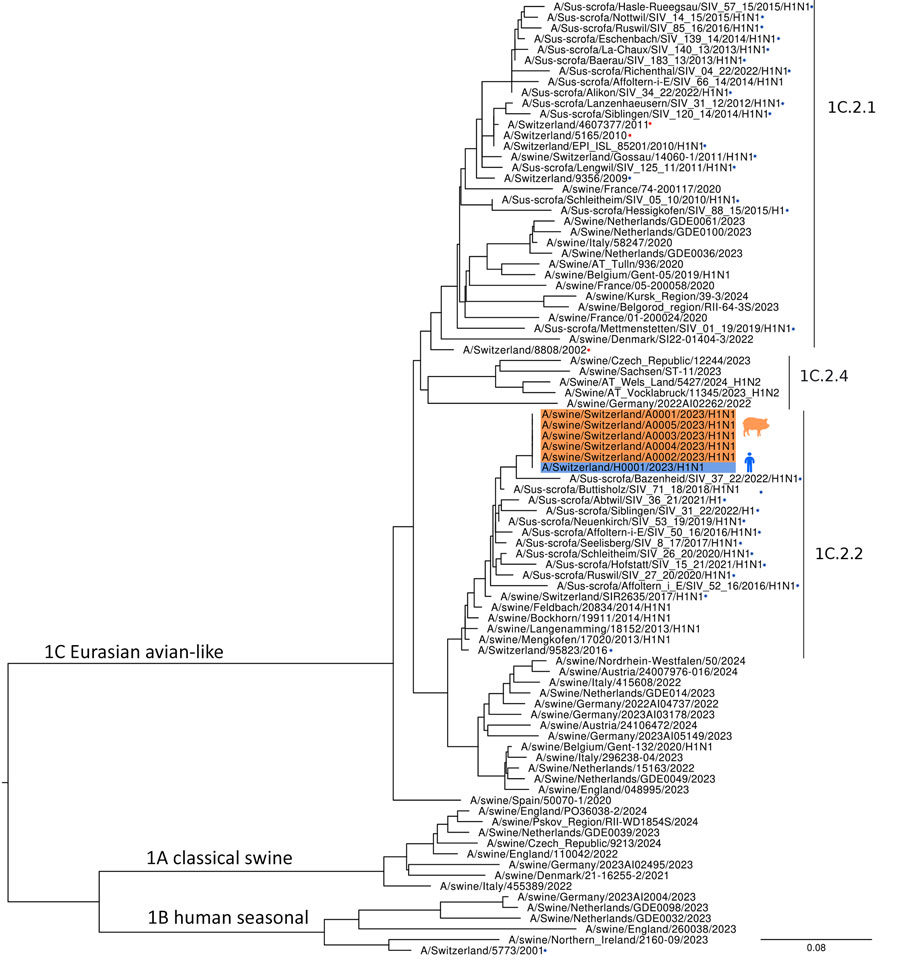
Maximum-likelihood phylogenetic tree from study of swine-origin influenza A(H1N1) virus in pigs and farmer, Switzerland, November 2023. We mapped hemagglutinin (HA) gene codon sequences, showing lineage classification of the study swine H1N1 virus based on lineage reference sequences and HA-H1 sequences from viruses identified in Switzerland and other Europe countries (2020–2023). The tree shows classification based on the 3 major swine H1N1 lineages: 1A, 1B, and 1C. Orange shading indicates swine H1N1 HA sequences from pig samples; blue indicates sequence from the farmer. Other swine H1N1 HA sequences from Switzerland are marked with asterisks: blue for those identified in pig samples and red for those identified in human samples. Study sequences cluster within the Eurasian avian-like lineage clade 1C.2.2. Pig sequences from previous years are grouped in clades 1C.2.1. and 1C.2.2. Scale bar indicates substitutions per site.

Figure 2. Maximum-likelihood phylogenetic tree from study of swine-origin influenza A(H1N1) virus in pigs and farmer, Switzerland, November 2023. We mapped hemagglutinin (HA) gene codon sequences, showing lineage classification of the study swine H1N1 virus based on lineage reference sequences and HA-H1 sequences from viruses identified in Switzerland and other Europe countries (2020–2023). The tree shows classification based on the 3 major swine H1N1 lineages: 1A, 1B, and 1C. Orange shading indicates swine H1N1 HA sequences from pig samples; blue indicates sequence from the farmer. Other swine H1N1 HA sequences from Switzerland are marked with asterisks: blue for those identified in pig samples and red for those identified in human samples. Study sequences cluster within the Eurasian avian-like lineage clade 1C.2.2. Pig sequences from previous years are grouped in clades 1C.2.1. and 1C.2.2. Scale bar indicates substitutions per site.

Main Article

1These first authors contributed equally to this article.

2These senior authors contributed equally to this article.

Page created: April 27, 2026
Page updated: May 13, 2026
Page reviewed: May 13, 2026
The conclusions, findings, and opinions expressed by authors contributing to this journal do not necessarily reflect the official position of the U.S. Department of Health and Human Services, the Public Health Service, the Centers for Disease Control and Prevention, or the authors' affiliated institutions. Use of trade names is for identification only and does not imply endorsement by any of the groups named above.
file_external