Volume 32, Number 6—June 2026
Research Letter
Neisseria gonorrhoeae Sequence Type 16676 in Disseminated Infections, Minnesota, USA, 2025
 , Allison LaPointe, Christine Peel, Khalid Bo-Subait, Elizabeth Dufort, Jenell Stewart, John Kaiyalethe, Bradley Craft, Matthew Plumb, Bonnie Weber, Laura Bohnker-Voels, Kelly Pung, Alyssa Mondelli, Jacob Garfin, Sarah Namugenyi, Paula Snippes-Vagnone, M. Elizabeth Gyllstrom, Kathryn Como-Sabetti, and Ruth Lynfield
Figure 2
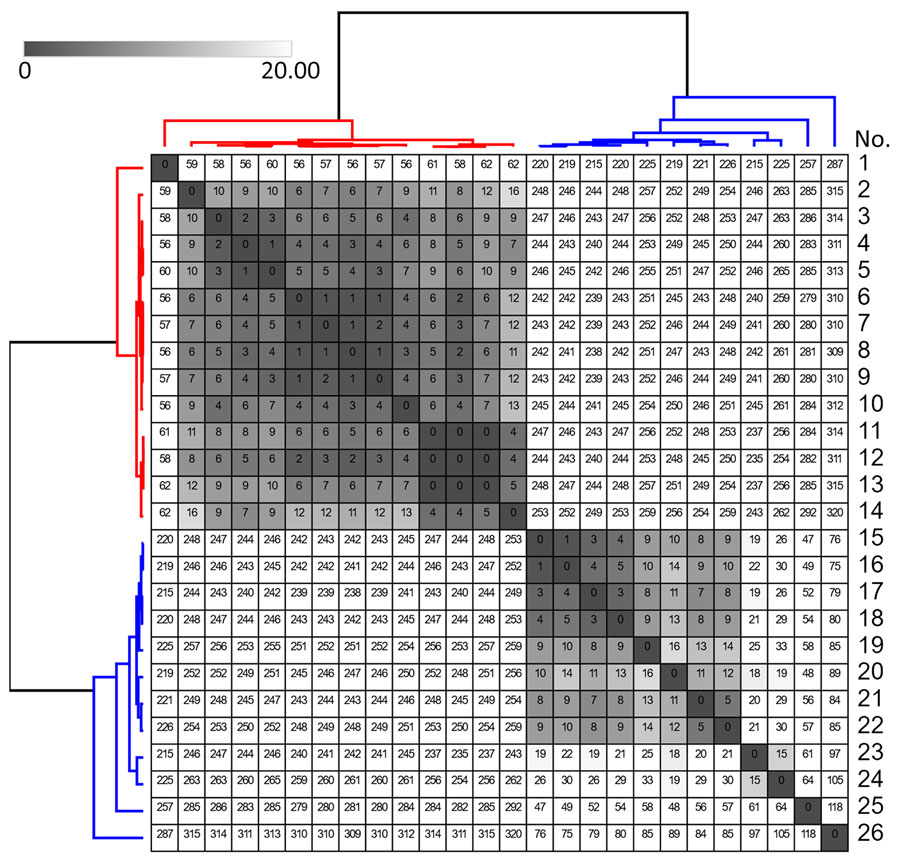
Figure 2. Reference-based pairwise single-nucleotide polymorphism (SNP) matrix of 26 Neisseria gonorrhoeae sequence type 16676 infections from study of outbreak of N. gonorrhoeae sequence type 16676 among disseminated infections, Minnesota, USA, 2025. Genomes numbered 1–14 (red) are from Minnesota disseminated gonococcal infection isolates in 2025. Genomes numbered 15–26 (blue) represent the other genomes grouped in the same National Center for Biotechnology Information Pathogen Detection cluster (PDS000214546.4.) in October 2025. SNP calls were clustered and displayed using Morpheus software (https://software.broadinstitute.org/morpheus). SNP calls <20 are highlighted in grayscale. Genome number 7 was used as an internal reference for calling SNPs with the Dryad version 3.0 pipeline (7).
References
- Weston EJ, Heidenga BL, Farley MM, Tunali A, D’Angelo MT, Moore A, et al. Surveillance for disseminated gonococcal infections, active bacterial core surveillance (ABCs)—United States, 2015–2019. Clin Infect Dis. 2022;75:953–8. DOIPubMedGoogle Scholar
- Evans D, Friedlander H, Bo-Subait K, Dennis J, Kaiyalethe J, Craft B, et al. Genomic investigation of disseminated gonococcal infections, Minnesota, USA, 2024. Emerg Infect Dis. 2025;31:2003–7. DOIPubMedGoogle Scholar
- Jolley KA, Bray JE, Maiden MCJ. Open-access bacterial population genomics: BIGSdb software, the PubMLST.org website and their applications. Wellcome Open Res. 2018;3:124. DOIPubMedGoogle Scholar
- Maiden MC, Bygraves JA, Feil E, Morelli G, Russell JE, Urwin R, et al. Multilocus sequence typing: a portable approach to the identification of clones within populations of pathogenic microorganisms. Proc Natl Acad Sci U S A. 1998;95:3140–5. DOIPubMedGoogle Scholar
- Demczuk W, Sidhu S, Unemo M, Whiley DM, Allen VG, Dillon JR, et al. Neisseria gonorrhoeae sequence typing for antimicrobial resistance, a novel antimicrobial resistance multilocus typing scheme for tracking global dissemination of N. gonorrhoeae strains. J Clin Microbiol. 2017;55:1454–68. DOIPubMedGoogle Scholar
- Feldgarden M, Brover V, Gonzalez-Escalona N, Frye JG, Haendiges J, Haft DH, et al. AMRFinderPlus and the Reference Gene Catalog facilitate examination of the genomic links among antimicrobial resistance, stress response, and virulence. Sci Rep. 2021;11:12728. DOIPubMedGoogle Scholar
- Sagulenko P, Puller V, Neher RA. TreeTime: maximum-likelihood phylodynamic analysis. Virus Evol. 2018;4:
vex042 . DOIPubMedGoogle Scholar - Welch G, Reed GW, Rice PA, Ram S. A meta-analysis to quantify the risk of disseminated gonococcal infection with porin B serotype. Open Forum Infect Dis. 2024;11:
ofae389 .PubMedGoogle Scholar - Berçot B, Assoumou L, Caméléna F, Voitichouk C, Mérimèche M, Ouattara M, et al. Antimicrobial drug-resistant Neisseria gonorrhoeae (GC) infections in men using doxycycline postexposure prophylaxis. A substudy of the ANRS 174 DOXYVAC trial. Clin Infect Dis. 2025;
ciaf591 ; [Epub ahead of print].PubMedGoogle Scholar