Volume 32, Number 6—June 2026
Dispatch
Suspected Sexual Transmission of Dermatophilosis among Men Who Have Sex with Men, Barcelona, Spain, 2025–2026
Vicente Descalzo1, Albert Moreno-Mingorance1, Patricia Álvarez-López, Paula Salmerón, Jorge N. García-Pérez, Ferran P. Pericás-Cladera, Jordi Arcarons, Guillem Puigsech-Boixeda, Ilaria Furlan, Ester del Barrio-Tofiño, Sol M. San José, Nieves Larrosa, Vicenç Falcó, Mayli Lung , Maider Arando2 , and Juan José González-López2
, Maider Arando2 , and Juan José González-López2
Figure 2
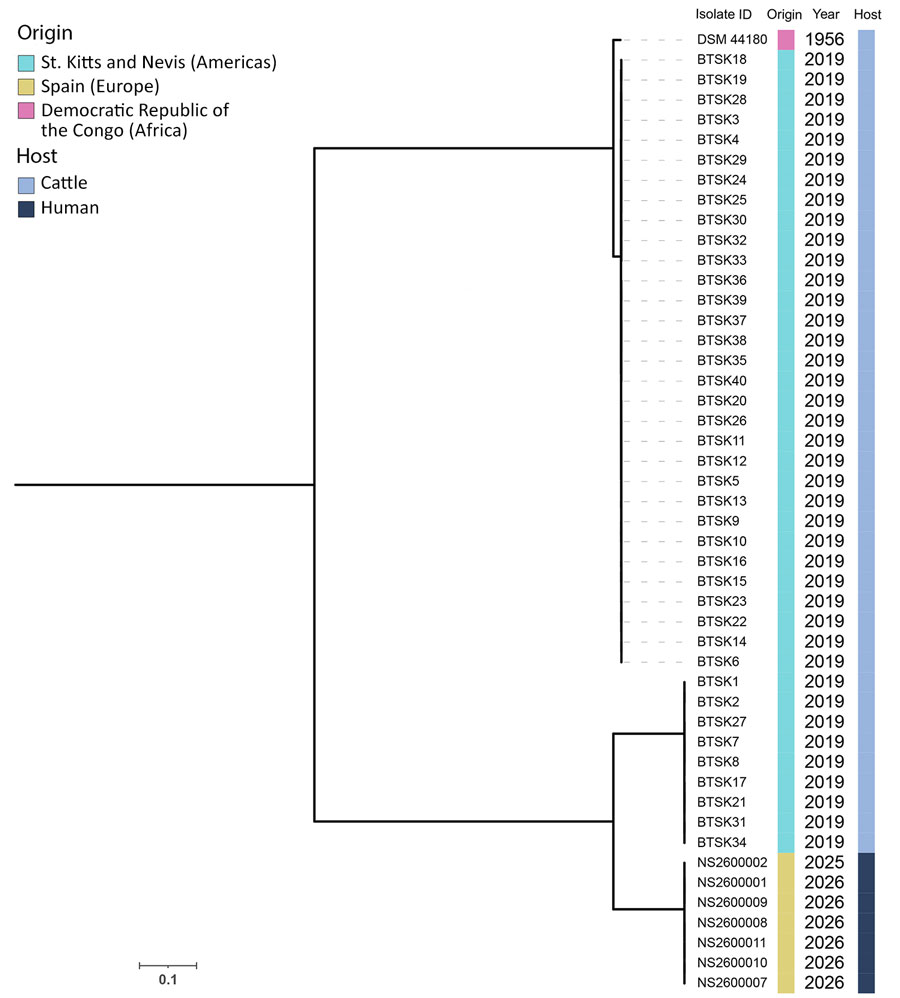
Figure 2. Phylogenetic analysis of Dermatophilus isolates in cluster of suspected sexual transmission of dermatophilosis among men who have sex with men, Barcelona, Spain, December 2025–March 2026. Maximum-likelihood phylogenetic tree shows Dermatophilus isolates from patient nos. 1–7 obtained in this study (bottom of tree) compared with 40 genomes from cattle in Saint Kitts and Nevis (8), and reference strain D. congolensis DSM 44180 (all from the National Center for Biotechnology Information Sequence Read Archive, https://www.ncbi.nlm.nih.gov/sra). Scale bar indicates nucleotide substitutions per site.
References
- Zaria LT. Dermatophilus congolensis infection (Dermatophilosis) in animals and man! An update. Comp Immunol Microbiol Infect Dis. 1993;16:179–222. DOIPubMedGoogle Scholar
- Dean DJ, Gordon MA, Severinghaus CW, Kroll E, Reilly JR. Streptothricosis: a new zoonotic disease. N Y State J Med. 1961;61:1285–7.
- Towersey L, Martins EC, Londero AT, Hay RJ, Soares Filho PJ, Takiya CM, et al. Dermatophilus congolensis human infection. J Am Acad Dermatol. 1993;29:351–4. DOIPubMedGoogle Scholar
- Burd EM, Juzych LA, Rudrik JT, Habib F. Pustular dermatitis caused by Dermatophilus congolensis. J Clin Microbiol. 2007;45:1655–8. DOIPubMedGoogle Scholar
- Alejo-Cancho I, Bosch J, Vergara A, Mascaro JM, Marco F, Vila J. Dermatitis by Dermatophilus congolensis. Clin Microbiol Infect. 2015;21:e73–4. DOIPubMedGoogle Scholar
- Aubin GG, Guillouzouic A, Chamoux C, Lepelletier D, Barbarot S, Corvec S. Two family members with skin infection due to Dermatophilus congolensis: a case report and literature review. Eur J Dermatol. 2016;26:621–2. DOIPubMedGoogle Scholar
- Clinical and Laboratory Standards Institute. Performance standards for susceptibility testing of mycobacteria, Nocardia spp., and other aerobic actinomycetes (document M24S). Wayne (PA): The Institute; 2023.
- Branford I, Boyen F, Johnson S, Zayas S, Chapwanya A, Butaye P, et al. Identification and antimicrobial resistance of Dermatophilus congolensis from cattle in Saint Kitts and Nevis. Vet Sci. 2021;8:135. DOIPubMedGoogle Scholar
- Riesco R, Trujillo ME. Update on the proposed minimal standards for the use of genome data for the taxonomy of prokaryotes. Int J Syst Evol Microbiol. 2024;74:
006300 . DOIPubMedGoogle Scholar - Tarín-Vicente EJ, Alemany A, Agud-Dios M, Ubals M, Suñer C, Antón A, et al. Clinical presentation and virological assessment of confirmed human monkeypox virus cases in Spain: a prospective observational cohort study. Lancet. 2022;400:661–9. DOIPubMedGoogle Scholar
- Descalzo V, Martín MT, Álvarez-López P, García-Pérez JN, Alcázar-Fuoli L, López-Pérez L, et al. Trichophyton mentagrophytes genotype VII and sexually transmitted tinea: an observational study in Spain. Mycoses. 2025;68:
e70049 . DOIPubMedGoogle Scholar - Spicknall IH, Gift TL, Bernstein KT, Aral SO. Sexual networks and infection transmission networks among men who have sex with men as causes of disparity and targets of prevention. Sex Transm Infect. 2017;93:307–8. DOIPubMedGoogle Scholar
- Abu-Samra MT. The epizootiology of Dermatophilus congolensis infection. Rev Elev Med Vet Pays Trop. 1980;33:23–32.PubMedGoogle Scholar
- Martinez D, Prior P. Survival of Dermatophilus congolensis in tropical clay soils submitted to different water potentials. Vet Microbiol. 1991;29:135–45. DOIPubMedGoogle Scholar
- García Sánchez A, Zurita SG, Gil Molino M, Martin Cano FE, Barraso Gil C, Hermoso de Mendoza Salcedo J. Outbreak of dermatophilosis in horses possibly transmitted by sharing riding equipment. Braz J Vet Med. 2024;46:
e002124 . DOIPubMedGoogle Scholar
1These first authors contributed equally to this article.
2These senior authors contributed equally to this article.
Page created: April 23, 2026
Page updated: June 01, 2026
Page reviewed: June 01, 2026
The conclusions, findings, and opinions expressed by authors contributing to this journal do not necessarily reflect the official position of the U.S. Department of Health and Human Services, the Public Health Service, the Centers for Disease Control and Prevention, or the authors' affiliated institutions. Use of trade names is for identification only and does not imply endorsement by any of the groups named above.