Volume 32, Number 7—July 2026
Dispatch
Household Transmission of Enterovirus D68, Washington and Oregon, United States, 2022–2024
Pavitra Roychoudhury , Erica Wetzler, Anna Elias-Warren, Katherine L. Hoffman, Alex Harteloo, Hyeong Geon Kim, Kevin Kong, Hong Xie, Jolene Gov, Margaret G. Mills, Collrane Frivold, Madison Hollcroft, Mark Drummond, Tara Hatchie, Erica Clark, Brenna Ehmen, Peter D. Han, Luis Gamboa, Sally Grindstaff, Jeremy Stone, Alexander L. Greninger, Lea M. Starita, Christina Lockwood, Janet A. Englund, Marco Carone, Ana A. Weil, Sacha L. Reich, Richard A. Mularski, Mark A. Schmidt, Jennifer L. Kuntz, Allison L. Naleway, and Helen Y. Chu
, Erica Wetzler, Anna Elias-Warren, Katherine L. Hoffman, Alex Harteloo, Hyeong Geon Kim, Kevin Kong, Hong Xie, Jolene Gov, Margaret G. Mills, Collrane Frivold, Madison Hollcroft, Mark Drummond, Tara Hatchie, Erica Clark, Brenna Ehmen, Peter D. Han, Luis Gamboa, Sally Grindstaff, Jeremy Stone, Alexander L. Greninger, Lea M. Starita, Christina Lockwood, Janet A. Englund, Marco Carone, Ana A. Weil, Sacha L. Reich, Richard A. Mularski, Mark A. Schmidt, Jennifer L. Kuntz, Allison L. Naleway, and Helen Y. Chu
Figure
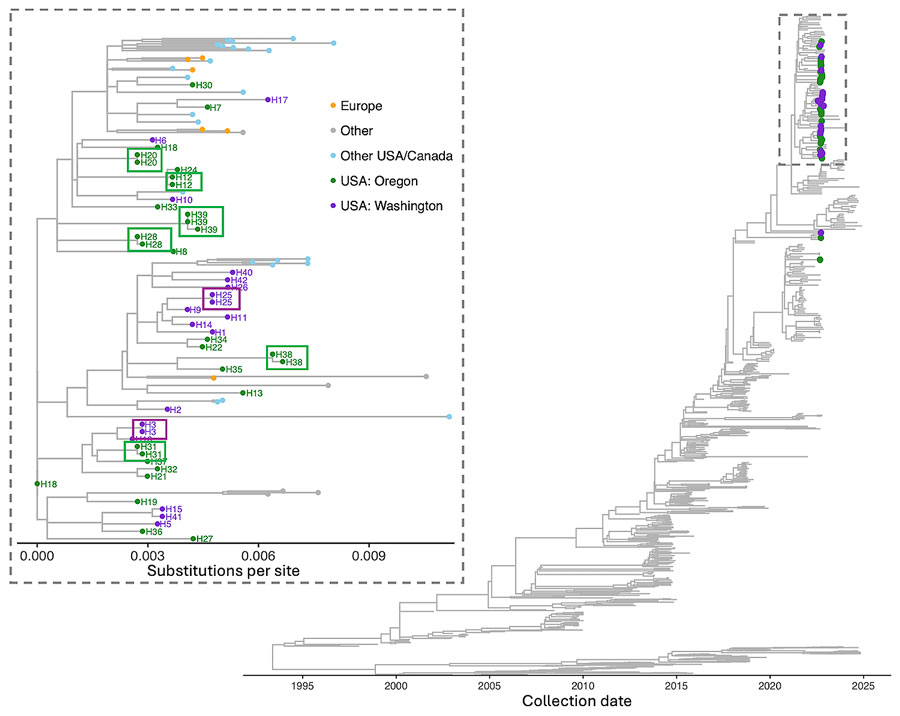
Figure. Maximum-likelihood time-resolved phylogenetic tree from study of household transmission of enterovirus D68, Washington (purple tips) and Oregon (green tips), United States, 2022–2024. Tree shows study samples from Washington and Oregon and publicly available global sequences. Inset shows a divergence tree by substitutions per site. Purple and green boxes around tips highlight close clustering of sequences from the same household.
Page created: May 28, 2026
Page updated: June 26, 2026
Page reviewed: June 26, 2026
The conclusions, findings, and opinions expressed by authors contributing to this journal do not necessarily reflect the official position of the U.S. Department of Health and Human Services, the Public Health Service, the Centers for Disease Control and Prevention, or the authors' affiliated institutions. Use of trade names is for identification only and does not imply endorsement by any of the groups named above.