Volume 32, Number 7—July 2026
Dispatch
Phormia regina Fly as Vector for Ignatzschineria spp. Bacteremia in Persons Experiencing Homelessness, Canada, 2025
Emma C.L. Finlayson-Trick , Awatif F. Alenazi, Yi Zhen Jia, Michael Payne, Gordon Ritchie, Aleksandra Stefanovic, Christopher F. Lowe, Samuel D. Chorlton, Nancy Matic, Patrick Tang, Victor Leung, David Harris, and Marc G. Romney
, Awatif F. Alenazi, Yi Zhen Jia, Michael Payne, Gordon Ritchie, Aleksandra Stefanovic, Christopher F. Lowe, Samuel D. Chorlton, Nancy Matic, Patrick Tang, Victor Leung, David Harris, and Marc G. Romney
Figure 3
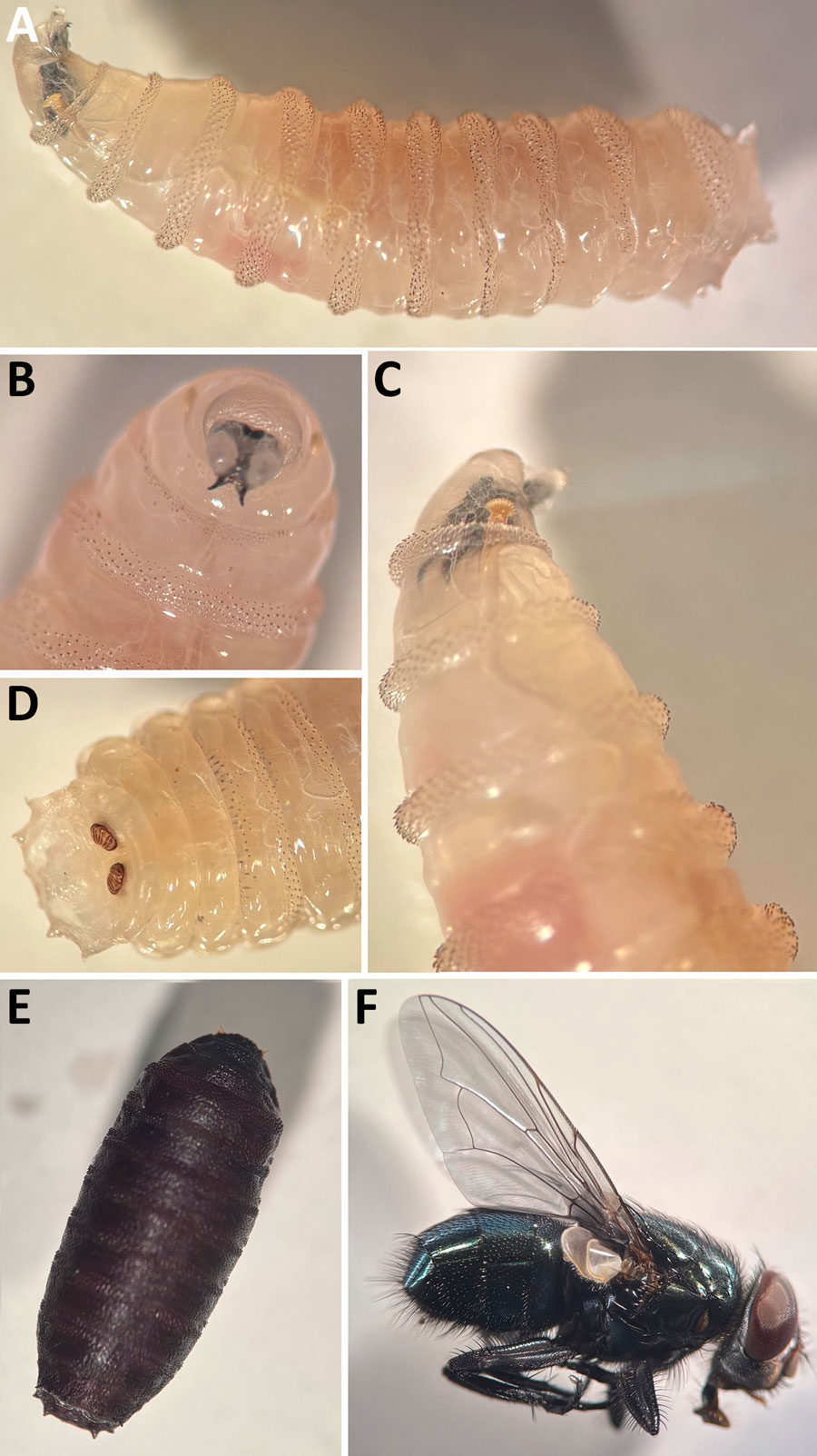
Figure 3. Development of black blow fly (Phormia regina) from larvae collected from case-patient 2 in pair of Ignatzschineria spp. bacteremia cases in persons experiencing homelessness, Vancouver, British Columbia, Canada, 2025. A–D) Third instar. E) Pupa. F) Adult. Key features of P. regina larvae include segmental spines (A), cephalopharyngeal skeleton (B), anterior spiracle (C), and peritremes (D).
Page created: April 27, 2026
Page updated: June 26, 2026
Page reviewed: June 26, 2026
The conclusions, findings, and opinions expressed by authors contributing to this journal do not necessarily reflect the official position of the U.S. Department of Health and Human Services, the Public Health Service, the Centers for Disease Control and Prevention, or the authors' affiliated institutions. Use of trade names is for identification only and does not imply endorsement by any of the groups named above.