Volume 32, Number 7—July 2026
Dispatch
Angiostrongylus cantonensis Rat Lungworm Detected in Rats, Madagascar, 2022–2023
Santatriniaina F. Randrianarisoa , Elise N. Paietta, Rachel A. Johnston, Tahina T. Razanamahenina, Antsa Ramboninarimalala, Toussaint G. Raherinirina, Laurent Raveloson, Nina L. Finley, Eric Baitchman, Arvind Varsani, and Fidisoa T. Rasambainarivo
, Elise N. Paietta, Rachel A. Johnston, Tahina T. Razanamahenina, Antsa Ramboninarimalala, Toussaint G. Raherinirina, Laurent Raveloson, Nina L. Finley, Eric Baitchman, Arvind Varsani, and Fidisoa T. Rasambainarivo
Figure 3
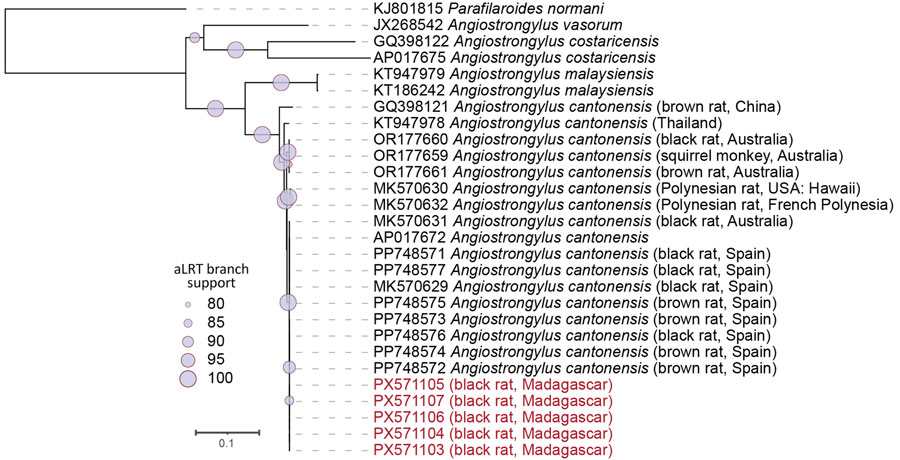
Figure 3. Whole-mitogenome maximum likelihood phylogenetic tree of complete sequences available for Angiostrongylus cantonensis rat lungworm and 3 related Angiostrongylus species along with the sequences identified in study of A. cantonensis lungworm detection in rats in Madagascar, 2022–2023. Red text indicates black rat oral swab specimens. GenBank accession numbers are indicated. For deposited sequences with available metadata, the host species and geolocation of the sample collected is included in parentheses. The tree was rooted with a representative mitogenome of Parafilaroides normani.
Page created: May 28, 2026
Page updated: June 26, 2026
Page reviewed: June 26, 2026
The conclusions, findings, and opinions expressed by authors contributing to this journal do not necessarily reflect the official position of the U.S. Department of Health and Human Services, the Public Health Service, the Centers for Disease Control and Prevention, or the authors' affiliated institutions. Use of trade names is for identification only and does not imply endorsement by any of the groups named above.