Volume 32, Number 7—July 2026
Dispatch
Trends in Congenital Syphilis Cases by Maternal Country of Birth, Spain, 2016–2024
 , Carmen Montaño, Ana Fernandez, Laura Molina, Guillermo Perez, Luis Viloria, Raquel Morales, Henar Marcos, Evelin Lopez-Corbeto, Paula Silvestre, Santiago Vicente, Olaia Perez-Martinez, Laura Montero, M. Isabel Barranco-Boada, Jesus Castilla, Pello Latasa, Eva Martinez, Ninoska Lopez, Daniel Castrillejo, Ana Roldan, Asuncion Diaz, and STIs Group of National Epidemiological Surveillance Network1
Cite This Article
Citation for Media
Abstract
The number of congenital syphilis cases in Spain remains low; 40 cases were confirmed during 2016–2024. However, a slight increase has been observed, particularly in children born to migrant mothers. Young maternal age, migrant status, and social disadvantages are warning signs that underscore the need to strengthen prenatal screening.
Congenital syphilis is preventable through antenatal screening and treatment of pregnant women (1); however, a resurgence of congenital syphilis has been observed (2). During 2018–2022, rates surged by 599% in Canada (3) and 81.8% in the United States (4); slight increases were also noted in Europe (5). That increase stems from multiple factors, including limited healthcare access, substance use, and migration (6), which can introduce legal, cultural, and language barriers that heighten vulnerability (7). We analyzed trends in congenital syphilis in Spain during 2016–2024 by maternal country of birth.
We analyzed confirmed cases of congenital syphilis in children <2 years of age reported to the National Epidemiologic Surveillance Network. In Spain, congenital syphilis has been a notifiable disease since 1997, although changes were made to the maternal variables collected in 2016. We categorized cases according to maternal country of birth: women born in Spain and women born elsewhere. We calculated annual incidence rates per 100,000 live births for each group using the annual number of live births in Spain as the denominator. We used the χ2 test to compare proportions and the Kruskal-Wallis test to compare medians.
Figure
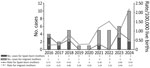
Figure. Number of congenital syphilis cases and rates per 100,000 live births by mother’s place of birth, Spain, 2016–2024.
Forty confirmed cases were reported during the study period. One case was excluded because of missing information on maternal country of birth. Of the 39 remaining cases, 12 (30.8%) cases involved children born to women born in Spain, whereas 27 (69.2%) cases involved infants of women born elsewhere (Figure). All children were born in Spain; no cases were classified as imported. From 2020 onward, incidence rates increased among women born outside Spain.
Of the infants born to women born in Spain, 75.0% (n = 9) were boys, compared with 44.4% (n = 12) for women born elsewhere (p = 0.096). Median age at diagnosis was 2 days in both groups; interquartile range (IQR) was 1–28 days for children of women born in Spain and 1–7 days for children of women born elsewhere (p = 0.817). Symptoms were present in 50.0% (n = 6) of infants of women born in Spain and 55.5% (n = 15) of infants of women born elsewhere (p = 0.950) (Table 1). No differences were observed in clinical manifestations.
Hospitalization percentages were similar in both groups: 83.3% (n = 10) among infants of women born in Spain and 81.5% (n = 22) among infants of women born elsewhere (p = 0.792). Complications were also comparable, occurring in 25.0% (n = 3) of children born to women in Spain and 22.2% (n = 6) of children born to women born elsewhere (p = 0.241). Two deaths were reported; both were children born to women born in Spain.
A total of 38 women were included in this analysis; 11 (28.9%) were born in Spain and 27 (71.0%) outside Spain. One woman born in Spain gave birth to twins; congenital syphilis was diagnosed in both. Among women born outside Spain, most originated from countries in Latin America (n = 22), including Paraguay (n = 8) and Colombia (n = 4). Three were from Eastern Europe and 1 from Western Europe; in 1 case, country of origin was not specified.
Women born in Spain were younger at the time of delivery than women born elsewhere (Table 2). Syphilis screening had not been performed during pregnancy in 9.1% (n = 1) of women born in Spain and 11.1% (n = 3) of women born elsewhere. Adequate treatment was recorded for 36.4% (n = 4) of women born in Spain and 22.2% (n = 6) of women born elsewhere. Of the 39 women included in the analysis, 11 were living in socially or economically disadvantaged circumstances. In 1 case, the mother’s syphilis was diagnosed after the diagnosis of congenital syphilis in the child; that woman was born in Spain.
Although the absolute number of congenital syphilis cases remains low in Spain, an increase has been observed in recent years, particularly among women born outside Spain. The observed increase in cases might be considered a consequence of the rising number of syphilis cases among young women. Previous studies in Spain have shown that the greatest increases in syphilis occurred among women 20–34 years of age (8) and women from Latin America (9). However, data are unavailable on the percentage of women with syphilis who were pregnant at the time of diagnosis or whose condition was diagnosed during delivery.
Of the confirmed congenital syphilis cases in this study, two thirds were in infants of women born outside Spain, whereas pregnancies among women born elsewhere accounted for only 25.6% of all pregnancies in 2024 (10). That difference might indicate unmet needs in antenatal care for migrant women, which pose risks to both child and maternal health, even though access to pregnancy, childbirth, and postpartum care is guaranteed to all women in Spain regardless of administrative status (11). Therefore, ensuring that migrants receive comprehensive information regarding their own health and prenatal care during pregnancy, such as screening tests, is essential to guaranteeing adequate follow-up care.
Most women in this study originated from countries in Latin America, which also represents the largest region of origin among migrants in Spain (10). Migration during pregnancy is not rare and poses a challenge for timely diagnosis and treatment of syphilis in pregnant women.
Other factors, such as younger maternal age, might also contribute to increased vulnerability. National data show a rising trend in maternal age in Spain. Among women born in Spain, the mean age at delivery increased from 32.5 years in 2016 to 33.1 years in 2023, whereas among women born elsewhere it rose from 29.5 years to 30.5 years over the same period (10). In contrast, the mothers in this analysis were younger; median age was 21.5 years for women born in Spain and 25 years for women born elsewhere.
Adverse birth outcomes related to congenital syphilis are closely linked to inadequate access to timely screening and treatment during pregnancy (12). Screening has also been shown to reduce syphilis-related deaths by up to 50% (13). In this analysis, the percentage of women whose condition was adequately diagnosed and treated was very low in both groups, underscoring the need for improved implementation of existing recommendations. Serologic screening for syphilis during pregnancy is recommended at the first prenatal visit, and additional testing should be performed during the third trimester and at delivery for women at high risk of acquiring syphilis (e.g., because of sex work, drug use, disadvantaged social conditions, or other sexually transmitted infections during pregnancy) or if no test was performed during the first trimester (14,15). Although information on predisposing factors was available for a limited number of women, more than half (14/26) were in disadvantaged situations, highlighting the role of broader social determinants of health.
Epidemiologic surveillance data provide a comprehensive overview of trends in the general population but have limitations. Under case definitions in Europe, only children <2 years of age are included, and fetal deaths or stillbirths caused by congenital syphilis are excluded, potentially leading to underdiagnosis. In addition, maternal information in surveillance records is often incomplete. Enhancing those data could help elucidate existing gaps in prenatal care for pregnant women and identify groups that are more vulnerable to syphilis.
Our findings highlight the importance of ensuring timely, accessible, and respectful prenatal care and syphilis screening for all pregnant women, particularly when social or structural vulnerabilities are present. Strengthening epidemiologic surveillance and reinforcing person-centered approaches in maternal care are essential steps toward preventing congenital syphilis and promoting maternal and child health.
Dr. Hernando is an epidemiologist and senior scientist at the National Epidemiology Centre of the Carlos III Health Institute in Madrid, Spain. Her research interests include sexually transmitted infections, HIV infection, and viral hepatitis, especially in aspects related to surveillance and public health.
Acknowledgments
Members of the STIs Study Group of National Epidemiological Surveillance Network: Andalucía: Isabel Maria Vázquez Rincón, Esperanza Carmona Fernández, Ana Roldán Garrido, Nicola Lorusso; Aragón: Carmen Montaño Remacha, Ana Delia Cebollada Gracia, Miriam García Vazquez; Asturias: Ana M Fernández Verdugo, Sara Iglesias Martinez, Maria del Campo San Emeterio, Ana Fernandez Ibañez; Baleares: Laura Molina Núñez, M Magdalena Salom Castell; Canarias: Oscar Guillermo Pérez Martín, Carles Barres Giménez, Fabiola González Rancel, Ricardo Jesús Moreno Saavedra, Álvaro Torres Lana; Cantabria: Luis Viloria; Castilla La Mancha: Carmen Morales, Raquel Morales; Castilla y León: Maria Henar Marcos Rodríguez, Maria del Mara Andreu Román, Maria Yolanda Vallejo Ramos, Cristina Ruiz Sopeña, Mª Isabel Carramiñana Martinez, José Antonio Aguilera Mellado, Loreto Mateos Baruque, Isabel González Vara, Rafael Villanueva Agero, Rosa Maria Moralejo Vicente, Maria Trinidad Romo Cortina, Clara Berbel Hernández, Marta Allúe Tango, Irene Andrés García, Maria José Cordero Maestre; Cataluña: Evelin Lopez Corbeto, Jordi Casabona, en nombre del grupo de trabajo de las ITS de la comisión de vigilancia epidemiológica de Cataluña y los profesionales de las secciones de Epidemiologia de los Servicios Territoriales; Comunidad Valenciana: Mª Elena Vidal Montañana, Begoña Medina Cortés, Katja Villatoro Bongiorno, Empar Giner Ferrando, Francisco Javier Roig Sena; Extremadura: Santiago Vicente Iglesias, Maria del Mar López-Tercero Torvisco, Noa Batalla Rebollo, Juan Antonio Linares Dopido; Galicia: Olaia Pérez Martínez, Miguel Conde Rodriguez, Cristina Estévez Dávila, Alberto Fernández Martínez, Mª Carmen Marrero Flores, María Blanca Vázquez Rodríguez; Madrid: Ángel Miguel Benito, Laura Montero Morales; Murcia: Isabel Barranco Boada, Encarnación Vicente Martinez, Encarnación Gutiérrez Pérez, Alonso Sanchez-Migallón Naranjo; Navarra: Jesús Castilla, Mercedes Herranz-Aguirre, Arantza de Miguel; País Vasco: Larraitz Etxebarriarteun Aranzabal, Madealen Oribe Amores, Idurre Ayala Izaguirre, Patricia Sancho Uriarte, Pello Latasa Zamalloa; La Rioja: Ana Carmen Ibáñez Pérez, Angela Blanco Martinez, Eva Martínez Ochoa; Ceuta: Ninoska Lopez Berrios, Violeta Ramos Martin; Melilla: Atanasio Gómez Anés, Daniel Castrillejo.
We thank the epidemiologic surveillance professionals in the autonomous regions, as well as all those who contribute to the reporting and improving the quality of the data of the National Epidemiological Surveillance Network.
References
- Medoro AK, Sánchez PJ. Syphilis in neonates and infants. Clin Perinatol. 2021;48:293–309. DOIPubMedGoogle Scholar
- Gilmour LS, Walls T. Congenital syphilis: a review of global epidemiology. Clin Microbiol Rev. 2023;36:
e0012622 . DOIPubMedGoogle Scholar - Public Health Agency of Canada. Infectious syphilis and congenital syphilis in Canada, 2022–2023 [cited 2026 Jun 12]. https://www.canada.ca/content/dam/phac-aspc/documents/services/reports-publications/canada-communicable-disease-report-ccdr/monthly-issue/2023-49/issue-10-october-2023/ccdrv49i10a04a-eng.pdf
- US Centers for Disease Control and Prevention. Sexually transmitted infections surveillance, 2024–2025 [cited 2026 Jun 12]. https://www.cdc.gov/sti-statistics/annual/index.html
- European Centre for Disease Prevention and Control. Congenital syphilis. Annual epidemiological report for 2023–2025 [cited 2026 Jun 12]. https://www.ecdc.europa.eu/sites/default/files/documents/congenital-syphilis-annual-epidemiological-report-2023.pdf
- Tetteh A, Moore V. The rise of congenital syphilis in Canada: threats and opportunities. Front Public Health. 2025;12:
1522698 . DOIPubMedGoogle Scholar - Adrian Parra C, Stuardo Ávila V, Contreras Hernández P, Quirland Lazo C, Bustos Ibarra C, Carrasco-Portiño M, et al. Structural and intermediary determinants in sexual health care access in migrant populations: a scoping review. Public Health. 2024;227:54–62. DOIPubMedGoogle Scholar
- Hernando V, Lorusso N, Montaño C, Boone AL, Garí A, Perez G, et al.; STIs Study Group of National Epidemiological Surveillance Network. Increased trends in reported sexually transmitted infections according to age groups and sex in Spain, 2016-2022. Infect Dis (Lond). 2025;57:247–55. DOIPubMedGoogle Scholar
- Hernando V, Simón L, Díaz A. Grupo de estudio de ITS de la RENAVE, Sífilis y gonococia notificada en España, 2023. Diferencia según sexo y región de nacimiento. XLIII Reunión anual de la Sociedad Española de Epidemiología (SEE) y XX Congresso da Associacao Portugesa de Epidemiología (APE); Las Palmas de Gran Canaria: Gaceta Sanitaria; 2025. p. 8.
- Instituto Nacional de Estadistica. Demography and population [cited 2026 Jun 12]. https://ine.es/dyngs/INEbase/en/categoria.htm?c=Estadistica_P&cid=1254734710984
- Agencia Estatal Boletín Oficial del Estado. Royal decree-law 7/2018, on universal access to the National Health System [in Spanish] [cited 2026 Jun 12]. https://www.boe.es/buscar/doc.php?id=BOE-A-2018-10752
- Korenromp EL, Rowley J, Alonso M, Mello MB, Wijesooriya NS, Mahiané SG, et al. Global burden of maternal and congenital syphilis and associated adverse birth outcomes-Estimates for 2016 and progress since 2012. PLoS One. 2019;14:
e0211720 . DOIPubMedGoogle Scholar - Hawkes S, Matin N, Broutet N, Low N. Effectiveness of interventions to improve screening for syphilis in pregnancy: a systematic review and meta-analysis. Lancet Infect Dis. 2011;11:684–91. DOIPubMedGoogle Scholar
- Janier M, Unemo M, Dupin N, Tiplica GS, Potočnik M, Patel R. 2020 European guideline on the management of syphilis. J Eur Acad Dermatol Venereol. 2021;35:574–88. DOIPubMedGoogle Scholar
- Salomè S, Cambriglia MD, Montesano G, Capasso L, Raimondi F. Congenital syphilis: a re-emerging but preventable infection. Pathogens. 2024;13:481. DOIPubMedGoogle Scholar
Figure
Tables
Cite This ArticleOriginal Publication Date: June 23, 2026
1STIs Study Group team members are listed at the end of this article.
Table of Contents – Volume 32, Number 7—July 2026
| EID Search Options |
|---|
 Advanced Article Search – Search articles by author and/or keyword.
|
 Articles by Country Search – Search articles by the topic country.
|
 Article Type Search – Search articles by article type and issue.
|
Please use the form below to submit correspondence to the authors or contact them at the following address:
Victoria Hernando, National Centre of Epidemiology, Carlos III Health Institute, Avda. Monforte de Lemos, 5. 28029 Madrid, Spain
Top