Volume 32, Number 7—July 2026
Synopsis
Outbreak of Legionnaires’ Disease Linked to Newly Installed Residential Water Heaters, the Netherlands, 2022–2023
Daphne F.M. Reukers , Sjoerd M. Euser, Alvin A. Bartels, Martijn G. Keet, Marijke Boot, Wilhelmina L.M. Ruijs, and Petra S. Brandsema
, Sjoerd M. Euser, Alvin A. Bartels, Martijn G. Keet, Marijke Boot, Wilhelmina L.M. Ruijs, and Petra S. Brandsema
Figure 3
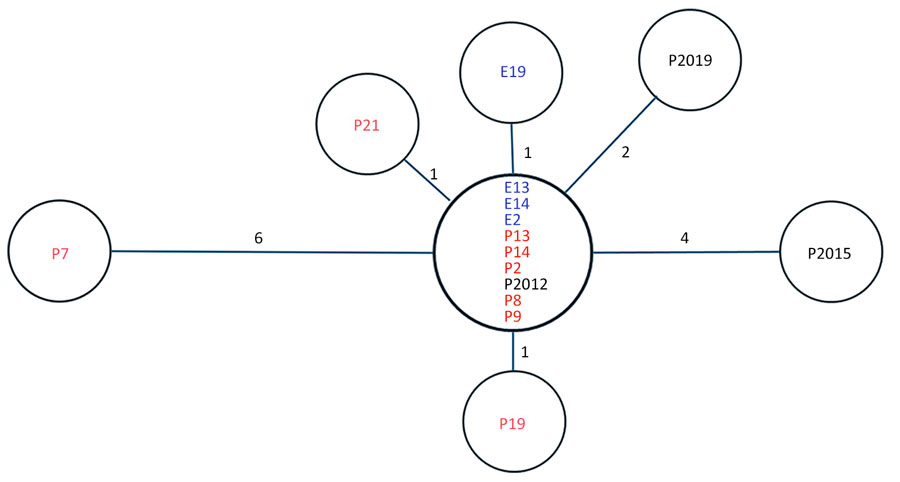
Figure 3. Genomic links among Legionella pneumophila isolates from reference sources and from an outbreak of Legionnaires’ disease linked to newly installed residential water heaters, the Netherlands, 2022–2023. Minimum-spanning tree was based on 1,521 core genome sequencing typing targets showing genomic links between L. pneumophila isolates from 8 clinical (red font) and 4 environmental (blue font) sequence type 37 isolates related to the outbreak, as well as 3 randomly selected non–outbreak-related sequence type 37 isolates from 2012, 2015, and 2019 for context (black font). Numbers on nodes indicate allele differences.
Page created: May 13, 2026
Page updated: June 25, 2026
Page reviewed: June 25, 2026
The conclusions, findings, and opinions expressed by authors contributing to this journal do not necessarily reflect the official position of the U.S. Department of Health and Human Services, the Public Health Service, the Centers for Disease Control and Prevention, or the authors' affiliated institutions. Use of trade names is for identification only and does not imply endorsement by any of the groups named above.