Skip directly to site content Skip directly to page options Skip directly to A-Z link Skip directly to A-Z link Skip directly to A-Z link

Disclaimer: Early release articles are not considered as final versions. Any changes will be reflected in the online version in the month the article is officially released.

Volume 32, Number 7—July 2026

Research Letter

Chikungunya Outbreak, Cuba, July 2025

Melissa M. Perez1, Sonia Resik1, Berta Maria Bello Rodriguez, Ariamys Companioni, Daniel Gonzalez, Ana Julia Benitez, Yanet Martinez, Mónica Sanchez, Mayling Alvarez, Denelsys Hernandez, Jose Raul de Armas, Aliuska Batista Serrano, Madelaine Rivera, Carilda Peña, Liannet Domínguez Ramos, Silvia Serrano, Rosario Gravier, Lorena Vazquez, Vivian Kourí, and Maria G. GuzmanComments to Author 
Author affiliation: Pedro Kouri Tropical Medicine Institute, Havana, Cuba (M.M. Perez, S. Resik, A. Companioni, D. Gonzalez, A.J. Benitez, Y. Martinez, M. Sanchez, M. Alvarez, D. Hernandez, S. Serrano, R. Gravier, L. Vazquez, V. Kourí, M.G. Guzman); Matanzas Provincial Center for Hygiene, Epidemiology and Microbiology, Matanzas, Cuba (B.M. Bello Rodriguez); Ministerio de Salud Pública, Havana (J.R. de Armas, M. Rivera, C. Peña); Polyclinic 30th Anniversary, Perico Municipality, Matanzas (A. Batista Serrano, L. Domínguez Ramos)

Main Article

Figure

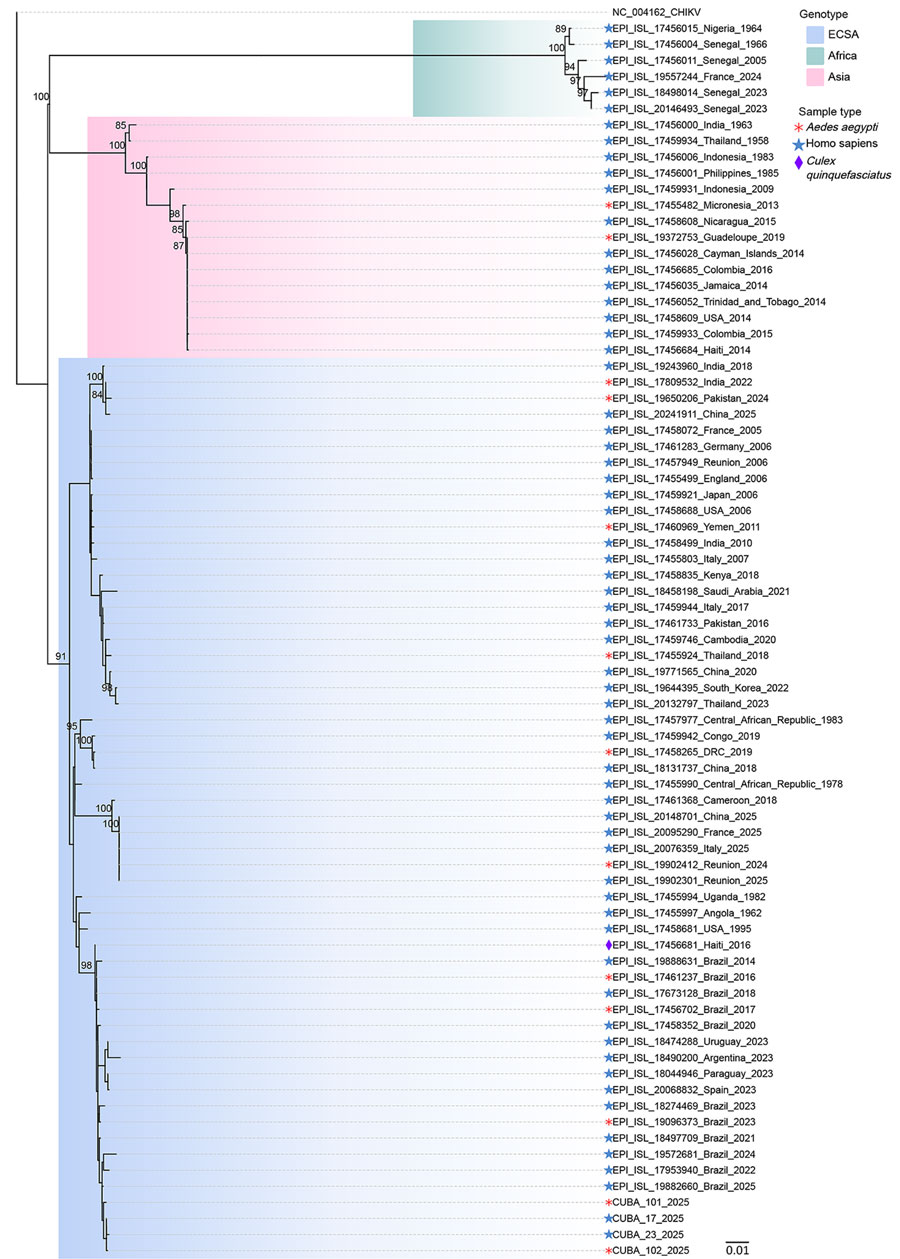
Molecular phylogenetic analysis of chikungunya virus from outbreak in Matanzas Province, Cuba, 2025. We obtained all available chikungunya virus sequences from GISAID, then filtered the sequences to ensure dataset and genetic diversity. We inferred evolutionary history by maximum-likelihood method by using the Tamura-Nei model (6). We applied the neighbor-joining method to a matrix of estimated pairwise distances to obtain initial trees and used a discrete gamma distribution to model evolutionary rate differences among sites. We conducted evolutionary analyses in MEGA version 6 (7). Numbers at branches indicate the percentage of trees in which associated taxa clustered together. Scale bar indicates number of substitutions per site. DRC, Democratic Republic of the Congo; USA, United States.

Figure. Molecular phylogenetic analysis of chikungunya virus from outbreak in Matanzas Province, Cuba, 2025. We obtained all available chikungunya virus sequences from GISAID, then filtered the sequences to ensure dataset and genetic diversity. We inferred evolutionary history by maximum-likelihood method by using the Tamura-Nei model (6). We applied the neighbor-joining method to a matrix of estimated pairwise distances to obtain initial trees and used a discrete gamma distribution to model evolutionary rate differences among sites. We conducted evolutionary analyses in MEGA version 6 (7). Numbers at branches indicate the percentage of trees in which associated taxa clustered together. Scale bar indicates number of substitutions per site. DRC, Democratic Republic of the Congo; USA, United States.

Main Article

References
  1. Pan American Health Organization. Chikungunya: analysis by country. 2025 [cited 2025 Dec 5]. https://www.paho.org/es/arbo-portal/chikunguna-datos-analisis/chikunguna-analisis-por-pais
  2. de Souza  WM, Ribeiro  GS, de Lima  STS, de Jesus  R, Moreira  FRR, Whittaker  C, et al. Chikungunya: a decade of burden in the Americas. Lancet Reg Health Am. 2024;30:100673. DOIPubMedGoogle Scholar
  3. Guzmán  MG, Vázquez  S, Álvarez  M, Pelegrino  JL, Amores  DR, Martínez  PA, et al. Laboratory surveillance of dengue and other arboviruses in Cuba, 1970–2017 [in Spanish]. Rev Cubana Med Trop. 2019;71:131.
  4. Naveca  FG, Nascimento  VAD, Souza  VC, Nunes  BTD, Rodrigues  DSG, Vasconcelos  PFDC. Multiplexed reverse transcription real-time polymerase chain reaction for simultaneous detection of Mayaro, Oropouche, and Oropouche-like viruses. Mem Inst Oswaldo Cruz. 2017;112:5103. DOIPubMedGoogle Scholar
  5. General Directorate of Public Health of Havana. MINSAP. Cuban chikungunya protocol. 2025 [cited 2026 Mar 10]. https://temas.sld.cu/chikungunya/files/2025/12/protocolo-cubano-chikungunya-1.3.pdf
  6. Kimura  M. A simple method for estimating evolutionary rates of base substitutions through comparative studies of nucleotide sequences. J Mol Evol. 1980;16:11120. DOIPubMedGoogle Scholar
  7. Tamura  K, Stecher  G, Peterson  D, Filipski  A, Kumar  S. MEGA6: Molecular Evolutionary Genetics Analysis version 6.0. Mol Biol Evol. 2013;30:27259. DOIPubMedGoogle Scholar
  8. Tsetsarkin  KA, Vanlandingham  DL, McGee  CE, Higgs  S. A single mutation in chikungunya virus affects vector specificity and epidemic potential. PLoS Pathog. 2007;3:e201. DOIPubMedGoogle Scholar

Main Article

1These authors contributed equally to this article.

Page created: May 28, 2026
Page updated: June 25, 2026
Page reviewed: June 25, 2026
The conclusions, findings, and opinions expressed by authors contributing to this journal do not necessarily reflect the official position of the U.S. Department of Health and Human Services, the Public Health Service, the Centers for Disease Control and Prevention, or the authors' affiliated institutions. Use of trade names is for identification only and does not imply endorsement by any of the groups named above.
file_external