Emergence of West African Human T-Lymphotropic Virus 1aC Subgroup, Brazilian Amazon
Jean de Melo Silva, Emmily Myrella Vasconcelos Mourão, Enzo Miranda Santos, Luma Silva Mineiro, Paulo Henrique Rodrigues de Souza, Leonardo Calheiros de Oliveira, Jacqueline da Silva Batista, Giselle Moura Guimarães Marques, Carolina Rosadas de Oliveira, Graham P. Taylor, Antonio Carlos Rosário Vallinoto, and Gemilson Soares Pontes

Author affiliation: Institute of Biological Science, Federal University of Amazonas, Manaus, Brazil (J. de Melo Silva, G.S. Pontes); Leônidas and Maria Deane Institute–ILMD/Fiocruz Amazônia, Manaus (E.M.V. Mourão); Foundation of Hematology and Hemotherapy of Amazonas, Manaus (E.M. Santos); National Institute of Amazonian Research, Manaus (L.S. Mineiro, P.H.R. de Souza, L.C. de Oliveira, J. da Silva Batista, G.M. Guimarães Marques, G.S. Pontes); Faculty of Medicine, Imperial College London, London, UK (C.R. de Oliveira, G.P. Taylor); National Centre for Human Retrovirology, St. Mary's Hospital, Imperial College Healthcare NHS Trust, London (G.P. Taylor); Federal University of Pará, Belém, Brazil (A.C.R. Vallinoto)
Main Article
Figure 2
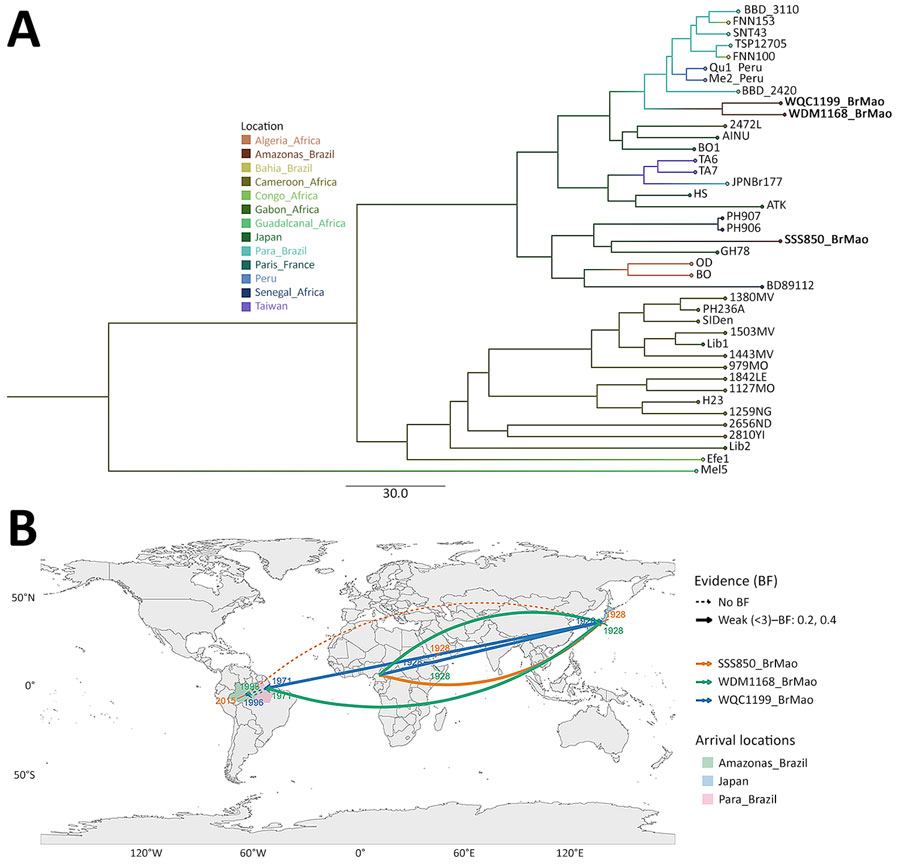
Figure 2. Time-scaled phylogeny and discrete phylogeographic diffusion of HTLV-1 lineages in study of emergence of West African HTLV-1aC subgroup, Brazilian Amazon. A) Time-calibrated maximum clade credibility tree inferred in BEAST version 10.5 (https://beast.community) from the long terminal repeat (LTR) dataset (3 sequences from this study plus reference sequences), using sampling year as tip date, a strict molecular clock, and discrete geographic-state reconstruction under a continuous-time Markov chain model with Bayesian stochastic search variable selection. Branches and tips are colored by inferred location (see key); bold text indicates sequences generated in this study. B) Spatiotemporal diffusion reconstructed from Markov jumps. Trajectory colors correspond to each Manaus lineage: orange, SSS850_BrMao; green, WDM1168_BrMao; blue, WQC1199_BrMao. Numbers indicate posterior median year of first arrival (labels shown for years >1970; Cameroon→Japan step, ≈1928, is retained for context). Line style indicates support: dashed, no Bayers factor recovered; solid, weak support (<3; here, 0.2–0.4). Shaded polygons indicate inferred arrival locations (Amazonas and Pará states, Brazil, and Japan). HTLV, human T-lymphotropic virus.
Main Article
Page created: May 28, 2026
Page updated: July 02, 2026
Page reviewed: July 02, 2026
The conclusions, findings, and opinions expressed by authors contributing to this journal do not necessarily reflect the official position of the U.S. Department of Health and Human Services, the Public Health Service, the Centers for Disease Control and Prevention, or the authors' affiliated institutions. Use of trade names is for identification only and does not imply endorsement by any of the groups named above.