Epidemiologic, Entomologic, and Virologic Findings during Reemergence of Western Equine Encephalitis Virus, Argentina
Lorena Spinsanti
1, Cintia Fabbri
1, Ana Piskorz, Victoria Luppo, Gonzalo Castro, Adrián Farías, Mauricio Beranek, Gabriel Barco, Mariel Feroci, Cintia Barulli, Jorge García, Anabel Sinchi, Anabella Fantilli, María Belén Pisano, Agostina Pierdomenico, Andrea Marcos, Rodrigo Balzano, Facundo Cuba, Sol Haim, Florencia Mallou, Carolina Paladino, Tomás Poklepovich, Liliana Luque, Brenda Konigheim, Juan Javier Aguilar, Jimena Renga, Maria Alejandra Morales
2, and Adrián Díaz
2
Author affiliation: National University of Córdoba, Córdoba, Argentina (L. Spinsanti, G. Castro, A. Farías, M. Beranek, G. Barco, A. Fantilli, M.B. Pisano, B. Konigheim, J.J. Aguilar, A. Díaz); National Administration of Laboratories and Health Institutes, Buenos Aires, Argentina (C. Fabbri, V. Luppo, M. Feroci, C. Barulli, J. García, A. Sinchi, F. Cuba, S. Haim, F. Mallou, C. Paladino, T. Poklepovich, M.A. Morales); National Service of Agrifood Health and Quality (SENASA), Buenos Aires (A. Piskorz, A. Pierdomenico, A. Marcos, R. Balzano, J. Renga); Ministry of Health of Córdoba Province, Córdoba (G. Castro, L. Luque); National Scientific and Technical Research Council (CONICET), Buenos Aires (G. Barco, M.B. Pisano, B. Konigheim, A. Diaz)
Main Article
Figure 3
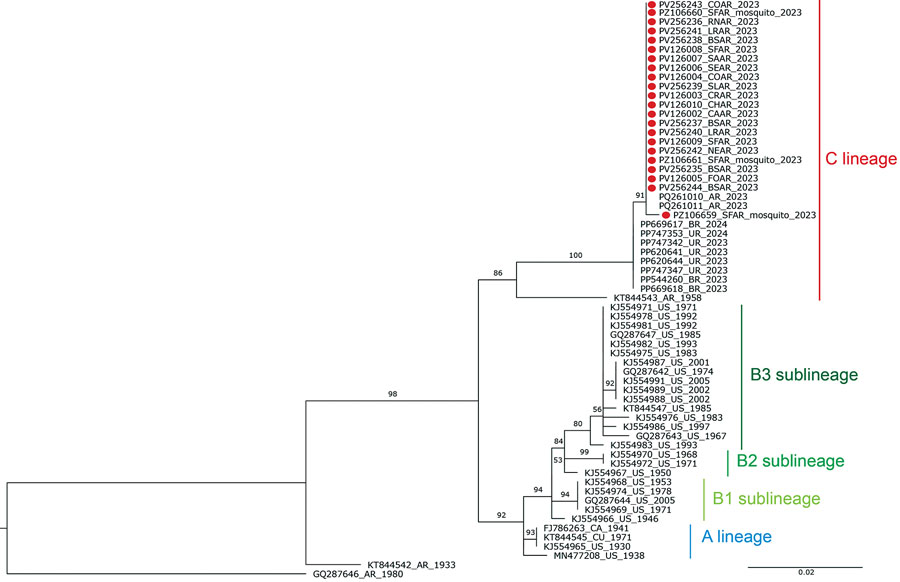
Figure 3. Maximum-likelihood phylogenetic tree based on partial nonstructural protein 4 gene sequences from study of epidemiologic, entomologic, and virologic findings during reemergence of western equine encephalitis virus, Argentina, 2023–2024. Analysis includes 19 newly sequenced isolates obtained from mosquitoes and equines (red dots) across a wide geographic range in Argentina. Numbers at major nodes indicate bootstrap support values based on 10,000 replicates. GenBank accession numbers are provided for reference sequences; accession numbers for all sequences from this study are provided in Tables 1 and 2 and the Appendix. Scale bar indicates number of nucleotide substitutions per site.
Main Article
Page created: June 25, 2026
Page updated: July 27, 2026
Page reviewed: July 27, 2026
The conclusions, findings, and opinions expressed by authors contributing to this journal do not necessarily reflect the official position of the U.S. Department of Health and Human Services, the Public Health Service, the Centers for Disease Control and Prevention, or the authors' affiliated institutions. Use of trade names is for identification only and does not imply endorsement by any of the groups named above.