Volume 32, Number 8—August 2026
Dispatch
Respiratory Syncytial Virus Suppression through Public Health and Social Measures, Hong Kong, China, 2020–2023


Cite This Article
Citation for Media
Abstract
Public health measures during COVID-19 were associated with reduced respiratory syncytial virus cases in Hong Kong, China. Mask wearing was associated with a 35% reduction; avoidance behaviors and hand hygiene were also associated with reductions. After the mask mandate was lifted in March 2023, we observed resurgence in RSV activity.
Respiratory syncytial virus (RSV) is a major cause of acute lower respiratory tract infections in infants, young children, and older adults. In Hong Kong, China, RSV circulates year-round with typical seasonal patterns (1). The COVID-19 pandemic altered RSV epidemiology through stringent public health and social measures (PHSMs), including masking, hand hygiene promotion, and gathering restrictions. Those interventions nearly eliminated RSV circulation until mask mandates were relaxed in March 2023; RSV incidence resurged by mid-2023 (2). Environmental factors, particularly temperature and humidity, might also influence RSV transmission. We analyzed RSV transmission in Hong Kong during 2005–2024 using epidemiologic, behavioral, and meteorologic data and examined the combined effects of PHSMs.
We estimated weekly RSV activity by multiplying influenza-like illness (ILI) consultation rates by the proportion of respiratory specimens testing positive for RSV, adjusted for population size (data from Centre for Health Protection, Hong Kong). We used the case estimates as a proxy measure of the weekly incidence of infections in the community (3). We obtained meteorologic variables, including temperature, wind speed, humidity, pressure, and rainfall, from the Hong Kong Observatory.
We derived PHSM data from cross-sectional telephone surveys of Hong Kong adults conducted during 2020–2023, measuring adoption of 8 behaviors across 2 categories: social distancing (avoiding crowded areas, going out, healthcare facilities, and social gatherings) and personal protection (mask use, handwashing, and protective practices with shared objects) (Appendix). The survey, which was approved by the Institutional Review Board of the University of Hong Kong, captured individual preventive behaviors but not policy-level interventions such as school closures or traveler quarantine. Among the survey-captured behaviors, mask use was the only behavior directly linked to a territorywide mandate; other PHSMs were gradually relaxed beginning in mid-2022, and the mask mandate was lifted on March 1, 2023 (4).
We modeled RSV activity using Bayesian negative binomial regression (5). The outcome was the log-transformed RSV activity at week t. Baseline covariates included RSV activity at week t − 1 to account for autocorrelation, and offset using population size at week t to account for change of population size over years (Appendix). We categorized survey variables into social distancing behaviors and personal protective behaviors. Model selection proceeded in 2 stages: we identified optimal combinations of PHSM variables (1–3 variables with lags of 0–2 weeks), then added meteorologic variables (log-transformed and quadratic-transformed temperature and humidity) (Appendix Figure 2). We compared models using leave-one-out cross-validation; we selected those within 2 SEs of the highest expected log predictive density (6), expressing coefficients as percent change in risk using the equation 100% × (exp(β) – 1) to represent the proportional change in RSV activity when a behavior changed from no to full adoption. Those estimates reflect within-period proportional changes in RSV activity associated with variation in survey-measured behaviors, rather than comparisons with the 2023 severe season or a prepandemic baseline.
Figure 1
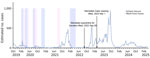
Figure 1. Weekly respiratory syncytial virus activity and several preventive measures against COVID-19 during 2019–2025 in study of respiratory syncytial virus suppression through public health and social measures, Hong Kong. Activity is...
Annual RSV epidemics occurred from late autumn to early spring until 2019 (Appendix Figure 1), but activity declined sharply during the COVID-19 pandemic, reaching a minimum during December 2020–July 2021. In November–December 2021, there was an RSV epidemic during the interval between 2 periods of school closures (Figure 1). After the mandated quarantine for travelers was lifted in September 2022 (7), RSV resurged and reached a peak in late 2022. After the mask mandate was lifted in March 2023, RSV activity peaked at ≈2 times the magnitude of the previous 2 epidemics. Self-reported mask use remained >90% through early 2023 but declined markedly after the mask mandate was lifted in March 2023; we observed similar downward trends for other PHSMs (Appendix Figure 4). Negative binomial regression confirmed substantial (62%–76%) reductions in RSV activity during the pandemic period (Appendix Table 3).
Figure 2
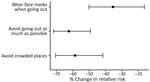
Figure 2. Percentage change in relative risk for several preventive behaviors in study of respiratory syncytial virus suppression through public health and social measures, Hong Kong, China, 2020–2023. Dots represent percentage change;...
We conducted regression testing for association between PHSMs and RSV activity (Figure 2). Mask wearing was associated with a 35% (95% CI 16%–50%) reduction in RSV activity. Avoiding going out (62% [95% CI 49%–72%] reduction), avoiding crowded places (59% [95% CI 42%–71%] reduction), and washing hands immediately after going outside (40% [95% CI 13%–58%] reduction) were also associated with reduced RSV activity. Alternative model specifications were consistent with a protective association of mask wearing (32%–43% reduction across models) and the importance of combined preventive measures (Appendix Figure 3). All PHSM variables selected in the models were 2-lag transformed.
After adjustment for meteorologic variables, the associations between behavioral interventions and RSV activity remained statistically significant and of similar magnitude. In the best weather-adjusted model, RSV activity increased by 6% (95% CI 3%–9%) for every 10% increase in relative humidity. Temperatures were less consistent across model specifications (Appendix Tables 1, 2).
Our analysis demonstrated that mask wearing was associated with a 35% reduction in RSV transmission, consistent with observations for other respiratory pathogens. That finding builds on previous work showing a 25% reduction for influenza (4) and aligns with laboratory studies demonstrating that masks reduce droplet emission by up to 90% (8). Similar findings across respiratory viruses support mask recommendations during RSV epidemics.
Other protective behaviors, such as avoiding crowded places and limiting outings, were also associated with reduced RSV activity. The combined implementation of those measures during Hong Kong’s COVID-19 restrictions coincided with dramatic RSV suppression, including >80% declines in pediatric hospitalizations compared with prepandemic years (9). The interruption of RSV circulation might have increased population susceptibility (accumulated immune debt), which might have made the association between masking and RSV activity seem larger (10).
The major RSV epidemic in mid-2023, shortly after the mask mandate was lifted, illustrates the rapid return of respiratory virus transmission after relaxation of protective measures (11). Meteorologic factors, particularly relative humidity, were also associated with transmission patterns in subtropical Hong Kong. Higher humidity was associated with increased RSV activity; possible causes were enhanced viral stability and behavioral changes that increase indoor crowding (12).
Our findings have important policy implications for RSV control. Although populationwide mask policies may not be sustainable long term, targeted masking during peak epidemic periods, particularly in healthcare settings, schools, kindergartens and daycare centers, and residential care facilities, was a practical intervention. Combined with enhanced surveillance, our findings suggest that timely populationwide mask mandates could help prevent severe off-season epidemics while minimizing disruption and healthcare system strain (13). Compared with reports from Europe and North America (14), Hong Kong showed a distinct postpandemic RSV pattern, which might partly reflect differences in mask-wearing adherence, school closure policies, and accumulated immune debt.
Our study did not account for potential changes in RSV ascertainment during the pandemic because of reduced testing and altered healthcare-seeking behavior. We did not conduct age-stratified analysis despite the greater burden of severe RSV disease in infants, young children, and older adults (15). As an ecologic study using aggregate surveillance and survey data, our findings reflect population-level associations and cannot establish causal effects of specific interventions at the individual level. Our analysis reflects RSV transmission during the COVID-19 period we studied. Subsequent introduction of RSV vaccines and immunoprophylaxis could change the relative role of PHSMs in current RSV prevention.
Ms. Xu is a PhD candidate at the School of Public Health, University of Hong Kong. Her research interests lie in infectious disease epidemiology and modeling, with a particular emphasis on developing statistical approaches for analyzing infectious diseases.
Acknowledgments
We thank Julie Au for technical assistance.
This project was supported by the Theme-based Research Scheme (project no. T11-712/19-N) of the Research Grants Council of the Hong Kong SAR Government.
B.J.C. reports honoraria from AstraZeneca, Fosun Pharma, GSK, Haleon, Moderna, Pfizer, Roche, and Sanofi Pasteur.
References
- Centre for Health Protection. Respiratory syncytial virus infection. 2025 [cited 2025 Jul 11]. https://www.chp.gov.hk/en/healthtopics/content/24/36.html
- He Y, Liu WJ, Jia N, Richardson S, Huang C. Viral respiratory infections in a rapidly changing climate: the need to prepare for the next pandemic. EBioMedicine. 2023;93:
104593 . DOIPubMedGoogle Scholar - Wong JY, Kelly H, Cheung CMM, Shiu EY, Wu P, Ni MY, et al. Hospitalization fatality risk of influenza A(H1N1)pdm09: a systematic review and meta-analysis. Am J Epidemiol. 2015;182:294–301. DOIPubMedGoogle Scholar
- Xiong W, Cowling BJ, Tsang TK. Influenza resurgence after relaxation of public health and social measures, Hong Kong, 2023. Emerg Infect Dis. 2023;29:2556–9. DOIPubMedGoogle Scholar
- Borchering RK, Huang AT, Mier-Y-Teran-Romero L, Rojas DP, Rodriguez-Barraquer I, Katzelnick LC, et al. Impacts of Zika emergence in Latin America on endemic dengue transmission. Nat Commun. 2019;10:5730. DOIPubMedGoogle Scholar
- Vehtari A, Gelman A, Gabry J. Practical Bayesian model evaluation using leave-one-out cross-validation and WAIC. Stat Comput. 2017;27:1413–32. DOIGoogle Scholar
- Yang B, Sullivan SG, Du Z, Tsang TK, Cowling BJ. Effectiveness of international travel controls for delaying local outbreaks of COVID-19. Emerg Infect Dis. 2022;28:251–3. DOIPubMedGoogle Scholar
- Leung NHL, Chu DKW, Shiu EYC, Chan KH, McDevitt JJ, Hau BJP, et al. Respiratory virus shedding in exhaled breath and efficacy of face masks. Nat Med. 2020;26:676–80. DOIPubMedGoogle Scholar
- Chiu SS, Cowling BJ, Peiris JSM, Chan ELY, Wong WHS, Lee KP. Effects of nonpharmaceutical COVID-19 interventions on pediatric hospitalizations for other respiratory virus infections, Hong Kong. Emerg Infect Dis. 2022;28:62–8. DOIPubMedGoogle Scholar
- Lau YC, Ryu S, Du Z, Wang L, Wu P, Lau EHY, et al. Impact of COVID-19 control measures on respiratory syncytial virus and hand-foot-and-mouth disease transmission in Hong Kong and South Korea. Epidemics. 2024;49:
100797 . DOIPubMedGoogle Scholar - Ali ST, Lau YC, Shan S, Ryu S, Du Z, Wang L, et al. Prediction of upcoming global infection burden of influenza seasons after relaxation of public health and social measures during the COVID-19 pandemic: a modelling study. Lancet Glob Health. 2022;10:e1612–22. DOIPubMedGoogle Scholar
- Chan PKS, Sung RYT, Fung KSC, Hui M, Chik KW, Adeyemi-Doro FA, et al. Epidemiology of respiratory syncytial virus infection among paediatric patients in Hong Kong: seasonality and disease impact. Epidemiol Infect. 1999;123:257–62. DOIPubMedGoogle Scholar
- Goins WP, Talbot HK, Talbot TR. Health care-acquired viral respiratory diseases. Infect Dis Clin North Am. 2011;25:227–44. DOIPubMedGoogle Scholar
- Floyd CJ, Joachim GE, Boulton ML, Zelner J, Wagner AL. COVID-19 vaccination and mask wearing behaviors in the United States, August 2020–June 2021. Expert Rev Vaccines. 2022;21:1487–93. DOIPubMedGoogle Scholar
- Petros BA, Milliren CE, Sabeti PC, Ozonoff A. Increased pediatric respiratory syncytial virus case counts following the emergence of SARS-CoV-2 can be attributed to changes in testing. Clin Infect Dis. 2024;78:1707–17. DOIPubMedGoogle Scholar
Figures
Cite This ArticleOriginal Publication Date: July 14, 2026
Table of Contents – Volume 32, Number 8—August 2026
| EID Search Options |
|---|
 Advanced Article Search – Search articles by author and/or keyword.
|
 Articles by Country Search – Search articles by the topic country.
|
 Article Type Search – Search articles by article type and issue.
|
Please use the form below to submit correspondence to the authors or contact them at the following address:
Tim K. Tsang, School of Public Health, Li Ka Shing Faculty of Medicine, The University of Hong Kong, 7 Sassoon Rd, Pokfulam, Hong Kong, China
Top