Volume 32, Number 8—August 2026
CME ACTIVITY - Synopsis
Western Equine Encephalitis Virus in Blood Donors during Outbreak, Argentina, 2023–2024
 , María C. Frutos, Kevin Brenot, Alejandra González Bustamante, Luis H. Carrizo, and Sandra V. Gallego
Figure
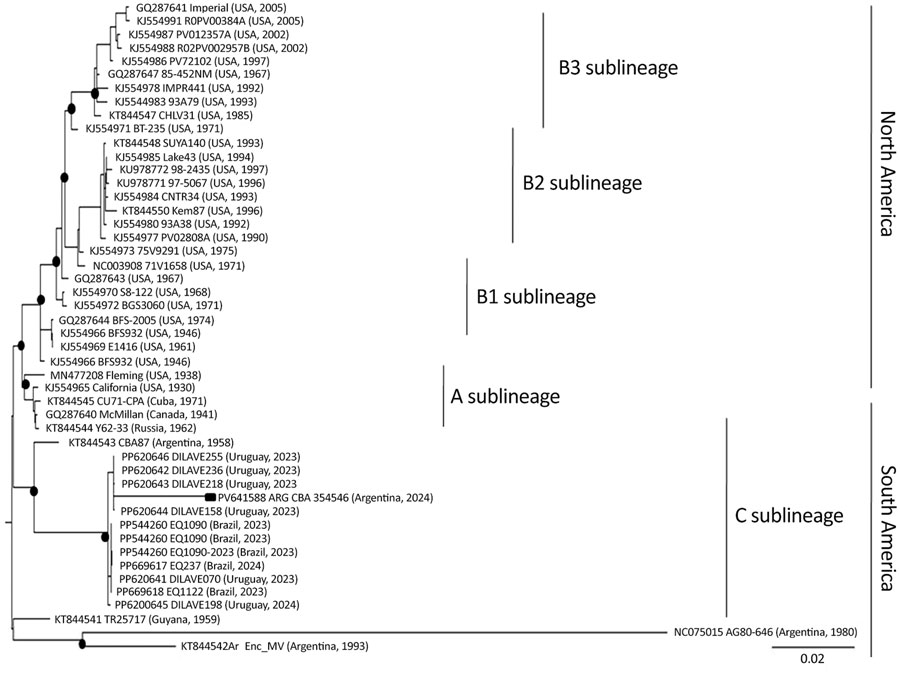
Figure. Phylogenetic analysis from study of western equine encephalitis virus (WEEV) in blood donors during outbreak, Argentina, 2023–2024. We generated a maximum-likelihood phylogenetic tree of a partial nucleotide sequence nonstructural protein 4 (201 bp) of a WEEV isolate from Argentina (black square) compared with other sequences from GenBank (accession numbers shown). We edited the tree using FigTree version 1.4.4 (https://tree.bio.ed.ac.uk/software/figtree). We selected the best-fit nucleotide substitution model general time-reversible substitution model with estimated base frequencies and gamma-distribution rate with 4 discrete categories according to the Bayesian Information Criterion. Black dots at nodes show the highest support (>80%) by SH-like approximate-likelihood ratio test. WEEV strains from the 2023–2024 outbreak group closely with other reported strains from Uruguay and Brazil (C sublineage). We defined WEEV lineages in accordance with previous research (22). Scale bar indicates number of nucleotide substitutions per site.
References
- Pealer LN, Marfin AA, Petersen LR, Lanciotti RS, Page PL, Stramer SL, et al.; West Nile Virus Transmission Investigation Team. Transmission of West Nile virus through blood transfusion in the United States in 2002.N Engl J Med. 2003;349:1236–45. DOIPubMedGoogle Scholar
- Giménez-Richarte Á, Ortiz de Salazar MI, Giménez-Richarte MP, Collado M, Fernández PL, Clavijo C, et al.Transfusion-transmitted arboviruses: update and systematic review.PLoS Negl Trop Dis. 2022;16:
e0010843 . DOIPubMedGoogle Scholar - Gould CV, Free RJ, Bhatnagar J, Soto RA, Royer TL, Maley WR, et al.; Yellow Fever Vaccine Virus Transplant and Transfusion Investigation Team. Transmission of yellow fever vaccine virus through blood transfusion and organ transplantation in the USA in 2021: report of an investigation.Lancet Microbe. 2023;4:e711–21. DOIPubMedGoogle Scholar
- Almeida FJ, Pacheco JT, Farias CGA, de Matos SF, de Morais CO, Guerra GG, et al.Dengue: a hidden threat in blood transfusions amidst Brazil’s largest outbreak?Lancet Infect Dis. 2025;25:
e10 . DOIPubMedGoogle Scholar - Teo D, Ng LC, Lam S. Is dengue a threat to the blood supply?Transfus Med. 2009;19:66–77. DOIPubMedGoogle Scholar
- Giménez-Richarte Á, de Salazar MO, Arbona C, Giménez-Richarte MP, Collado M, Fernández PL, et al.Prevalence of chikungunya, dengue and Zika viruses in blood donors: a systematic literature review and meta-analysis.Blood Transfus. 2022;20:267–80. DOIPubMedGoogle Scholar
- Frank C, Schmidt-Chanasit J, Ziegler U, Lachmann R, Preußel K, Offergeld R. West Nile virus in Germany: an emerging infection and its relevance for transfusion safety.Transfus Med Hemother. 2022;49:192–204. DOIPubMedGoogle Scholar
- Moreira-Soto A, Postigo-Hidalgo I, Tabares X, Roell Y, Fischer C, Gotuzzo E, et al.Transfusion-transmitted infections: risks and mitigation strategies for Oropouche virus and other emerging arboviruses in Latin America and the Caribbean.Lancet Reg Health Am. 2025;46:
101089 . DOIPubMedGoogle Scholar - Blanco S, Marín ÁL, Frutos MC, Barahona NY, Rivarola ME, Carrizo LH, et al.Haemovigilance survey and screening strategy for arthropod-borne viruses in blood donors from Argentina.J Med Virol. 2024;96:
e29476 . DOIPubMedGoogle Scholar - Tomás G, Marandino A, Rodríguez S, Wallau GL, Dezordi FZ, de Oliveira ALS, et al.Diagnosis and genomic characterization of the largest western equine encephalitis virus outbreak in Uruguay during 2023–2024.Npj Viruses. 2024;2:70. DOIPubMedGoogle Scholar
- Campos AS, Franco AC, Godinho FM, Huff R, Candido DS, da Cruz Cardoso J, et al.Molecular epidemiology of western equine encephalitis virus, South America, 2023–2024.Emerg Infect Dis. 2024;30:1834–40. DOIPubMedGoogle Scholar
- Vissani MA, Alamos F, Tordoya MS, Minatel L, Schammas JM, Dus Santos MJ, et al.Outbreak of western equine encephalitis virus infection associated with neurological disease in horses following a nearly 40-year intermission period in Argentina.Viruses. 2024;16:1594. DOIPubMedGoogle Scholar
- Servicio Nacional de Sanidad y Calidad Agroalimentaria (SENASA). Resolución 521/2016. Boletín Oficial de la República Argentina. 2016 Sep 12 [cited 2026 May 8]. https://www.boletinoficial.gob.ar/detalleAviso/primera/150852/20160915
- Ministerio de Salud de la Nación. Boletín Epidemiológico Nacional no. 700. 2024 [cited 2026 May 8]. https://www.argentina.gob.ar/sites/default/files/2024/04/ben_700_se15_vf.pdf
- González Pannia P, De Lillo L, Roldán M, Miño L, Pruscino F, Farias E, et al.Western equine encephalitis: a pediatric case report.Arch Argent Pediatr. 2025;123:
e202410392 . DOIPubMedGoogle Scholar - Campassi ML, Cuitiño M, Dorregaray F, Litardo Banegas DM, Repetto FG, Fauez C. Western equine encephalitis: brainstem involvement and clinical manifestations.Medicina (B Aires). 2024;84:1240–5.PubMedGoogle Scholar
- Sánchez-Seco MP, Rosario D, Quiroz E, Guzmán G, Tenorio A. A generic nested-RT-PCR followed by sequencing for detection and identification of members of the alphavirus genus.J Virol Methods. 2001;95:153–61. DOIPubMedGoogle Scholar
- Trifinopoulos J, Nguyen LT, von Haeseler A, Minh BQ. W-IQ-TREE: a fast online phylogenetic tool for maximum likelihood analysis.Nucleic Acids Res. 2016;44(W1):
W232–5 . DOIPubMedGoogle Scholar - Kalyaanamoorthy S, Minh BQ, Wong TKF, von Haeseler A, Jermiin LS. ModelFinder: fast model selection for accurate phylogenetic estimates.Nat Methods. 2017;14:587–9. DOIPubMedGoogle Scholar
- Guindon S, Dufayard JF, Lefort V, Anisimova M, Hordijk W, Gascuel O. New algorithms and methods to estimate maximum-likelihood phylogenies: assessing the performance of PhyML 3.0.Syst Biol. 2010;59:307–21. DOIPubMedGoogle Scholar
- Blanco S, Frutos MC, Spinsanti L, Gallego SV. Silent St. Louis encephalitis virus circulation evidence by a haemovigilance survey in a centralized blood bank.J Public Health (Oxf). 2025;47:e56–8. DOIPubMedGoogle Scholar
- Bergren NA, Haller S, Rossi SL, Seymour RL, Huang J, Miller AL, et al.“Submergence” of Western equine encephalitis virus: evidence of positive selection argues against genetic drift and fitness reductions.PLoS Pathog. 2020;16:
e1008102 . DOIPubMedGoogle Scholar