Volume 32, Number 8—August 2026
Dispatch
Case-Fatality Risk of Norovirus, England, 2022–2025
Maria L. Tang , Amy Douglas, Cristina Celma, Roberto Vivancos, Gauri Godbole, Thomas Ward, and Jonathon Mellor
, Amy Douglas, Cristina Celma, Roberto Vivancos, Gauri Godbole, Thomas Ward, and Jonathon Mellor
Figure 1
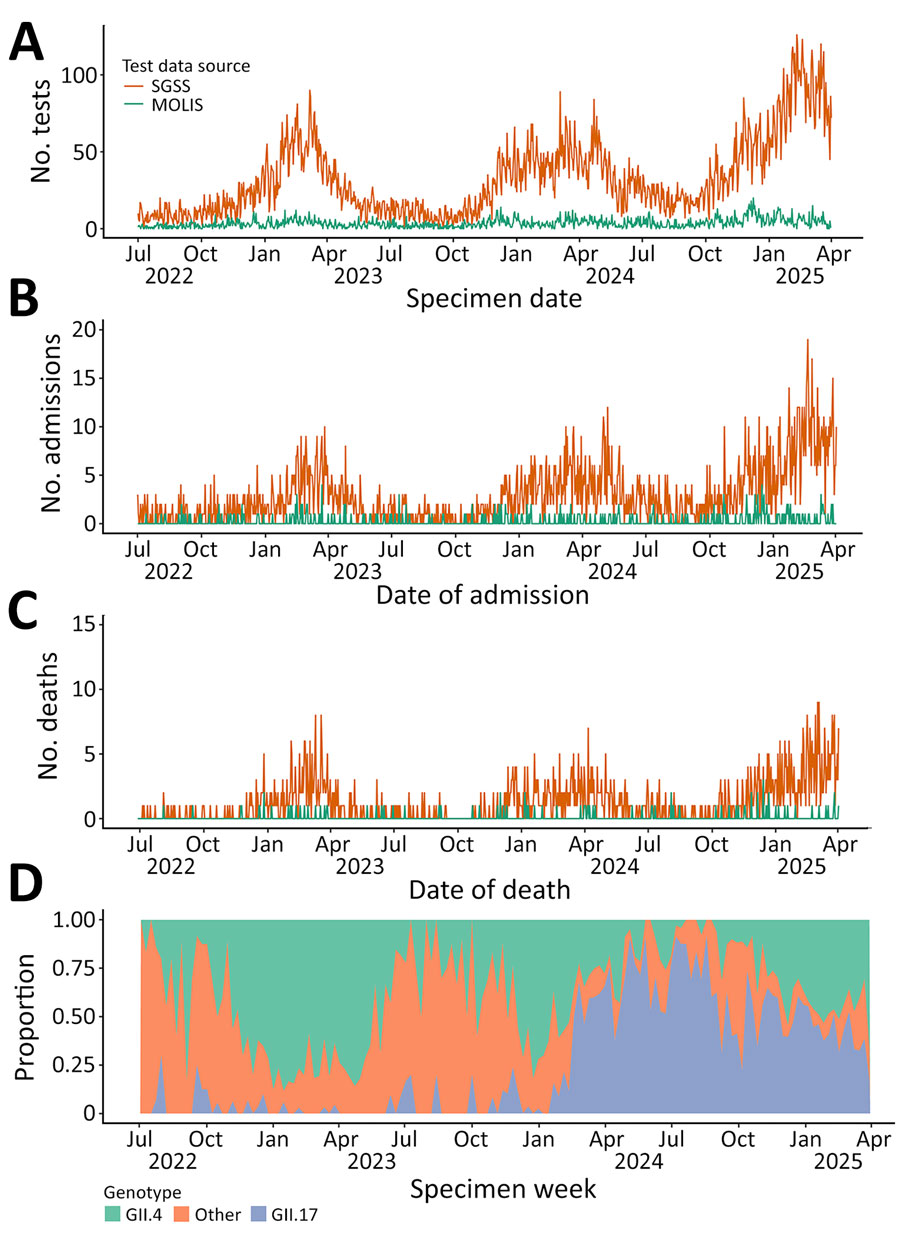
Figure 1. Number and proportion of positive norovirus test results and linked severe outcomes from a study of norovirus case-fatality risk in England during the 2022–23 and 2024–25 seasons. A) Number of de-duplicated positive norovirus test results. B) Number of hospital admissions within 14 days after a linked positive norovirus test result. C) Number of deaths occurring within 14 days of a linked positive norovirus test result. D) Proportion of norovirus genotypes among positive cases identified through the MOLIS. MOLIS, Modular Open Laboratory Information System; SGSS, Second Generation Surveillance Service.
Page created: June 28, 2026
Page updated: July 26, 2026
Page reviewed: July 26, 2026
The conclusions, findings, and opinions expressed by authors contributing to this journal do not necessarily reflect the official position of the U.S. Department of Health and Human Services, the Public Health Service, the Centers for Disease Control and Prevention, or the authors' affiliated institutions. Use of trade names is for identification only and does not imply endorsement by any of the groups named above.