Volume 32, Number 8—August 2026
Dispatch
Filovirus Surveillance in Communities Bordering Equatorial Guinea, Marburg Outbreak, Cameroon, 2023
Figure 1
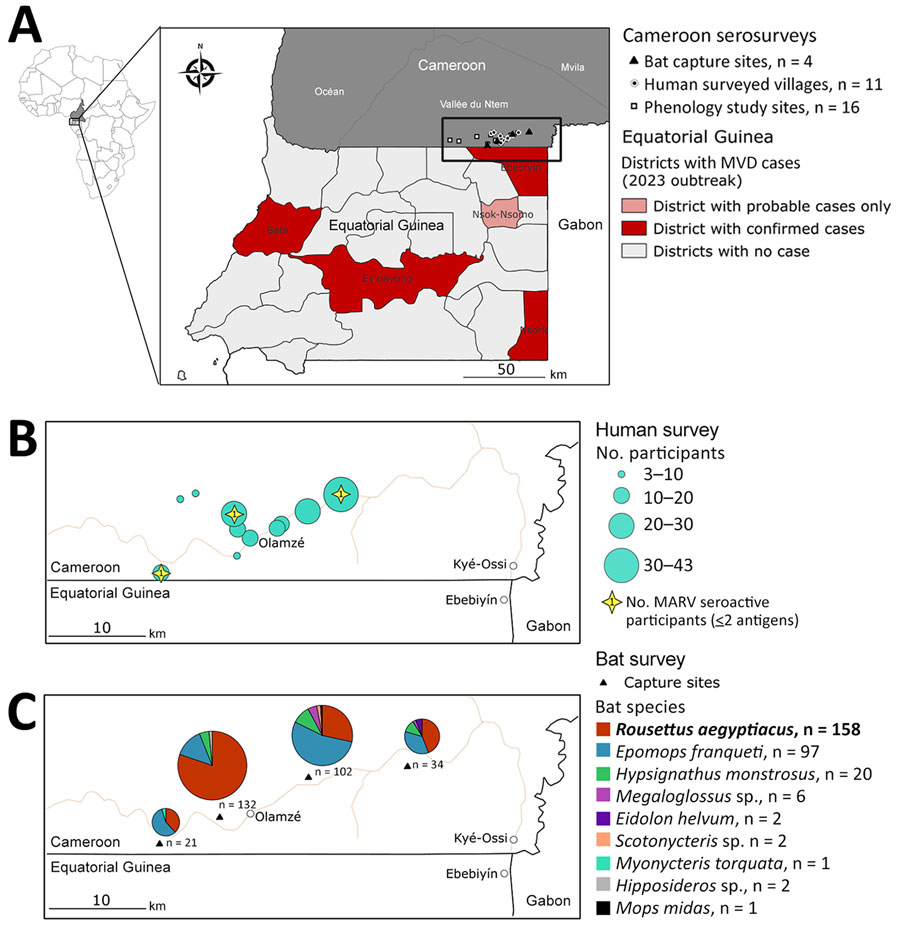
Figure 1. Study area of One Health surveillance for MARV in communities bordering Equatorial Guinea Marburg outbreak, Cameroon, 2023. A) Locations in Equatorial Guinea with confirmed and probable MVD cases during the outbreak (5) and study area in Cameroon (black box) with integrated surveillance sites (triangle, circle, and square icons). Inset map shows location of study area in Africa. B) Human survey villages; circle size indicates number of participants (n = 181 total participants). Stars indicate villages with MARV seropositive participants, defined as reactivity to >2 antigens (1.7%, n = 3 participants). C) Bat capture sites with species composition (n = 288 bats). Rousettus aegyptiacus bats, the MARV reservoir species, were most abundant (54.9%, n = 158 bats). We did not detect MARV RNA by using panfilovirus reverse transcription PCR of 589 bat samples. MARV, Marburg virus; MVD, Marburg virus disease.
References
- Cuomo-Dannenburg G, McCain K, McCabe R, Unwin HJT, Doohan P, Nash RK, et al.; Pathogen Epidemiology Review Group. Marburg virus disease outbreaks, mathematical models, and disease parameters: a systematic review. Lancet Infect Dis. 2024;24:e307–17. DOIPubMedGoogle Scholar
- Towner JS, Pourrut X, Albariño CG, Nkogue CN, Bird BH, Grard G, et al. Marburg virus infection detected in a common African bat. PLoS One. 2007;2:
e764 . DOIPubMedGoogle Scholar - Bausch DG, Borchert M, Grein T, Roth C, Swanepoel R, Libande ML, et al. Risk factors for Marburg hemorrhagic fever, Democratic Republic of the Congo. Emerg Infect Dis. 2003;9:1531–7. DOIPubMedGoogle Scholar
- Towner JS, Amman BR, Sealy TK, Carroll SAR, Comer JA, Kemp A, et al. Isolation of genetically diverse Marburg viruses from Egyptian fruit bats. PLoS Pathog. 2009;5:
e1000536 . DOIPubMedGoogle Scholar - Ngai S, Evers ES, Seoane AKL, Ameh G, Anoko JN, Barnadas C, et al.; Marburg Virus Disease Outbreak Response Working Group. Outbreak of Marburg virus disease, Equatorial Guinea, 2023. Emerg Infect Dis. 2025;31:887–95. DOIPubMedGoogle Scholar
- Harris E. WHO: Marburg virus outbreak confirmed in Equatorial Guinea. JAMA. 2023;329:969. DOIPubMedGoogle Scholar
- Ayouba A, Touré A, Butel C, Keita AK, Binetruy F, Sow MS, et al. Development of a sensitive and specific serological assay based on Luminex technology for detection of antibodies to Zaire Ebola virus. J Clin Microbiol. 2016;55:165–76. DOIPubMedGoogle Scholar
- Goldstein T, Anthony SJ, Gbakima A, Bird BH, Bangura J, Tremeau-Bravard A, et al. The discovery of Bombali virus adds further support for bats as hosts of ebolaviruses. Nat Microbiol. 2018;3:1084–9. DOIPubMedGoogle Scholar
- De Nys HM, Kingebeni PM, Keita AK, Butel C, Thaurignac G, Villabona-Arenas CJ, et al. Survey of Ebola viruses in frugivorous and insectivorous bats in Guinea, Cameroon, and the Democratic Republic of the Congo, 2015–2017. Emerg Infect Dis. 2018;24:2228–40. DOIPubMedGoogle Scholar
- Ramassamy JL, Ayouba A, Thaurignac G, Bilounga Ndongo C, Nnuka P, Betsem E, et al. High seroreactivities to Orthoebolaviruses in rural Cameroon: a case-control study on nonhuman primate bites and a cross-sectional survey in rural populations. J Infect Dis. 2024;230:e1067–76. DOIPubMedGoogle Scholar
- Amman BR, Schuh AJ, Albariño CG, Towner JS. Marburg virus persistence on fruit as a plausible route of bat to primate filovirus transmission. Viruses. 2021;13:2394. DOIPubMedGoogle Scholar
- Baudel H, De Nys H, Mpoudi Ngole E, Peeters M, Desclaux A. Understanding Ebola virus and other zoonotic transmission risks through human–bat contacts: exploratory study on knowledge, attitudes and practices in Southern Cameroon. Zoonoses Public Health. 2019;66:288–95. DOIPubMedGoogle Scholar
- Ramassamy JL, Ndongo CB, Nnuka P, Njouom R, Gessain A. High potential for zoonotic pathogen emergence through wildlife exposure in East Cameroon. One Health. 2025;21:
101275 . DOIPubMedGoogle Scholar - Amman BR, Carroll SA, Reed ZD, Sealy TK, Balinandi S, Swanepoel R, et al. Seasonal pulses of Marburg virus circulation in juvenile Rousettus aegyptiacus bats coincide with periods of increased risk of human infection. PLoS Pathog. 2012;8:
e1002877 . DOIPubMedGoogle Scholar - Makenov MT, Boumbaly S, Tolno FR, Sacko N, N’Fatoma LT, Mansare O, et al. Marburg virus in Egyptian Rousettus bats in Guinea: investigation of Marburg virus outbreak origin in 2021. PLoS Negl Trop Dis. 2023;17:
e0011279 . DOIPubMedGoogle Scholar
1These first authors contributed equally to this article.
2These senior authors contributed equally to this article.