Volume 32, Number 8—August 2026
Dispatch
Detection of Dengue Virus in Aedes aegypti Mosquitoes, Dubai, United Arab Emirates

Cite This Article
Citation for Media
Abstract
We performed a 1-year mosquito survey in Dubai, United Arab Emirates, after a dengue virus outbreak in 2024. We collected 1,598 Aedes aegypti mosquitoes and detected dengue virus in 5 pools of <20 mosquitoes. Our findings underscore the importance of sustained vector surveillance for dengue virus in arid urban environments.
During the past few decades, mosquitoborne diseases have increased worldwide, partly because of the spread of competent mosquito vectors. Changes in climate are among the primary factors contributing to the expanded ranges of arbovirus vector mosquitoes into temperate zones (1). Meanwhile, arid regions with extremely hot summers, such as the Gulf countries of the Arabian Peninsula, were not colonized by invasive mosquitoes until recently, likely because of increased urbanization (2).
Dengue fever is a mosquitoborne disease caused by dengue virus (DENV) and monitored through regional and international surveillance systems. Increased dengue activity, including autochthonous cases, was reported in the United Arab Emirates (UAE) after periods of increased rainfall in April 2024 (3). To monitor local mosquito species and identify circulating mosquitoborne viruses, we conducted a mosquito survey in Dubai, UAE.
To investigate the spread and distribution pattern of Aedes aegypti mosquitoes in the city of Dubai, we initiated a targeted mosquito survey. We evaluated the trapped mosquitoes for the presence of mosquitoborne human pathogens by using molecular techniques.
Mosquito trapping was part of an enhanced Dubai Municipality Public Health Services Department mosquito surveillance program. We started the entomologic survey on June 20, 2024, and continued it for 1 year. Our trapping method was opportunistic, designed to sample Ae. aegypti mosquitoes in urban areas, specifically targeting labor camps, construction sites, residential communities, and green spaces including parks, stables, ponds and lakes, and gardens.
We placed BG-Sentinel mosquito traps (Biogents, https://us-shop.biogents.com) without a light source throughout the city of Dubai combined with CO2 lures. We conducted trapping over 3 days at 60 sites, each sampled 1–33 times (mean 4.3 times, median 2 times), with 1–7 sites (mean 1.9 sites, median 1 site) sampled per trapping period. We collected and transferred the trap contents to the Public Health Pest Control Section laboratory of Dubai Municipality. We identified Ae. aegypti and Anopheles stephensi mosquitoes morphologically (4; World Health Organization, https://iris.who.int/handle/10665/334210) and identified other mosquitoes to genus level. We pooled <20 mosquitoes per vial and froze the vials at –50°C.
We homogenized mosquito pools in 500 µL of phosphate buffered saline with stainless steel beads (Benchmark Scientific, https://www.benchmarkscientific.com) on a Bead Mill homogenizer (OMNI International, https://www.fishersci.com). We extracted viral nucleic acid from mosquitoes by using a Quick-RNA Viral Kit (Zymo Research, https://www.zymoresearch.com) according to manufacturer instructions. We screened Ae. aegypti mosquitoes for dengue, chikungunya, Zika, yellow fever, Rift Valley fever, and Alkhurma hemorrhagic fever virus nucleic acids by using virus-specific quantitative reverse transcription PCR (qRT-PCR) kits (altona Diagnostics, https://altona-diagnostics.com). We retested and serotyped all samples positive for DENV by using the RealStar Dengue Type qRT-PCR Kit 1.0 (altona Diagnostics). We screened Culex spp., Aedes, and Ochlerotatus spp. mosquitoes for West Nile, Rift valley fever, and Alkhurma hemorragic fever virus nucleic acids by using the corresponding RealStar qRT-PCR Kits (altona Diagnostics). We also screened An. stephensi mosquitoes for Plasmodia parasites by using the RealStar Malaria Screen & Type PCR kit 1.0 (altona Diagnostics).
Figure 1
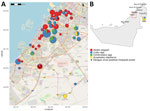
Figure 1. Geographic distribution of trapped mosquitoes in study of dengue virus in Aedes aegyptimosquitoes, Dubai, United Arab Emirates. A) Of the 60 sampling sites, all except 3 were located...
Figure 2
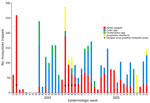
Figure 2. Number of mosquitos trapped in study of dengue virus in Aedes aegypti mosquitoes, Dubai, United Arab Emirates, June 2024–June 2025. We used BG Sentinel traps (Biogents, https://us-shop.biogents.com...
We used a bias-corrected maximum likelihood estimate of minimum infection rate on the basis of variable size pooling with the package binGroup v2.2-1 in R version 4.3.3 (The R Project for Statistical Computing, https://www.r-project.org). We collected a total of 3,743 adult mosquitoes over 263 trapping periods: 1,598 Ae. aegypti, 1,555 Culex spp., 376 Ochlerotatus spp., and 214 An. stephensi. We found Ae. aegypti mosquitoes throughout Dubai, mainly collected from labor camps, construction sites, and green spaces, whereas we detected An. stephensi mosquitoes in limited numbers in periurban areas with aquatic habitats (Figure 1). We observed seasonal variability in the number of mosquitoes collected, with the lowest number collected during the summer months (Figure 2).
We detected DENV in 5 of 151 Ae. aegypti pools: 3 pools with DENV-1 and 2 with DENV-2. The field minimum infection rate was 3.1 (95% CI 0.4–5.9)/1,000 mosquitoes . We detected DENV-2 in the last week of June (epidemiologic week 26 of 2024) near the main Dubai airport (Figure 2). We detected both DENV-1 and DENV-2 from mid-November through mid-December (epidemiologic weeks 47–50 of 2024) in the southwest Al Hebiah 5 district (Figure 2). We did not detect any other viruses in the other mosquito pools, and we did not find Plasmodia parasites in any of the mosquito pools with An. stephensi mosquitoes.
In most of the Gulf countries, the workforce is recruited from countries in which dengue, chikungunya, Zika, yellow fever, Rift Valley fever, or West Nile virus are endemic, and imported cases were previously reported in the Arabian Peninsula. Dengue fever outbreaks in the Arabian Peninsula have occurred in Yemen and the Jeddah and Mecca region of Saudi Arabia (5). Oman, which borders UAE, experienced its first autochthonous dengue outbreak during December 2018 through mid-March 2019, with 59 reported cases (6). A second autochthonous outbreak occurred from mid-March through mid-April 2022 and involved 169 locally acquired cases (7).
In the UAE, neither Aedes (Stegomyia) mosquitoes nor locally acquired dengue cases were reported in recent decades (5). Historically, there was evidence of Ae. aegypti mosquitoes in UAE as early as 1944 (8). However, it is assumed that the populations of Ae. aegypti mosquitoes from older records would not have survived the liberal use of insecticides in the second half of the 1900s (9). We did not find Ae. aegypti mosquitoes in our entomologic survey conducted during January–May 2018 in the UAE (10). The first recent record of an Ae. aegypti mosquito in Dubai was in May 2016, identified by the Public Health Pest Control Section laboratory, Dubai Municipality, and confirmed by the British Natural History Museum. Other Gulf countries such as Qatar also reported recent, yet sporadic, evidence of Ae. aegypti mosquitoes (11). Regional and global species distribution models have indicated that urban areas in Gulf countries are suitable for Ae. aegypti mosquitoes (12). Likely, the increased DENV activity we observed was driven by a recently established Ae. aegypti population in Dubai.
In recent years, increased frequency of heavy rainfall with flooding and stagnant surface water were recorded worldwide including the Gulf countries, contributing to an increase in mosquito abundance and dengue cases (13). In addition, manmade water-containing vessels can serve as reservoirs for immature Ae. aegypti mosquitoes and correlate with cases of dengue fever (14). Those sources of water in arid environments likely contribute to extended mosquito survival during dry periods (15).
Our results demonstrate the widespread distribution of Ae. aegypti mosquitoes in Dubai. We detected DENV-1 and DENV-2 in Ae. aegypti mosquitoes from 2 sampling locations within the urban area of Dubai, which coincided with a DENV-2 outbreak in humans (Dubai Health, unpub. data). Our findings demonstrate the value of integrated entomologic and molecular surveillance for early detection of mosquitoborne pathogens in arid urban settings. Future studies should establish seasonality and habitat associations to assist with mosquito control.
The presence of Ae. aegypti mosquitos in urban areas in the Gulf region necessitates steps to reduce or eliminate DENV transmission. Efforts should include educating the public on avoiding mosquitoes, surveillance and targeted mosquito control, and isolating infected individuals quickly to prevent spread.
Dr. Nowotny is professor of virology at the University of Veterinary Medicine, Vienna, Austria, and visiting professor at the College of Medicine, Mohammed Bin Rashid University of Medicine and Health Sciences, Dubai Health, Dubai, UAE. His research interests include emerging, zoonotic, and mosquitoborne virus infections.
Acknowledgments
We cordially thank the Dubai Municipality staff members Mohammed Sultan Alsaadi, Ahmad Buthaina Alsuwaidi, Amin ElTayeb Mohammed, Shajahan Puthan Veettil, Theverparambil Ashraf Kadar, Asharaf Kollante Padinharayil, and Manal Youssef Abdo for their help in all aspects of field mosquito survey and Dominika and Michael Kolodziejek for preparing the graphs.
This project was funded by Mohammed Bin Rashid University of Medicine and Health Sciences/Dubai Health and Dubai Municipality, Dubai, UAE.
References
- Merkenschlager C, Bangelesa F, Paeth H, Hertig E. Evolution of the recent habitat suitability area of Aedes albopictus in the extended Mediterranean area due to land-use and climate change. Sci Total Environ. 2025;974:
179202 . DOIPubMedGoogle Scholar - Hajissa K, Hammed-Akanmu M, Alfaqih HO, Alshehri AA, Goni MD, Al-Asmakh M. Current epidemiological status of mosquito-borne arboviruses in Gulf countries: a systematic review and meta-analysis. Trop Dis Travel Med Vaccines. 2025;11:13. DOIPubMedGoogle Scholar
- Francis N, Asapu P, Qazi MU, Jaiganesh T. The ultimate buzzkill: when dengue hits hard. Cureus. 2025;17:
e80761 . DOIPubMedGoogle Scholar - Rueda LM. Pictorial keys for the identification of mosquitoes (Diptera: Culicidae) associated with dengue virus transmission. Zootaxa. 2004;589:1–60. DOIGoogle Scholar
- Humphrey JM, Cleton NB, Reusken CB, Glesby MJ, Koopmans MP, Abu-Raddad LJ. Dengue in the Middle East and North Africa: a systematic review. PLoS Negl Trop Dis. 2016;10:
e0005194 . DOIPubMedGoogle Scholar - Al-Abri SS, Kurup PJ, Al Manji A, Al Kindi H, Al Wahaibi A, Al Jardani A, et al. Control of the 2018–2019 dengue fever outbreak in Oman: a country previously without local transmission. Int J Infect Dis. 2020;90:97–103. DOIPubMedGoogle Scholar
- Al Balushi L, Al Kalbani M, Al Manji A, Amin M, Al Balushi Z, Al Barwani N, et al. A second local dengue fever outbreak: a field experience from Muscat Governorate in Oman, 2022. IJID Reg. 2023;7:237–41. DOIPubMedGoogle Scholar
- Mattingly PF, Knight KL. The mosquitoes of Arabia. I. Bulletin of the British Museum (Natural History). Entomology. 1956;4:89–141.
- Powell JR, Gloria-Soria A, Kotsakiozi P. Recent history of Aedes aegypti: vector genomics and epidemiology records. Bioscience. 2018;68:854–60. DOIPubMedGoogle Scholar
- Camp JV, Karuvantevida N, Chouhna H, Safi E, Shah JN, Nowotny N. Mosquito biodiversity and mosquito-borne viruses in the United Arab Emirates. Parasit Vectors. 2019;12:153. DOIPubMedGoogle Scholar
- Mohamed HO, Eldos HI, Samuel B, Al-Ansari T, Al-Ghamdi SG, Sultan AA. First molecular evidence of Aedes aegypti and dengue virus in Qatar: Spatiotemporal data, 2022-2024. Curr Res Parasitol Vector Borne Dis. 2026;9:
100379 . DOIPubMedGoogle Scholar - Ducheyne E, Tran Minh NN, Haddad N, Bryssinckx W, Buliva E, Simard F, et al. Current and future distribution of Aedes aegypti and Aedes albopictus (Diptera: Culicidae) in WHO Eastern Mediterranean Region. Int J Health Geogr. 2018;17:4. DOIPubMedGoogle Scholar
- Liu Q, Zhang S, Liu M, Liu J. Assessing the impact of flood duration on dengue burden across 108 countries. iScience. 2026;29:
115917 . DOIPubMedGoogle Scholar - Al-Manji A, Wirayuda AAB, Eltayib RAA, Al-Azri M, Chan MF. Factors contributing to mosquito-borne disease: a systematic review in the Middle East and North Africa (MENA) region. Curr Res Parasitol Vector Borne Dis. 2025;8:
100281 . DOIPubMedGoogle Scholar - Newman EA, Feng X, Onland JD, Walker KR, Young S, Smith K, et al. Defining the roles of local precipitation and anthropogenic water sources in driving the abundance of Aedes aegypti, an emerging disease vector in urban, arid landscapes. Sci Rep. 2024;14:2058. DOIPubMedGoogle Scholar
Figures
Cite This ArticleOriginal Publication Date: July 13, 2026
1These authors contributed equally to this article.
Table of Contents – Volume 32, Number 8—August 2026
| EID Search Options |
|---|
 Advanced Article Search – Search articles by author and/or keyword.
|
 Articles by Country Search – Search articles by the topic country.
|
 Article Type Search – Search articles by article type and issue.
|
Please use the form below to submit correspondence to the authors or contact them at the following address:
Alawi Alsheikh-Ali, Dubai Health Authority, Government of Dubai, Sheikh Ahmed Square, Al Jaddaf, Dubai, United Arab Emirates
Top