Skip directly to site content Skip directly to page options Skip directly to A-Z link Skip directly to A-Z link Skip directly to A-Z link

Disclaimer: Early release articles are not considered as final versions. Any changes will be reflected in the online version in the month the article is officially released.

Volume 32, Number 8—August 2026

Dispatch

Human Cases of Borrelia miyamotoi Disease, Slovenia, 2025

Petra BogovičComments to Author , Jan Slunečko, Meta Kodre, Rok Kogoj, Mateja Brecl Jakob, Miša Korva, Eva Ružić-Sabljić, and Franc Strle
Author affiliation: University Medical Center Ljubljana, Ljubljana, Slovenia (P. Bogovič, F. Strle); University of Ljubljana, Ljubljana (J. Slunečko, M. Kodre, R. Kogoj, M. Brecl Jakob, M. Korva, E. Ružić-Sabljić)

Main Article

Figure

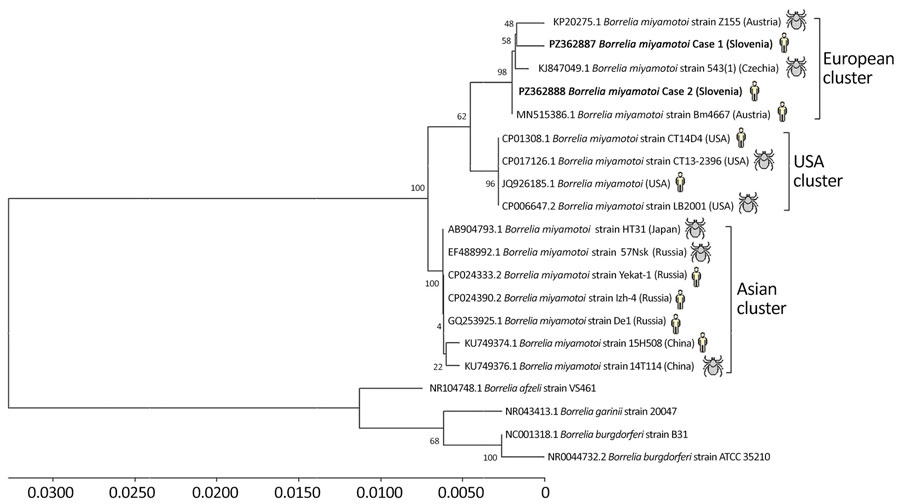
Phylogenetic analysis of 2 cases of Borrelia miyamotoi disease, Slovenia, 2025. Analysis was based on the 16S rRNA gene. We aligned consensus sequences (1,241-bp-long 16S rRNA sequences) using MAFFT version 7.490 (https://mafft.cbrc.jp/alignment/software) with a global alignment >1,000 iterations. We constructed the phylogenetic tree based on the multiple sequence alignment using IQ-TREE 2 version 2.2.0 (http://www.iqtree.org) with automatic model selection for tree inference and ultrafast bootstrapping with 1,000 iterations. Bold text indicates study sequences (GenBank accession nos. PZ362887 and PZ362888). We selected reference sequences to represent the European, Asian, and US B. miyamotoi clusters. We used B. burgdorferi (GenBank accession nos. NC_001318.1, NR_044732.2), B. afzelii (GenBank accession no. NR_104748.1) and B. garinii (GenBank accession no. NR_043413.1) as the outgroups. Numbers at nodes indicate bootstrap values. Scale bar indicates substitutions per site.

Figure. Phylogenetic analysis of 2 cases of Borrelia miyamotoi disease, Slovenia, 2025. Analysis was based on the 16S rRNA gene. We aligned consensus sequences (1,241-bp-long 16S rRNA sequences) using MAFFT version 7.490 (https://mafft.cbrc.jp/alignment/software) with a global alignment >1,000 iterations. We constructed the phylogenetic tree based on the multiple sequence alignment using IQ-TREE 2 version 2.2.0 (http://www.iqtree.org) with automatic model selection for tree inference and ultrafast bootstrapping with 1,000 iterations. Bold text indicates study sequences (GenBank accession nos. PZ362887 and PZ362888). We selected reference sequences to represent the European, Asian, and US B. miyamotoi clusters. We used B. burgdorferi (GenBank accession nos. NC_001318.1, NR_044732.2), B. afzelii (GenBank accession no. NR_104748.1) and B. garinii (GenBank accession no. NR_043413.1) as the outgroups. Numbers at nodes indicate bootstrap values. Scale bar indicates substitutions per site.

Main Article

Page created: June 25, 2026
Page updated: July 13, 2026
Page reviewed: July 13, 2026
The conclusions, findings, and opinions expressed by authors contributing to this journal do not necessarily reflect the official position of the U.S. Department of Health and Human Services, the Public Health Service, the Centers for Disease Control and Prevention, or the authors' affiliated institutions. Use of trade names is for identification only and does not imply endorsement by any of the groups named above.
file_external