Volume 32, Number 8—August 2026
Research Letter
Antimicrobial Resistance in Extragenital Neisseria gonorrhoeae Infections, US Military Centers, 2022–2024

Cite This Article
Citation for Media
Abstract
We analyzed antimicrobial resistance markers in 189 Neisseria gonorrhoeae patient encounters from 2 US military medical centers. Co-occurring resistance-associated markers were common; we detected plasmid-mediated β-lactamase in extragenital sites. Our findings highlight the importance of anatomic site–specific surveillance and, potentially, molecular antimicrobial resistance detection to guide screening and treatment strategies.
Neisseria gonorrhoeae infection remains a major global public health concern because of increasing antimicrobial resistance (AMR), including reduced susceptibility to extended-spectrum cephalosporins (1,2). Extragenital infections, particularly in the pharynx and rectum, are often asymptomatic and can contribute to persistence and transmission of resistant organisms (3–5).
We analyzed samples from 189 N. gonorrhoeae–positive clinical encounters collected during 2022–2024 at Tripler Army Medical Center (TAMC; Honolulu, Hawaii, USA) and Madigan Army Medical Center (MAMC; Tacoma, Washington, USA). The human research protection offices from both institutions, under the umbrella of the Defense Health Agency, reviewed the study and determined it to be research not involving human subjects. Investigators adhered to US policies for the protection of human subjects as prescribed in 45 Code of Federal Regulation 46.
We analyzed data from specimens that included urine and swabs from oropharyngeal, rectal, and urogenital sites (Table). We deidentified data and analyzed it at the encounter level; we were unable to exclude repeat encounters from the same patient. We performed targeted next-generation sequencing using the Urinary Pathogen ID/AMR Panel (Illumina, https://www.illumina.com). We identified AMR markers using predefined sequence-matching rules specific to each gene or mutation (e.g., exact match for point mutations such as rpsJ V57M and curated allele grouping for penA variants). Because short-read data and panel design did not support reliable allele-level or phylogenetic resolution, we analyzed penA variants as a single category. This study did not include phylogenetic reconstruction, multilocus sequence typing, or transmission network analysis; therefore, our findings describe marker prevalence and co-occurrence patterns rather than clonal relationships.
Figure
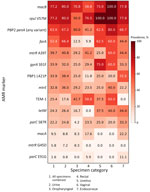
Figure. Prevalence of AMR markers in study of AMR patterns in extragenital Neisseria gonorrhoeaeinfections, US military medical centers, 2022–2024. Heatmap shows percent of encounters in which each genotypic marker...
Across all encounters, resistance-associated markers frequently co-occurred. The most prevalent markers were macB (77.2%) and rpsJ V57M (75.7%), and we detected penA variants in 63.0% of isolates (Figure). We observed co-occurrence of these markers in 60.3% of encounters, which suggested common resistance-associated marker combinations within the cohort. Findings from TAMC demonstrated higher prevalence of rpsJ V57M (84.2% vs. 65.9%; p = 0.004) and penA variants (70.3% vs. 54.5%; p = 0.034) than for those from MAMC.
Markers associated with fluoroquinolone resistance were also present (gyrA S91F, 35.4%). We frequently detected structural efflux pump genes (macB, farA, mtrE); however, because those genes are part of the core genome, their presence alone does not predict phenotypic resistance. Regulatory mutations (e.g., mtrR variants) and combined genetic contexts are more directly associated with resistance expression.
We observed anatomic site–specific differences. The plasmid-mediated β-lactamase gene blaTEM-1 was more prevalent in extragenital specimens; we detected blaTEM-1 in 10/17 (58.8%) of rectal swab samples and 10/24 (41.7%) of oropharyngeal swab samples, compared with 22/125 (17.6%) of urine specimens (Figure). Compared with oropharyngeal swab samples, rectal specimens had increased odds of blaTEM-1 detection (odds ratio [OR] 6.3; p = 0.004), whereas urine specimens had lower odds (OR 0.29; p = 0.012). In adjusted analyses controlling for age, sex, and institution, rectal specimens showed increased odds and wide 95% CIs (adjusted OR 2.57 [95% CI 0.94–7.00]).
Chromosomal resistance-associated markers such as rpsJ V57M were more common in urine specimens (80.0%) than in oropharyngeal specimens (50.0%; OR 3.90; p = 0.014). Conversely, we detected farA more frequently in urine (66.4%) than in extragenital (oropharyngeal and rectal) sites (<12.5%) (Figure). Those findings suggest that different anatomic niches may harbor distinct resistance-associated profiles.
Among 189 encounters, 24.9% occurred in persons with documented use of HIV pre-exposure prophylaxis. blaTEM-1 was more common among users (36.2% vs. 21.8%; p = 0.056), whereas farA was less frequent (21.3% vs. 62.7%; OR 0.16, p<0.001). Associations were attenuated after adjustment.
Antimicrobial drug treatment varied across encounters. Doxycycline exposure was common; however, doxycycline is not recommended for treating uncomplicated gonorrhea and was likely prescribed for concurrent or presumptive chlamydial infection or syndromic management (6). A high (78.3%) percentage of isolates exposed to doxycycline contained rpsJ V57M, consistent with tetracycline-associated resistance markers (7).
Our study targeted sequencing and short-read data, which limited resolution of gene variants (e.g., blaTEM subtypes) and precluded plasmid reconstruction or phylogenetic analyses. The absence of phenotypic susceptibility testing limited our ability to interpret clinical resistance. Retrospective data and incomplete sampling across anatomic sites might affect prevalence estimates. Finally, lack of temporal and patient-level linkage data limited inferences regarding transmission dynamics.
In summary, we identified frequent co-occurrence of resistance-associated markers in N. gonorrhoeae from US military medical centers and found enrichment of blaTEM-1 in extragenital sites. Our findings support the value of anatomic site–specific surveillance, especially for extragenital infections in sexually transmitted infections, and molecular AMR marker detection (1,4,8,9).
Dr. Dombach is currently a DVM student at Purdue University after serving as the laboratory services officer for the United States Military Hospital–Kuwait. Current research interests are focused on One Health initiatives and combatting antimicrobial resistance.
Acknowledgments
This work was supported by funding from Global Emerging Infections Surveillance.
The views expressed in this study are those of the authors and do not necessarily reflect the official policy or position of the Defense Health Agency, Department of Defense, nor the US Government. This work was prepared as part of official duties. Title 17, U.S.C., Section 105 provides that copyright protection under this title is not available for any work of the US Government. Title 17, U.S.C., Section 101 defines a US Government work as a work prepared by a military service member or employee of the US Government as part of that person’s official duties.
References
- Unemo M, Lahra MM, Cole MJ, Marcano Zamora D, Jacobsson S, Galarza P, et al. WHO global gonococcal antimicrobial surveillance programmes, 2019–22: a retrospective observational study. Lancet Microbe. 2025;6:
101181 . DOIPubMedGoogle Scholar - Wi T, Lahra MM, Ndowa F, Bala M, Dillon JR, Ramon-Pardo P, et al. Antimicrobial resistance in Neisseria gonorrhoeae: global surveillance and a call for international collaborative action. PLoS Med. 2017;14:
e1002344 . DOIPubMedGoogle Scholar - Gaspari V, Djusse ME, Morselli S, Rapparini L, Foschi C, Ambretti S, et al. Non-pathogenic Neisseria species of the oropharynx as a reservoir of antimicrobial resistance: a cross-sectional study. Front Cell Infect Microbiol. 2023;13:
1308550 . DOIPubMedGoogle Scholar - Adamson PC, Klausner JD. The staying power of pharyngeal gonorrhea: implications for public health and antimicrobial resistance. Clin Infect Dis. 2021;73:583–5. DOIPubMedGoogle Scholar
- Whittles LK, Didelot X, Grad YH, White PJ. Testing for gonorrhoea should routinely include the pharynx. Lancet Infect Dis. 2018;18:716–7. DOIPubMedGoogle Scholar
- St Cyr S, Barbee L, Workowski KA, Bachmann LH, Pham C, Schlanger K, et al. Update to CDC’s treatment guidelines for gonococcal infection, 2020. MMWR Morb Mortal Wkly Rep. 2020;69:1911–6. DOIPubMedGoogle Scholar
- Hu M, Nandi S, Davies C, Nicholas RA. High-level chromosomally mediated tetracycline resistance in Neisseria gonorrhoeae results from a point mutation in the rpsJ gene encoding ribosomal protein S10 in combination with the mtrR and penB resistance determinants. Antimicrob Agents Chemother. 2005;49:4327–34. DOIPubMedGoogle Scholar
- World Health Organization. Enhanced Gonococcal Antimicrobial Surveillance Programme (EGASP): general protocol. Geneva: The Organization; 2021 [cited 2026 Jun 29]. https://www.who.int/publications/i/item/9789240021341
- Sun S, Redai AH, Thorley K, Ivanov Z, Day M, Pitt R, et al. O07 Reduced susceptibility of pharyngeal Neisseria gonorrhoeae infections to current recommended therapeutics in England and Wales using national surveillance data (GRASP). Sex Transm Infect. 2023;99:A3. DOIGoogle Scholar
Figure
Table
Cite This ArticleOriginal Publication Date: July 16, 2026
1Current affiliation: Cepheid, Sunnyvale, California, USA.
Table of Contents – Volume 32, Number 8—August 2026
| EID Search Options |
|---|
 Advanced Article Search – Search articles by author and/or keyword.
|
 Articles by Country Search – Search articles by the topic country.
|
 Article Type Search – Search articles by article type and issue.
|
Please use the form below to submit correspondence to the authors or contact them at the following address:
Edwin Kamau, Cepheid, 904 Caribbean Dr, Sunnyvale CA 94089, USA
Top