Volume 32, Number 8—August 2026
Emerging Infection Networks Letter
Detection of blaOXA-23–Positive Proteus mirabilis Isolate, United States, 2024
 , Porscha Bumpus-White, Alyssa G. Kent, Erin Breaker, Matthew Doucette, Caryn Ivanof, Esther Fortes, Sanjib Bhattacharyya, Nicolas Epie, Susannah L. McKay, Stephen P. LaVoie, and Sarah Sabour
Figure
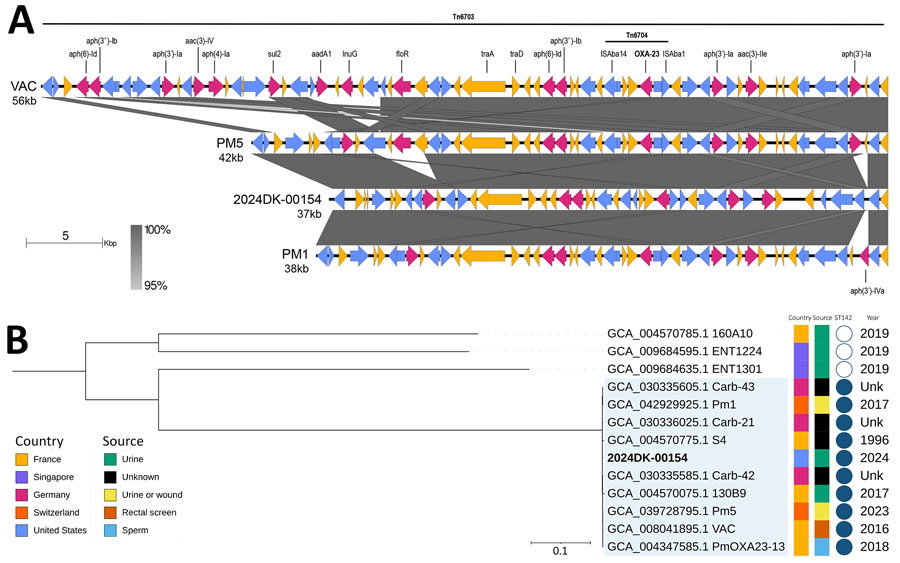
Figure. Genomic comparisons of blaOXA-23–positive Proteus mirabilis detected in Massachusetts, USA, in 2024 to clinical isolates identified in previous studies. A) Genomic context of blaOXA-23 regions of P. mirabilis isolate detected in Massachusetts (2024DK-00154) and P. mirabilis clinical isolates previously identified in Switzerland (Pm1 and Pm5) and France (VAC). BLASTn (https://blast.ncbi.nlm.nih.gov) was used to identify the best match to the National Center for Biotechnology Information nucleotide database (https://www.ncbi.nlm.nih.gov/nucleotide) of the blaOXA-23-containing region. Genomic region comparison was generated using Easyfig (https://mjsull.github.io/Easyfig). Pink indicates antimicrobial resistance genes; blue indicates insertion sequences and transposon genes; yellow indicates other genes. Grey shading represents percent nucleotide sequence identity as indicated by the key. B) Phylogenetic tree based on core-genome alignment of blaOXA-23–positive P. mirabilis isolate detected in Massachusetts (2024DK-00154, in bold; GenBank accession no. CP194042) and blaOXA-23–positive P. mirabilis clinical isolates previously identified in other countries (GenBank accession nos. GCA_004347585.1a, GCA_004570075.1, GCA_004570775.1, GCA_004570785.1, GCA_008041895.1, GCA_009684595.1, GCA_009684635.1, GCA_030335585.1, GCA_030335605.1, GCA_030336025.1, GCA_039728795.1, GCA_042929925.1; genome assembly sizes min: 3.91 Mb; max: 4.11 Mb; average: 4.00 Mb). Core-genome alignment and construction of a maximum-likelihood tree were performed using Parsnp (https://github.com/marbl/parsnp). Tree was visualized using iTOL (https://itol.embl.de) and rooted at the midpoint. Country and source of isolate collection are specified. Filled blue circles represent sequence type (ST) 142 isolates; empty circles represent non-ST142 isolates. Year of isolate collection is provided when known. Blue box indicates ST142 isolate cluster. Scale bar indicates number of substitutions per nucleotide. Unk, unknown.