Skip directly to site content Skip directly to page options Skip directly to A-Z link Skip directly to A-Z link Skip directly to A-Z link

Disclaimer: Early release articles are not considered as final versions. Any changes will be reflected in the online version in the month the article is officially released.

Volume 31, Number 11—November 2025

Dispatch

Novel Dolphin Tupavirus from Stranded Atlantic White-Sided Dolphin with Severe Encephalitis, Canada, 2024

Oksana Vernygora1, Laura Bourque1, Megan Jones, Ole Nielsen, Carissa Embury-Hyatt, Estella Moffat, Tonya Wimmer, and Oliver LungComments to Author 
Author affiliation: National Centre for Foreign Animal Disease, Winnipeg, Manitoba, Canada (O. Vernygora, C. Embury-Hyatt, E. Moffat, O. Lung); Canadian Wildlife Health Cooperative, Atlantic Region, Charlottetown, Prince Edward Island, Canada (L. Bourque, M. Jones); Department of Fisheries and Oceans Canada, Winnipeg (O. Nielsen); Marine Animal Response Society, Halifax, Nova Scotia, Canada (T. Wimmer); University of Manitoba, Winnipeg (O. Lung)

Main Article

Figure 2

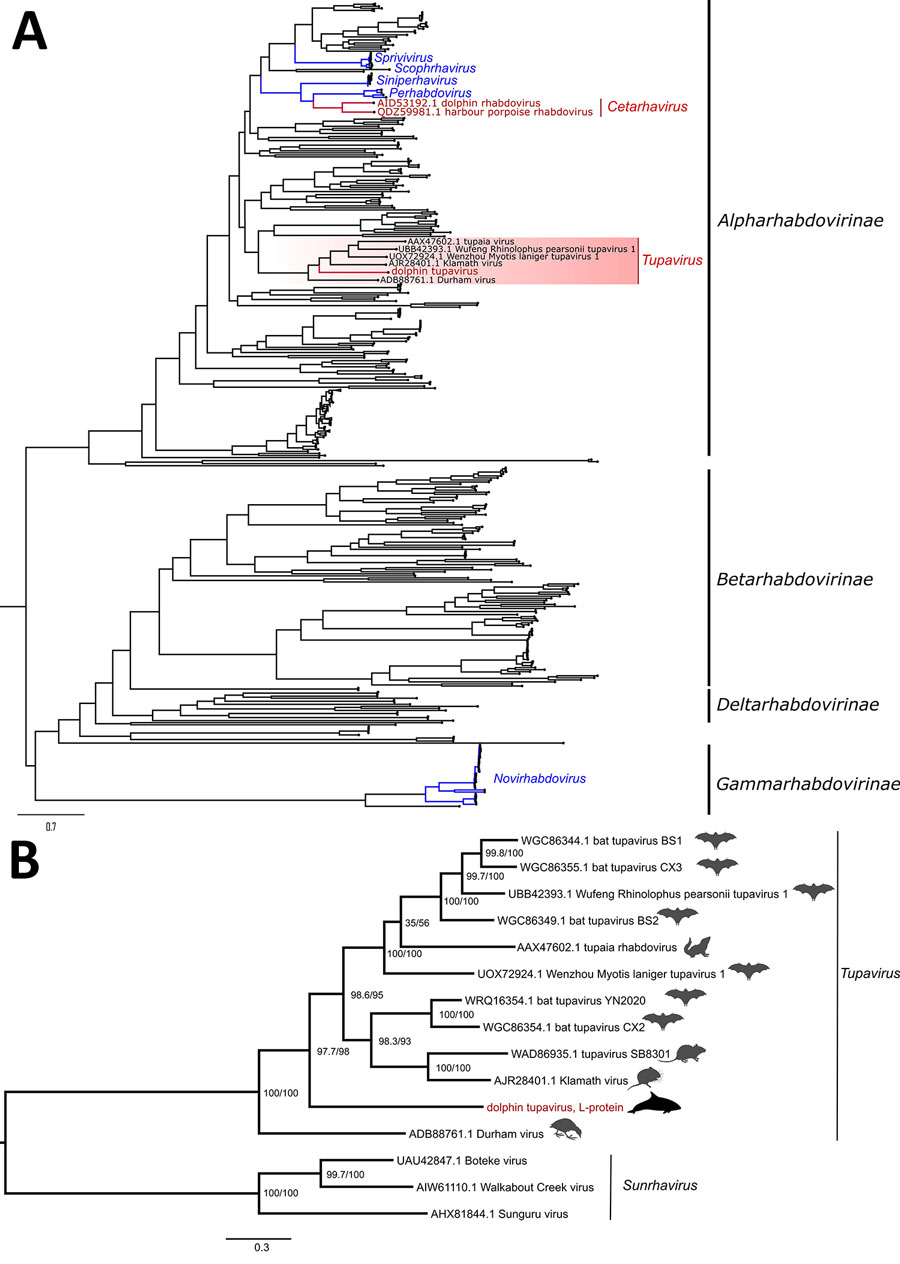
Maximum-likelihood phylogenetic trees of novel dolphin tupavirus from stranded Atlantic white-sided dolphin, Canada, and reference rhabdoviruses. Trees were reconstructed based on the full-length amino acid sequences of the polymerase protein. All sequence records for the phylogenetic analysis were downloaded from GenBank (Appendix 2 Table 2). Scale bars represent the estimated average number of substitutions per site. A) High-level phylogeny includes a subset of representative members across the Rhabdoviridae family (n = 438 sequence records) to determine the placement of the new virus within the family. Red text indicates rhabdoviruses of marine mammals, including the newly identified dolphin tupavirus; blue text indicates fish rhabdoviruses. The tree was rooted at the midpoint. B) Genus-level phylogeny provides a fine-level assessment of the phylogenetic affinities of the new virus within the Tupavirus genus. Red text indicates the sequence of the novel tupavirus; red shading highlights the Tupavirus clade in the phylogenetic tree. The phylogenetic bracket of the dolphin tupavirus includes a basal Durham virus and a large crown clade comprising the rest of the Tupavirus member viruses. Durham virus described from an American coot (Fulica americana) that demonstrated signs of severe disease associated with infection, including lesions isolated to the central nervous system and consisting of severe cerebral necrosis and mononuclear inflammation similar to DTV. Support values at the nodes were determined by SSH-aLRT/Ultrafast bootstrap. Tupavirus genus tree was rooted to the outgroup members of the Sunrhavirus genus, Boteke, Sunguru, and Walkabout Creek viruses.

Figure 2. Maximum-likelihood phylogenetic trees of novel dolphin tupavirus from stranded Atlantic white-sided dolphin, Canada, and reference rhabdoviruses. Trees were reconstructed based on the full-length amino acid sequences of the polymerase protein. All sequence records for the phylogenetic analysis were downloaded from GenBank (Appendix 2 Table 2). Scale bars represent the estimated average number of substitutions per site. A) High-level phylogeny includes a subset of representative members across the Rhabdoviridae family (n = 438 sequence records) to determine the placement of the new virus within the family. Red text indicates rhabdoviruses of marine mammals, including the newly identified dolphin tupavirus; blue text indicates fish rhabdoviruses. The tree was rooted at the midpoint. B) Genus-level phylogeny provides a fine-level assessment of the phylogenetic affinities of the new virus within the Tupavirus genus. Red text indicates the sequence of the novel tupavirus; red shading highlights the Tupavirus clade in the phylogenetic tree. The phylogenetic bracket of the dolphin tupavirus includes a basal Durham virus and a large crown clade comprising the rest of the Tupavirus member viruses. Durham virus described from an American coot (Fulica americana) that demonstrated signs of severe disease associated with infection, including lesions isolated to the central nervous system and consisting of severe cerebral necrosis and mononuclear inflammation similar to DTV. Support values at the nodes were determined by SSH-aLRT/Ultrafast bootstrap. Tupavirus genus tree was rooted to the outgroup members of the Sunrhavirus genus, Boteke, Sunguru, and Walkabout Creek viruses.

Main Article

1These authors contributed equally to this article.

Page created: September 30, 2025
Page updated: November 20, 2025
Page reviewed: November 20, 2025
The conclusions, findings, and opinions expressed by authors contributing to this journal do not necessarily reflect the official position of the U.S. Department of Health and Human Services, the Public Health Service, the Centers for Disease Control and Prevention, or the authors' affiliated institutions. Use of trade names is for identification only and does not imply endorsement by any of the groups named above.
file_external