Volume 31, Supplement—November 2025
SUPPLEMENT ISSUE
Supplement
Functional Limitations and Illness-Related Absenteeism among School-Aged Children with and without Long COVID, United States, 2022–2023
 , Regina M. Simeone, Caroline Pratt, and Sharon Saydah
Figure
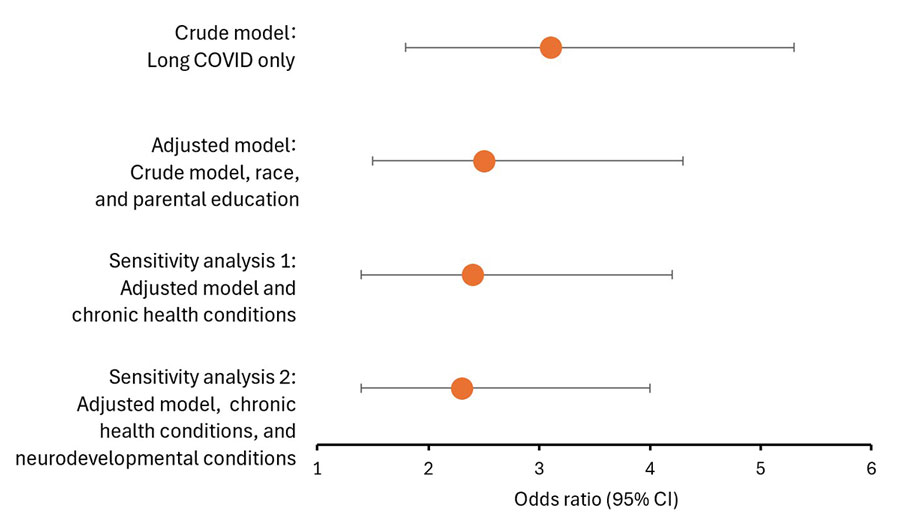
Figure. Adjusted odds ratios from a study of functional limitations and illness-related chronic absenteeism among school-aged children with and without long COVID, United States, 2022–2023. Graph shows adjusted odds ratios (dots) and 95% CIs (whiskers) for chronic absence from school for health reasons among children with prior COVID-19 illness comparing children who did and did not have long COVID. The study examined 4,587 school-aged children (5–17 years) who had COVID-19 illness identified through the National Health Interview Survey, 2022–2023 (5,6). Chronic absence from school for health reasons was defined as missing >18 days of school because of illness or injury (compared with 0–17 days) during the 12 months preceding the survey. The minimally adjusted model controls for race and Hispanic ethnicity and parental education. Chronic health conditions included asthma, prediabetes, and diabetes. Neurodevelopmental conditions include autism, attention-deficit hyperactivity disorder, intellectual disability, learning disability, and developmental delay.
References
- National Academies of Sciences, Engineering, and Medicine; Health and Medicine Division; Board on Health Care Services; Committee on the Long-Term Health Effects Stemming from COVID-19 and Implications for the Social Security Administration. Long-term health effects of COVID-19: disability and function following SARS-CoV-2 infection. Spicer CM, Chu BX, Volberding PA, editors. Washington: National Academies Press; 2024.
- National Academies of Sciences, Engineering, and Medicine; Health and Medicine Division; Board on Global Health; Board on Health Sciences Policy; Committee on Examining the Working Definition for Long COVID. A long COVID definition: a chronic, systemic disease state with profound consequences. Goldowitz I, Worku T, Brown L, Fineberg HV, editors. Washington: National Academies Press; 2024.
- Ford ND, Vahratian A, Pratt CQ, Yousaf AR, Gregory CO, Saydah S. Long COVID prevalence and associated activity limitation in US children. JAMA Pediatr. 2025;179:471–3.PubMedGoogle Scholar
- MacLean A, Wild C, Hunt K, Nettleton S, Skea ZC, Ziebland S. Impact of Long Covid on the school experiences of children and young people: a qualitative study. BMJ Open. 2023;13:
e075756 .PubMedGoogle Scholar - National Center for Health Statistics. National Health Interview Survey 2022 survey description. Hyattsville (MD): National Center for Health Statistics; 2023.
- National Center for Health Statistics. National Health Interview Survey 2023 survey description. Hyattsville (MD): National Center for Health Statistics; 2024.
- Washington Group on Disability Statistics. The Washington Group/UNICEF child functioning module (CFM)—ages 5–17 years [cited 2024 Aug 19]. https://nhis.ipums.org/nhis/resources/Washington_Group_Questionnaire__5_-_WG-UNICEF_Child_Functioning_Module__ages_5-17_.pdf
- Parker JD, Talih M, Malec DJ, Beresovsky V, Carroll M, Gonzalez JF Jr, et al. National Center for Health Statistics data presentation standards for proportions; vital statistics series 2, no. 175. Hyattsville (MD): National Center for Health Statistics: 2017.
- US Department of Education. Chronic absenteeism [cited 2025 June 2]. https://www.ed.gov/teaching-and-administration/supporting-students/chronic-absenteeism
- Vahratian A, Adjaye-Gbewonyo D, Lin JMS, Saydah S. Long COVID in children: United States, 2022; NCHS data brief no. 479. Hyattsville (MD): National Center for Health Statistics; 2023.
- Ingram D, Franco S. 2013 NCHS urban-rural classification scheme for counties; vital health statistics, series 2, no. 166. Hyattsville (MD): National Center for Health Statistics; 2014.
- Centers for Disease Control and Prevention. Isolation and precautions for people with COVID-19 [cited 2024 Nov 27]. https://archive.cdc.gov/www_cdc_gov/coronavirus/2019-ncov/your-health/isolation.html
- Popoli DM, Burns TG, Meehan WP III, Reisner A; Children’s Health of Atlants. CHOA concussion consensus: establishing a uniform policy for academic accommodations. Clin Pediatr (Phila). 2014;53:217–24.PubMedGoogle Scholar
- Wolraich ML, Hagan JF Jr, Allan C, Chan E, Davison D, Earls M, et al.; SUBCOMMITTEE ON CHILDREN AND ADOLESCENTS WITH ATTENTION-DEFICIT/HYPERACTIVE DISORDER. Clinical practice guideline for the diagnosis, evaluation, and treatment of attention-deficit/hyperactivity disorder in children and adolescents. Pediatrics. 2019;144:
e20192528 .PubMedGoogle Scholar - Rao S, Gross RS, Mohandas S, Stein CR, Case A, Dreyer B, et al. Postacute sequelae of SARS-CoV-2 in children. Pediatrics. 2024;153:
e2023062570 .PubMedGoogle Scholar - Lopez-Leon S, Wegman-Ostrosky T, Ayuzo Del Valle NC, Perelman C, Sepulveda R, Rebolledo PA, et al. Long-COVID in children and adolescents: a systematic review and meta-analyses. Sci Rep. 2022;12:9950.PubMedGoogle Scholar
- Delogu AB, Aliberti C, Birritella L, De Rosa G, De Rose C, Morello R, et al. Autonomic cardiac function in children and adolescents with long COVID: a case-controlled study. Eur J Pediatr. 2024;183:2375–82.PubMedGoogle Scholar
- Cocciolillo F, Di Giuda D, Morello R, De Rose C, Valentini P, Buonsenso D. Orbito-frontal cortex hypometabolism in children with post-COVID condition (long COVID): a preliminary experience. Pediatr Infect Dis J. 2022;41:663–5.PubMedGoogle Scholar
- Baldi F, De Rose C, Mariani F, Morello R, Raffaelli F, Valentini P, et al. Cardiopulmonary exercise testing in children with long COVID: a case-controlled study. Pediatr Infect Dis J. 2024;43:795–802.PubMedGoogle Scholar
- Johnson SB, Spin P, Connolly F, Stein M, Cheng TL, Connor K. Asthma and attendance in urban schools. Prev Chronic Dis. 2019;16:
E148 .PubMedGoogle Scholar - Glaab LA, Brown R, Daneman D. School attendance in children with Type 1 diabetes. Diabet Med. 2005;22:421–6.PubMedGoogle Scholar
- Badenoch JB, Rengasamy ER, Watson C, Jansen K, Chakraborty S, Sundaram RD, et al. Persistent neuropsychiatric symptoms after COVID-19: a systematic review and meta-analysis. Brain Commun. 2021;4:
fcab297 .PubMedGoogle Scholar - Becker JH, Lin JJ, Doernberg M, Stone K, Navis A, Festa JR, et al. Assessment of cognitive function in patients after COVID-19 infection. JAMA Netw Open. 2021;4:
e2130645 .PubMedGoogle Scholar - Leeb RT, Danielson ML, Claussen AH, Robinson LR, Lebrun-Harris LA, Ghandour R, et al. Trends in mental, behavioral, and developmental disorders among children and adolescents in the US, 2016–2021. Prev Chronic Dis. 2024;21:
E96 .PubMedGoogle Scholar - Substance Abuse and Mental Health Services Administration. Identification and management of mental health symptoms and conditions associated with long COVID. Publication no. PEP23-06-05-007. Rockville (MD): The Administration; 2023.
- Camporesi A, Morello R, La Rocca A, Zampino G, Vezzulli F, Munblit D, et al. Characteristics and predictors of Long Covid in children: a 3-year prospective cohort study. EClinicalMedicine. 2024;76:
102815 .PubMedGoogle Scholar - Heslin KP, Haruna A, George RA, Chen S, Nobel I, Anderson KB, et al. Association between ADHD and COVID-19 infection and clinical outcomes: a retrospective cohort study from electronic medical records. J Atten Disord. 2023;27:169–81.PubMedGoogle Scholar
- Centers for Disease Control and Prevention. People with certain medical conditions and COVID-19 risk factors [cited 2024 May 14]. https://www.cdc.gov/coronavirus/2019-ncov/need-extra-precautions/people-with-medical-conditions.html
- Hall JP, Kurth NK, McCorkell L, Goddard KS. Long COVID among people with preexisting disabilities. Am J Public Health. 2024;114:1261–4.PubMedGoogle Scholar
- Zheng YB, Zeng N, Yuan K, Tian SS, Yang YB, Gao N, et al. Prevalence and risk factor for long COVID in children and adolescents: A meta-analysis and systematic review. J Infect Public Health. 2023;16:660–72.PubMedGoogle Scholar
- Kompaniyets L, Bull-Otterson L, Boehmer TK, Baca S, Alvarez P, Hong K, et al. Post–COVID-19 symptoms and conditions among children and adolescents—United States, March 1, 2020–January 31, 2022. MMWR Morb Mortal Wkly Rep. 2022;71:993–9.PubMedGoogle Scholar
- Danielson ML, Bohm MK, Newsome K, Claussen AH, Kaminski JW, Grosse SD, et al. Trends in stimulant prescription fills among commercially insured children and adults—United States, 2016–2021. MMWR Morb Mortal Wkly Rep. 2023;72:327–32.PubMedGoogle Scholar
- Chua KP, Volerman A, Zhang J, Hua J, Conti RM. Antidepressant dispensing to US adolescents and young adults: 2016–2022. Pediatrics. 2024;153:
e2023064245 .PubMedGoogle Scholar - Koonce RM, Martin BC. The association between suspected long-COVID and stimulant prescribing in the United States. Psychiatry Res. 2024;331:
115686 .PubMedGoogle Scholar - Vernon SD, Zheng T, Do H, Marconi VC, Jason LA, Singer NG, et al.; NIH Researching COVID to Enhance Recovery (RECOVER) Consortium. Incidence and prevalence of post-COVID-19 myalgic encephalomyelitis: a report from the observational RECOVER-Adult study. J Gen Intern Med. 2025;40:1085–94.PubMedGoogle Scholar
- Grach SL, Seltzer J, Chon TY, Ganesh R. Diagnosis and management of myalgic encephalomyelitis/chronic fatigue syndrome. Mayo Clin Proc. 2023;98:1544–51.PubMedGoogle Scholar
- American Federation of Teachers. Chronic absenteeism 2016 [cited 2024 Nov 25]. https://www.aft.org/childrens-health-safety-and-well-being/childrens-access-care/chronic-absenteeism
- Dee TS. Higher chronic absenteeism threatens academic recovery from the COVID-19 pandemic. Proc Natl Acad Sci U S A. 2024;121:
e2312249121 .PubMedGoogle Scholar - Black LI, Elgaddal N. Chronic school absenteeism for health-related reasons among children ages 5‒17 years: United States, 2022. NCHS data brief, no. 498. Hyattsville (MD): National Center for Health Statistics; 2024.
- Wikel K, Markelz AM. Chronic health conditions, school attendance, and socioeconomic factors: a literature review. J Spec Educ Apprenticeship. 2023;12:9. DOIGoogle Scholar
- Attendance Works. Chronic absence: 3 tiers of intervention [cited 2025 Feb 19]. https://www.attendanceworks.org/chronic-absence/addressing-chronic-absence/3-tiers-of-intervention/
- Kearney CA, Dupont R, Fensken M, Gonzálvez C. School attendance problems and absenteeism as early warning signals: review and implications for health-based protocols and school-based practices. Front Educ (Lausanne). 2023;8:
1253595 . DOIGoogle Scholar - Malone LA, Morrow A, Chen Y, Curtis D, de Ferranti SD, Desai M, et al. Multi-disciplinary collaborative consensus guidance statement on the assessment and treatment of postacute sequelae of SARS-CoV-2 infection (PASC) in children and adolescents. PM R. 2022;14:1241–69.PubMedGoogle Scholar
- Howard J, Cloeren M, Vanichkachorn G. Long COVID and occupational medicine practice. J Occup Environ Med. 2024;66:1–5.
- Ziauddeen N, Gurdasani D, O’Hara ME, Hastie C, Roderick P, Yao G, et al. Characteristics and impact of Long Covid: Findings from an online survey. PLoS One. 2022;17:
e0264331 .PubMedGoogle Scholar - Appelman B, Charlton BT, Goulding RP, Kerkhoff TJ, Breedveld EA, Noort W, et al. Muscle abnormalities worsen after post-exertional malaise in long COVID. Nat Commun. 2024;15:17.PubMedGoogle Scholar
- Lipkin PH, Okamoto J; Council on Children with Disabilities; Council on School Health. The Individuals With Disabilities Education Act (IDEA) for Children With Special Educational Needs. Pediatrics. 2015;136:e1650–62.PubMedGoogle Scholar