Volume 32, Number 1—January 2026
Dispatch
Disseminated Nocardia ignorata Infection with Splenic and Brain Involvement in Patient with Large B-Cell Lymphoma
Sherif Elbaz, Mahmoud Ismail , Seth Glassman, Asmaa Badr, and Eric John Dove
, Seth Glassman, Asmaa Badr, and Eric John Dove
Figure 3
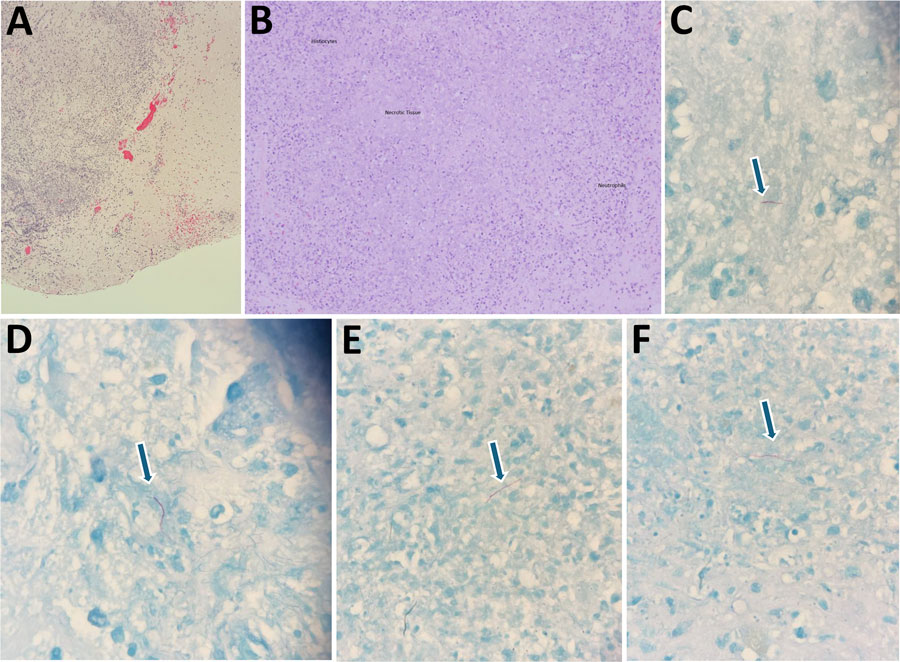
Figure 3. Brain tissue images from 79-year-old man with chronic obstructive pulmonary disease and large B-cell lymphoma who had disseminated Nocardia ignorata infection, United States. A, B) Parenchyma with identifiable granulation tissue, neutrophils, and histocytes and background hemorrhage and necrosis are seen. Hematoxylin and eosin stain; original magnification ×10. C–F) Thin, filamentous, partially acid-fast rods with a beaded appearance within the necrotic tissue background are visible. Branching within visualized organisms was not identified. Arrows indicate N. ignorata bacteria. Fite–Faraco stain; original magnification × 100.
Page created: December 31, 2025
Page updated: January 29, 2026
Page reviewed: January 29, 2026
The conclusions, findings, and opinions expressed by authors contributing to this journal do not necessarily reflect the official position of the U.S. Department of Health and Human Services, the Public Health Service, the Centers for Disease Control and Prevention, or the authors' affiliated institutions. Use of trade names is for identification only and does not imply endorsement by any of the groups named above.