Volume 32, Number 10—October 2026
Synopsis
Detection of Anaplasma capra in Patients with Suspected Crimean-Congo Hemorrhagic Fever, Turkey, 2022
Kursat Altay1, Nazif Elaldi1 , Ufuk Erol, Binnur Koksal, Omer Faruk Sahin, Ayse Nur Pektas, Seyit Ali Buyuktuna, Murtaza Oz, Yasemin Cakır Kıymaz, Tuba Nur Tasseten, Husnu Furkan Sakar, and Mehmet Bakir
, Ufuk Erol, Binnur Koksal, Omer Faruk Sahin, Ayse Nur Pektas, Seyit Ali Buyuktuna, Murtaza Oz, Yasemin Cakır Kıymaz, Tuba Nur Tasseten, Husnu Furkan Sakar, and Mehmet Bakir
Figure 3
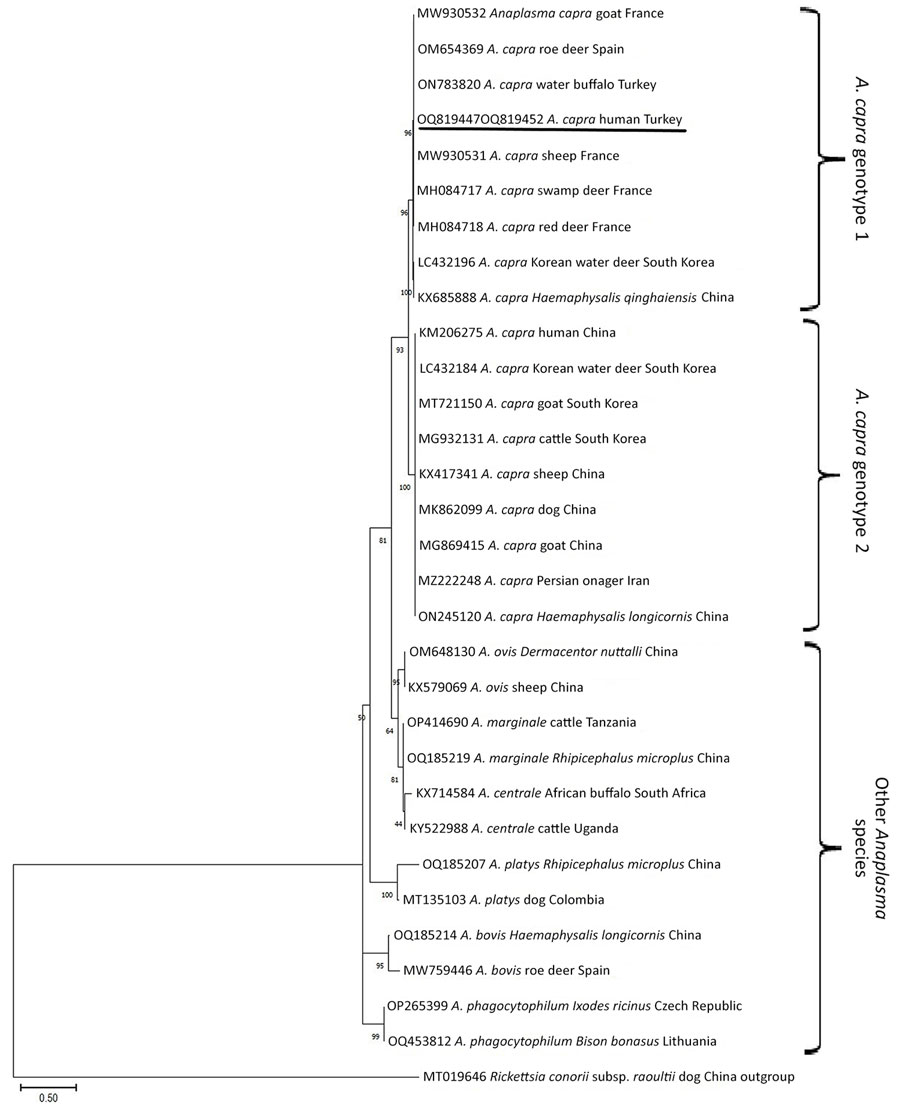
Figure 3. Phylogenetic tree of groEL gene sequences from Anaplasma capra genotype 1, genotype 2, and other Anaplasma species from patients with suspected or confirmed Crimean-Congo hemorrhagic fever, Turkey, 2022. We constructed the tree by using the maximum-likelihood method in MEGA 11 (25). Rickettsia conorii subspecies raoultii was used as the outgroup. Study sequences are underlined. GenBank accession numbers are provided. Scale bar represents nucleotide substitutions per site.
References
- Negi T, Kandari LS, Arunachalam K. Update on prevalence and distribution pattern of tick-borne diseases among humans in India: a review. Parasitol Res. 2021;120:1523–39. DOIPubMedGoogle Scholar
- Sonenshine DE. Range expansion of tick disease vectors in North America: implications for spread of tick-borne disease. Int J Environ Res Public Health. 2018;15:478. DOIPubMedGoogle Scholar
- de la Fuente J, Estrada-Pena A, Venzal JM, Kocan KM, Sonenshine DE. Overview: ticks as vectors of pathogens that cause disease in humans and animals. Front Biosci. 2008;13:6938–46. DOIPubMedGoogle Scholar
- Centers for Disease Control and Prevention. Lyme disease surveillance and data, 2025 [cited 2026 Mar 23]. https://www.cdc.gov/lyme/data-research/facts-stats/index.html
- Düzlü Ö, İnci A, Yıldırım A, Doğanay M, Özbel Y, Aksoy S. Vector-borne zoonotic diseases in Turkey: rising threats on public health. Turkiye Parazitol Derg. 2020;44:168–75. DOIPubMedGoogle Scholar
- Inci A, Yildirim A, Duzlu O, Doganay M, Aksoy S. Tick-borne diseases in Turkey: a review based on one health perspective. PLoS Negl Trop Dis. 2016;10:
e0005021 . DOIPubMedGoogle Scholar - Aydin L, Bakirci S. Geographical distribution of ticks in Turkey. Parasitol Res. 2007;101(Suppl 2):S163–6. DOIPubMedGoogle Scholar
- Sorvillo TE, Rodriguez SE, Hudson P, Carey M, Rodriguez LL, Spiropoulou CF, et al. Towards a sustainable One Health approach to Crimean-Congo hemorrhagic fever prevention: focus areas and gaps in knowledge. Trop Med Infect Dis. 2020;5:113. DOIPubMedGoogle Scholar
- Shahhosseini N, Wong G, Babuadze G, Camp JV, Ergonul O, Kobinger GP, et al. Crimean-Congo hemorrhagic fever virus in Asia, Africa and Europe. Microorganisms. 2021;9:1907. DOIPubMedGoogle Scholar
- Bente DA, Forrester NL, Watts DM, McAuley AJ, Whitehouse CA, Bray M. Crimean-Congo hemorrhagic fever: history, epidemiology, pathogenesis, clinical syndrome and genetic diversity. Antiviral Res. 2013;100:159–89. DOIPubMedGoogle Scholar
- Gunes T, Engin A, Poyraz O, Elaldi N, Kaya S, Dokmetas I, et al. Crimean-Congo hemorrhagic fever virus in high-risk population, Turkey. Emerg Infect Dis. 2009;15:461–4. DOIPubMedGoogle Scholar
- Hawman DW, Feldmann H. Crimean-Congo haemorrhagic fever virus. Nat Rev Microbiol. 2023;21:463–77. DOIPubMedGoogle Scholar
- Yilmaz GR, Buzgan T, Irmak H, Safran A, Uzun R, Cevik MA, et al. The epidemiology of Crimean-Congo hemorrhagic fever in Turkey, 2002–2007. Int J Infect Dis. 2009;13:380–6. DOIPubMedGoogle Scholar
- Dumler JS, Barbet AF, Bekker CP, Dasch GA, Palmer GH, Ray SC, et al. Reorganization of genera in the families Rickettsiaceae and Anaplasmataceae in the order Rickettsiales: unification of some species of Ehrlichia with Anaplasma, Cowdria with Ehrlichia and Ehrlichia with Neorickettsia, descriptions of six new species combinations and designation of Ehrlichia equi and ‘HGE agent’ as subjective synonyms of Ehrlichia phagocytophila. Int J Syst Evol Microbiol. 2001;51:2145–65. DOIPubMedGoogle Scholar
- Altay K, Erol U, Sahin OF. The first molecular detection of Anaplasma capra in domestic ruminants in the central part of Turkey, with genetic diversity and genotyping of Anaplasma capra. Trop Anim Health Prod. 2022;54:129. DOIPubMedGoogle Scholar
- Altay K, Erol U, Sahin OF, Aytmirzakizi A. First molecular detection of Anaplasma species in cattle from Kyrgyzstan; molecular identification of human pathogenic novel genotype Anaplasma capra and Anaplasma phagocytophilum related strain. Ticks Tick Borne Dis. 2022;13:
101861 . DOIPubMedGoogle Scholar - Altay K, Erol U, Sahin OF, Aytmirzakizi A, Temizel EM, Aydin MF, et al. The detection and phylogenetic analysis of Anaplasma phagocytophilum-like 1, A. ovis and A. capra in sheep: A. capra divides into two genogroups. Vet Res Commun. 2022;46:1271–9. DOIPubMedGoogle Scholar
- Sahin OF, Erol U, Altay K. Buffaloes as new hosts for Anaplasma capra: Molecular prevalence and phylogeny based on gtlA, groEL, and 16S rRNA genes. Res Vet Sci. 2022;152:458–64. DOIPubMedGoogle Scholar
- Liu Z, Ma M, Wang Z, Wang J, Peng Y, Li Y, et al. Molecular survey and genetic identification of Anaplasma species in goats from central and southern China. Appl Environ Microbiol. 2012;78:464–70. DOIPubMedGoogle Scholar
- Li H, Zheng YC, Ma L, Jia N, Jiang BG, Jiang RR, et al. Human infection with a novel tick-borne Anaplasma species in China: a surveillance study. Lancet Infect Dis. 2015;15:663–70. DOIPubMedGoogle Scholar
- Fırtına Topcu K, Sümer Z. Investigation of the Crimean-Congo hemorrhagic fever virus and the seropositivity of Coxiella burnetii, Borrelia burgdorferi in patients with a history of tick bites. Turk Mikrobiyol Cemiy Derg. 2022;52:265–73. DOIGoogle Scholar
- Leblebicioglu H, Bodur H, Dokuzoguz B, Elaldi N, Guner R, Koksal I, et al. Case management and supportive treatment for patients with Crimean-Congo hemorrhagic fever. Vector Borne Zoonotic Dis. 2012;12:805–11. DOIPubMedGoogle Scholar
- Öz M, Çubuk F, Çakır Kıymaz Y, Öksüz C, Hasbek M, Büyüktuna SA, et al. Hidden threats: brucellosis diagnosis and co-infection patterns in Crimean-Congo hemorrhagic fever suspects. Diagn Microbiol Infect Dis. 2025;111:
116724 . DOIPubMedGoogle Scholar - Yang J, Liu Z, Niu Q, Liu J, Han R, Liu G, et al. Molecular survey and characterization of a novel Anaplasma species closely related to Anaplasma capra in ticks, northwestern China. Parasit Vectors. 2016;9:603. DOIPubMedGoogle Scholar
- Tamura K, Stecher G, Kumar S. MEGA11: molecular evolutionary genetics analysis version 11. Mol Biol Evol. 2021;38:3022–7. DOIPubMedGoogle Scholar
- Kimura M. A simple method for estimating evolutionary rates of base substitutions through comparative studies of nucleotide sequences. J Mol Evol. 1980;16:111–20. DOIPubMedGoogle Scholar
- Tamura K, Nei M. Estimation of the number of nucleotide substitutions in the control region of mitochondrial DNA in humans and chimpanzees. Mol Biol Evol. 1993;10:512–26.PubMedGoogle Scholar
- Yang J, Liu Z, Niu Q, Liu J, Han R, Guan G, et al. A novel zoonotic Anaplasma species is prevalent in small ruminants: potential public health implications. Parasit Vectors. 2017;10:264. DOIPubMedGoogle Scholar
- Guo WP, Huang B, Zhao Q, Xu G, Liu B, Wang YH, et al. Human-pathogenic Anaplasma spp., and Rickettsia spp. in animals in Xi’an, China. PLoS Negl Trop Dis. 2018;12:
e0006916 . DOIPubMedGoogle Scholar - Shi K, Li J, Yan Y, Chen Q, Wang K, Zhou Y, et al. Dogs as new hosts for the emerging zoonotic pathogen Anaplasma capra in China. Front Cell Infect Microbiol. 2019;9:394. DOIPubMedGoogle Scholar
- Wang Y, Zhang Q, Han S, Li Y, Wang B, Yuan G, et al. Ehrlichia chaffeensis and four Anaplasma species with veterinary and public health significance identified in Tibetan sheep (Ovis aries) and yaks (Bos grunniens) in Qinghai, China. Front Vet Sci. 2021;8:
727166 . DOIPubMedGoogle Scholar - Zhang H, Sun Y, Jiang H, Huo X. Prevalence of severe febrile and thrombocytopenic syndrome virus, Anaplasma spp. and Babesia microti in hard ticks (Acari: Ixodidae) from Jiaodong Peninsula, Shandong Province. Vector Borne Zoonotic Dis. 2017;17:134–40. DOIPubMedGoogle Scholar
- Guo WP, Zhang B, Wang YH, Xu G, Wang X, Ni X, et al. Molecular identification and characterization of Anaplasma capra and Anaplasma platys-like in Rhipicephalus microplus in Ankang, Northwest China. BMC Infect Dis. 2019;19:434. DOIPubMedGoogle Scholar
- Han R, Yang JF, Mukhtar MU, Chen Z, Niu QL, Lin YQ, et al. Molecular detection of Anaplasma infections in ixodid ticks from the Qinghai-Tibet Plateau. Infect Dis Poverty. 2019;8:12. DOIPubMedGoogle Scholar
- Koh FX, Panchadcharam C, Sitam FT, Tay ST. Molecular investigation of Anaplasma spp. in domestic and wildlife animals in Peninsular Malaysia. Vet Parasitol Reg Stud Reports. 2018;13:141–7. DOIPubMedGoogle Scholar
- Grandi G, Aspán A, Pihl J, Gustafsson K, Engström F, Jinnerot T, et al. Detection of tick-borne pathogens in lambs undergoing prophylactic treatment against ticks on two Swedish farms. Front Vet Sci. 2018;5:72. DOIPubMedGoogle Scholar
- Barradas PF, Mesquita JR, Ferreira P, Gärtner F, Carvalho M, Inácio E, et al. Molecular identification and characterization of Rickettsia spp. and other tick-borne pathogens in cattle and their ticks from Huambo, Angola. Ticks Tick Borne Dis. 2021;12:
101583 . DOIPubMedGoogle Scholar - Peng Y, Lu C, Yan Y, Song J, Pei Z, Gong P, et al. The novel zoonotic pathogen, Anaplasma capra, infects human erythrocytes, HL-60, and TF-1 cells in vitro. Pathogens. 2021;10:600. DOIPubMedGoogle Scholar
- MacQueen D, Centellas F. Human granulocytic anaplasmosis. Infect Dis Clin North Am. 2022;36:639–54. DOIPubMedGoogle Scholar
- Ma R, Li C, Gao A, Jiang N, Feng X, Li J, et al. Evidence-practice gap analysis in the role of tick in brucellosis transmission: a scoping review. Infect Dis Poverty. 2024;13:3. DOIPubMedGoogle Scholar
1These first authors contributed equally to this article.
Page created: August 05, 2026
Page updated: September 28, 2026
Page reviewed: September 28, 2026
The conclusions, findings, and opinions expressed by authors contributing to this journal do not necessarily reflect the official position of the U.S. Department of Health and Human Services, the Public Health Service, the Centers for Disease Control and Prevention, or the authors' affiliated institutions. Use of trade names is for identification only and does not imply endorsement by any of the groups named above.