Volume 32, Number 10—October 2026
Research
Multiple Introductions and Cross-Sector Transmission of Salmonella enterica Serovar Infantis Carrying blaCTX-M-65 Gene, South Korea, 2022–2024

Figure 2
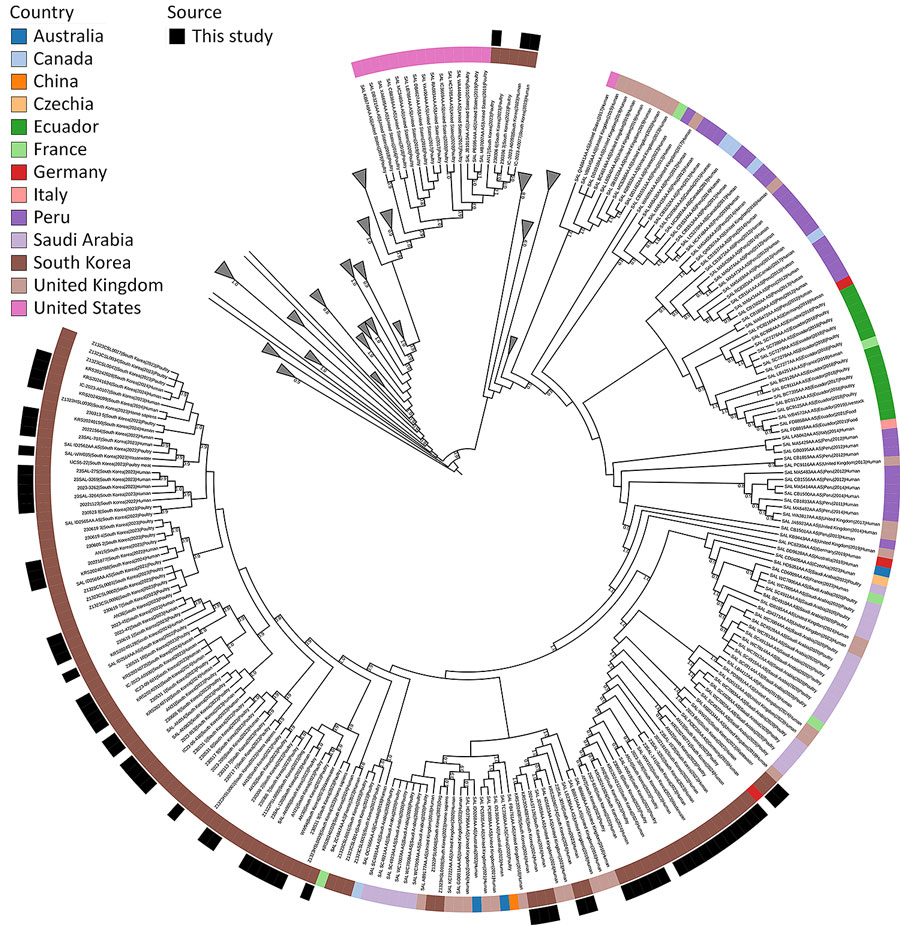
Figure 2. Global phylogenetic placement of isolates from study of multiple introductions and cross-sector transmission of Salmonella enterica serovar Infantis carrying blaCTX-M-65 gene, South Korea, 2022–2024. The cladogram was inferred from the global whole-genome single-nucleotide polymorphism dataset, and branches without South Korea isolates were collapsed for clarity. The inner ring denotes country of origin, and the outer ring denotes isolates sequenced in this study. Numbers at nodes indicate FastTree (23) support values >0.9.
References
- European Food Safety Authority (EFSA); European Centre for Disease Prevention and Control (ECDC). The European Union One Health 2022 zoonoses report. EFSA J. 2023;21:
e8442 . DOIPubMedGoogle Scholar - Hendriksen RS, Vieira AR, Karlsmose S, Lo Fo Wong DM, Jensen AB, Wegener HC, et al. Global monitoring of Salmonella serovar distribution from the World Health Organization Global Foodborne Infections Network Country Data Bank: results of quality assured laboratories from 2001 to 2007. Foodborne Pathog Dis. 2011;8:887–900. DOIPubMedGoogle Scholar
- Georganas A, Graziosi G, Catelli E, Lupini C. Salmonella enterica serovar Infantis in broiler chickens: a systematic review and meta-analysis. Animals (Basel). 2024;14:3453. DOIPubMedGoogle Scholar
- Mattock J, Chattaway MA, Hartman H, Dallman TJ, Smith AM, Keddy K, et al. A One Health perspective on Salmonella enterica serovar Infantis, an emerging human multidrug-resistant pathogen. Emerg Infect Dis. 2024;30:701–10. DOIPubMedGoogle Scholar
- Aviv G, Tsyba K, Steck N, Salmon-Divon M, Cornelius A, Rahav G, et al. A unique megaplasmid contributes to stress tolerance and pathogenicity of an emergent Salmonella enterica serovar Infantis strain. Environ Microbiol. 2014;16:977–94. DOIPubMedGoogle Scholar
- Granda A, Riveros M, Martínez-Puchol S, Ocampo K, Laureano-Adame L, Corujo A, et al. Presence of extended-spectrum β-lactamase, CTX-M-65 in Salmonella enterica serovar Infantis isolated from children with diarrhea in Lima, Peru. J Pediatr Infect Dis. 2019;14:194–200. DOIGoogle Scholar
- Tate H, Folster JP, Hsu CH, Chen J, Hoffmann M, Li C, et al. Comparative analysis of extended-spectrum-β-lactamase CTX-M-65–producing Salmonella enterica serovar Infantis isolates from humans, food animals, and retail chickens in the United States. Antimicrob Agents Chemother. 2017;61:e00488–17. DOIPubMedGoogle Scholar
- Piña-Iturbe A, Díaz-Gavidia C, Álvarez FP, Barron-Montenegro R, Álvarez-Espejo DM, García P, et al. Genomic characterisation of the population structure and antibiotic resistance of Salmonella enterica serovar Infantis in Chile, 2009–2022. Lancet Reg Health Am. 2024;32:
100711 . DOIPubMedGoogle Scholar - Jeong HJ, Shin E, Kim J, Yoo J. Trends in the serotype distribution of Salmonella enterica isolated from patients with diarrhea in the Republic of Korea from 2022 to 2024 [in Korean]. Jugan Geongang Gwa Jilbyeong. 2025;18:1790–812. DOIPubMedGoogle Scholar
- Jeong J, Chae M, Kang MS, Lee JY, Kwon YK, Lee HJ, et al. Emergence and characteristics of multidrug-resistant Salmonella enterica subspecies enterica serovar Infantis harboring the pESI plasmid in chicken slaughterhouses in South Korea. Microbiol Spectr. 2025;13:
e0295524 . DOIPubMedGoogle Scholar - Kim Y, Cho H, Lee M, Jung SH, Chung YJ, Ko KS, et al. Molecular epidemiology of pESI-carrying Salmonella Infantis in Korea: insights from a one health framework. Emerg Microbes Infect. 2025;14:
2565389 . DOIPubMedGoogle Scholar - Clinical and Laboratory Standards Institute. Performance standards for antimicrobial susceptibility testing; twenty-ninth informational supplement (M100-S29). Wayne (PA): The Institute; 2019.
- Bolger AM, Lohse M, Usadel B. Trimmomatic: a flexible trimmer for Illumina sequence data. Bioinformatics. 2014;30:2114–20. DOIPubMedGoogle Scholar
- Bankevich A, Nurk S, Antipov D, Gurevich AA, Dvorkin M, Kulikov AS, et al. SPAdes: a new genome assembly algorithm and its applications to single-cell sequencing. J Comput Biol. 2012;19:455–77. DOIPubMedGoogle Scholar
- Zankari E, Hasman H, Cosentino S, Vestergaard M, Rasmussen S, Lund O, et al. Identification of acquired antimicrobial resistance genes. J Antimicrob Chemother. 2012;67:2640–4. DOIPubMedGoogle Scholar
- Wick RR, Howden BP, Stinear TP. Autocycler: long-read consensus assembly for bacterial genomes. Bioinformatics. 2025;41:
btaf474 . DOIPubMedGoogle Scholar - Wick RR, Judd LM, Gorrie CL, Holt KE. Unicycler: Resolving bacterial genome assemblies from short and long sequencing reads. PLOS Comput Biol. 2017;13:
e1005595 . DOIPubMedGoogle Scholar - La TM, Kim T, Lee SW, Hyeon JY. Complete genome sequences and structural variants of pESI-like plasmids in multidrug-resistant Salmonella Infantis carrying blaCTX-M-65 from retail chicken meat in South Korea. J Glob Antimicrob Resist. 2026;47:38–40. DOIPubMedGoogle Scholar
- Wishart DS, Han S, Saha S, Oler E, Peters H, Grant JR, et al. PHASTEST: faster than PHASTER, better than PHAST. Nucleic Acids Res. 2023;51:
W443–50 . DOIPubMedGoogle Scholar - Marçais G, Delcher AL, Phillippy AM, Coston R, Salzberg SL, Zimin A. MUMmer4: A fast and versatile genome alignment system. PLOS Comput Biol. 2018;14:
e1005944 . DOIPubMedGoogle Scholar - Croucher NJ, Page AJ, Connor TR, Delaney AJ, Keane JA, Bentley SD, et al. Rapid phylogenetic analysis of large samples of recombinant bacterial whole genome sequences using Gubbins. Nucleic Acids Res. 2015;43:
e15 . DOIPubMedGoogle Scholar - Nguyen LT, Schmidt HA, von Haeseler A, Minh BQ. IQ-TREE: a fast and effective stochastic algorithm for estimating maximum-likelihood phylogenies. Mol Biol Evol. 2015;32:268–74. DOIPubMedGoogle Scholar
- Price MN, Dehal PS, Arkin AP. FastTree 2—approximately maximum-likelihood trees for large alignments. PLoS One. 2010;5:
e9490 . DOIPubMedGoogle Scholar - Rambaut A, Lam TT, Max Carvalho L, Pybus OG. Exploring the temporal structure of heterochronous sequences using TempEst (formerly Path-O-Gen). Virus Evol. 2016;2:
vew007 . DOIPubMedGoogle Scholar - Suchard MA, Lemey P, Baele G, Ayres DL, Drummond AJ, Rambaut A. Bayesian phylogenetic and phylodynamic data integration using BEAST 1.10. Virus Evol. 2018;4:
vey016 . DOIPubMedGoogle Scholar - Darriba D, Posada D, Kozlov AM, Stamatakis A, Morel B, Flouri T. ModelTest-NG: a new and scalable tool for the selection of DNA and protein evolutionary models. Mol Biol Evol. 2020;37:291–4. DOIPubMedGoogle Scholar
- Xie W, Lewis PO, Fan Y, Kuo L, Chen MH. Improving marginal likelihood estimation for Bayesian phylogenetic model selection. Syst Biol. 2011;60:150–60. DOIPubMedGoogle Scholar
- Bielejec F, Baele G, Vrancken B, Suchard MA, Rambaut A, Lemey P. SpreaD3: interactive visualization of spatiotemporal history and trait evolutionary processes. Mol Biol Evol. 2016;33:2167–9. DOIPubMedGoogle Scholar
- Minin VN, Suchard MA. Fast, accurate and simulation-free stochastic mapping. Philos Trans R Soc Lond B Biol Sci. 2008;363:3985–95. DOIPubMedGoogle Scholar
- García-Soto S, Abdel-Glil MY, Tomaso H, Linde J, Methner U. Emergence of multidrug-resistant Salmonella enterica subspecies enterica serovar Infantis of multilocus sequence type 2283 in German broiler farms. Front Microbiol. 2020;11:1741. DOIPubMedGoogle Scholar
- Kim SH, Sung GH, Park EH, Hwang IY, Kim GR, Song SA, et al. Serotype distribution and antimicrobial resistance of Salmonella isolates in Korea between 2016 and 2017. Ann Lab Med. 2022;42:268–73. DOIPubMedGoogle Scholar
- Jin YH, Yu YA, Song MO, Kwon EY, Kim JK, Suh HS, et al. Serotype distribution and antimicrobial resistance of Salmonella isolates in Seoul, 2020–2022. J Bacteriol Virol. 2023;53:131–40. DOIGoogle Scholar
- Alvarez DM, Barrón-Montenegro R, Conejeros J, Rivera D, Undurraga EA, Moreno-Switt AI. A review of the global emergence of multidrug-resistant Salmonella enterica subsp. enterica serovar Infantis. Int J Food Microbiol. 2023;403:
110297 . DOIPubMedGoogle Scholar - Su B, Du G, Hou S, Chen Z, Wu X, He G, et al. Antimicrobial resistance analysis and whole-genome sequencing of Salmonella isolates from environmental sewage—Guangzhou City, Guangdong Province, China, 2022–2023. China CDC Wkly. 2024;6:254–60. DOIPubMedGoogle Scholar
- Piña-Iturbe A, Tichy-Navarro D, Miranda-Riveros J, Navarrete MJ, Moreno-Switt AI. Emergent Salmonella enterica serovar Infantis forms a monophyletic lineage shaped by geographic structuring. Int J Food Microbiol. 2026;446:
111536 . DOIPubMedGoogle Scholar - Liao YS, Wei HL, Kuo HC, Chen BH, Wang YW, Teng RH, et al. Chromosome-borne CTX-M-65 extended-spectrum β-Lactamase–producing Salmonella enterica serovar Infantis, Taiwan. Emerg Infect Dis. 2023;29:1634–7. DOIPubMedGoogle Scholar
- Monte DFM, Harrell E, Harden L, Thakur S. Clonal spread of blaCTX-M-65 producing Salmonella enterica serovars detected in poultry retail meat in North Carolina, USA. Sci Rep. 2025;15:26520. DOIPubMedGoogle Scholar
- Li S, He Y, Mann DA, Deng X. Global spread of Salmonella Enteritidis via centralized sourcing and international trade of poultry breeding stocks. Nat Commun. 2021;12:5109. DOIPubMedGoogle Scholar
- Shin E, La TM, Yoo J, Kim J, Hyeon JY. Emergence of distinct Salmonella enterica serovar Enteritidis lineage since 2020, South Korea. Emerg Infect Dis. 2025;31:1386–93. DOIPubMedGoogle Scholar
- Food and Agriculture Organization of the United Nations. FAOSTAT [cited 2025 May 5]. https://www.fao.org/faostat
1These first authors contributed equally to this article.
2These authors contributed equally to this article.
Page created: August 20, 2026
Page updated: September 28, 2026
Page reviewed: September 28, 2026
The conclusions, findings, and opinions expressed by authors contributing to this journal do not necessarily reflect the official position of the U.S. Department of Health and Human Services, the Public Health Service, the Centers for Disease Control and Prevention, or the authors' affiliated institutions. Use of trade names is for identification only and does not imply endorsement by any of the groups named above.