Skip directly to site content Skip directly to page options Skip directly to A-Z link Skip directly to A-Z link Skip directly to A-Z link

Disclaimer: Early release articles are not considered as final versions. Any changes will be reflected in the online version in the month the article is officially released.

Volume 32, Number 10—October 2026

Research

Multiple Introductions and Cross-Sector Transmission of Salmonella enterica Serovar Infantis Carrying blaCTX-M-65 Gene, South Korea, 2022–2024

Eunkyung Shin1, Tae-Min La1, Jaeil Yoo, Sungsuck Oh, Juhee Kim, Junyoung Kim2, and Ji-Yeon Hyeon2Comments to Author 
Author affiliation: Division of Bacterial Diseases, Korea Diseases Control and Prevention Agency, Cheongju, South Korea (E. Shin, J. Yoo, Junyoung Kim); College of Veterinary Medicine, Konkuk University, Seoul, South Korea (T.-M. La, J.-Y. Hyeon); Division of Emerging Infectious Diseases, Incheon Metropolitan City Institute of Public Health and Environment, Incheon, South Korea (S. Oh, Juhee Kim)

Main Article

Figure 3

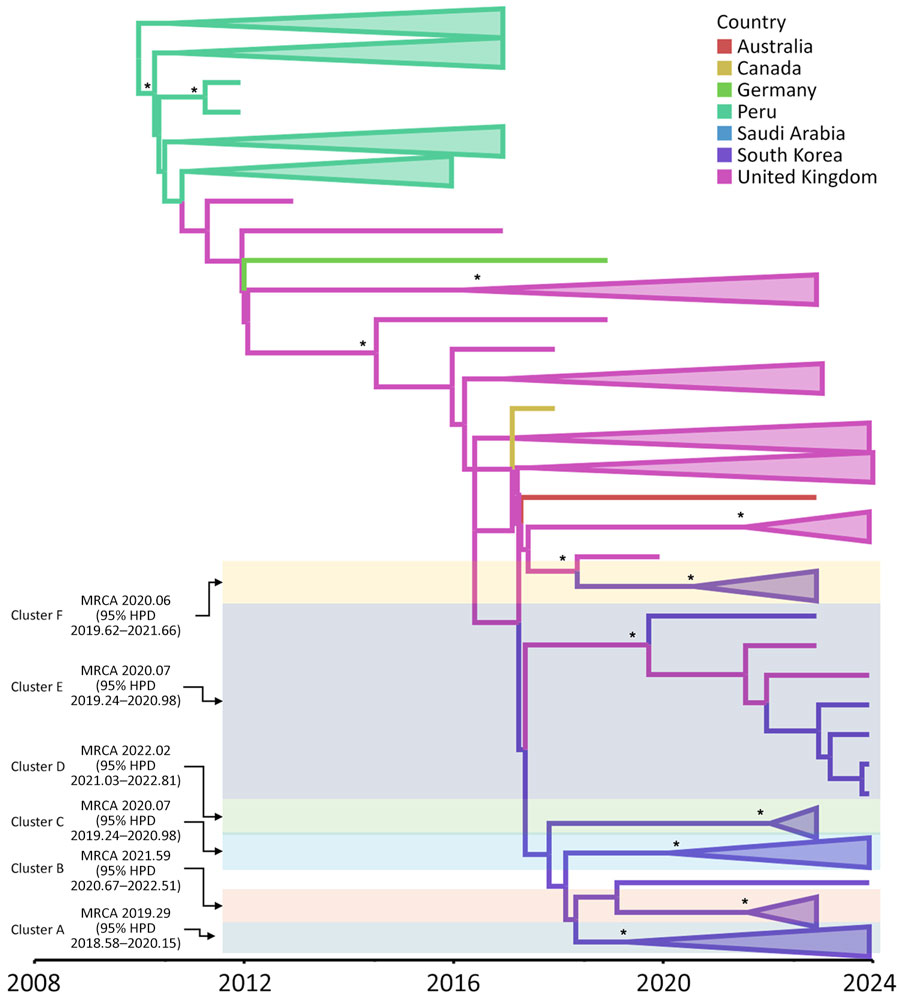
Bayesian phylogenetic tree from study of multiple introductions and cross-sector transmission of Salmonella enterica serovar Infantis carrying blaCTX-M-65 gene, South Korea, 2022–2024. The geographic origin was treated as a discrete trait in the analysis. Branches are colored according to geographic origin. Branches without South Korea isolates were collapsed for clarity. South Korea clusters supported by a posterior probability of 1 were also collapsed to improve readability. Asterisks indicate clusters with posterior probability of 1. South Korea clusters are highlighted in color, with the inferred median MRCA age for South Korea isolates along with the 95% HPD interval. The full phylogeny is available in Appendix Figure 2. HPD, highest posterior density; MRCA, most recent common ancestor.

Figure 3. Bayesian phylogenetic tree from study of multiple introductions and cross-sector transmission of Salmonella enterica serovar Infantis carrying blaCTX-M-65 gene, South Korea, 2022–2024. The geographic origin was treated as a discrete trait in the analysis. Branches are colored according to geographic origin. Branches without South Korea isolates were collapsed for clarity. South Korea clusters supported by a posterior probability of 1 were also collapsed to improve readability. Asterisks indicate clusters with posterior probability of 1. South Korea clusters are highlighted in color, with the inferred median MRCA age for South Korea isolates along with the 95% HPD interval. The full phylogeny is available in Appendix Figure 2. HPD, highest posterior density; MRCA, most recent common ancestor.

Main Article

1These first authors contributed equally to this article.

2These authors contributed equally to this article.

Page created: August 20, 2026
Page updated: September 16, 2026
Page reviewed: September 16, 2026
The conclusions, findings, and opinions expressed by authors contributing to this journal do not necessarily reflect the official position of the U.S. Department of Health and Human Services, the Public Health Service, the Centers for Disease Control and Prevention, or the authors' affiliated institutions. Use of trade names is for identification only and does not imply endorsement by any of the groups named above.
file_external