Skip directly to site content Skip directly to page options Skip directly to A-Z link Skip directly to A-Z link Skip directly to A-Z link

Disclaimer: Early release articles are not considered as final versions. Any changes will be reflected in the online version in the month the article is officially released.

Volume 32, Number 10—October 2026

Perspective

Reassortment of Highly Pathogenic Avian Influenza as a Driver for Zoonotic Spillover, Asia

Alexander M.P. Byrne1, Lorcan Carnegie1, Nicola S. Lewis, Ian G. Barr, Erik A. Karlsson, and Michelle WilleComments to Author 
Author affiliation: Worldwide Influenza Centre, The Francis Crick Institute, London, UK (A.M.P. Byrne, N.S. Lewis); Food and Agriculture Organization of the United Nations, Rome, Italy (L. Carnegie); World Health Organization Collaborating Centre for Reference and Research on Influenza, Peter Doherty Institute for Infection and Immunity, University of Melbourne, Melbourne, Victoria, Australia (I.G. Barr, M. Wille); Institut Pasteur du Cambodge, Phnom Penh, Cambodia (E.A. Karlsson); Environment and Infectious Risks Unit, Laboratory for Urgent Response to Biological Threats, Institut Pasteur, Paris, France (E.A. Karlsson)

Main Article

Figure 1

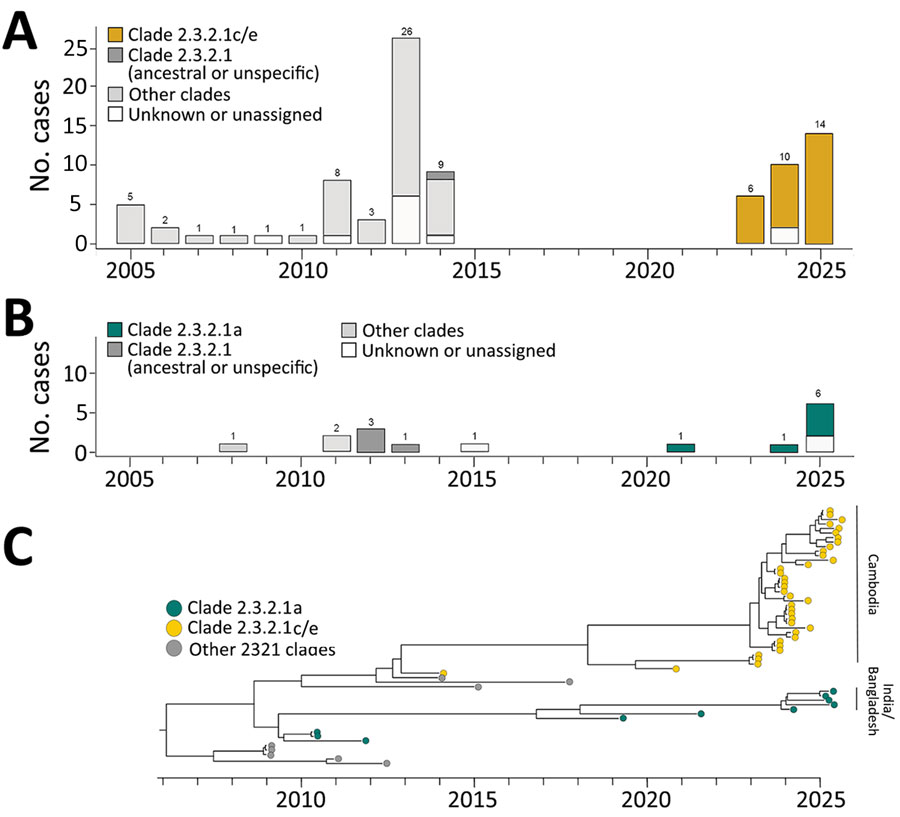
Emergence and human case trends of highly pathogenic avian influenza (HPAI) H5N1 clade 2.3.2.1 viruses in study of reassortment of HPAI as a driver for zoonotic spillover, Asia. A, B) Case notification data of HPAI H5N1 in Cambodia (A) and India and Bangladesh (B), demonstrating the clear resurgence of zoonotic spillover occurring in 2023, driven by reassortant clade 2.3.2.1c/e and 2.3.2.1a viruses. C) Time-scaled phylogeny of the H5 hemagglutinin gene for clade 2.3.2.1 viruses, highlighting the divergence of clade 2.3.2.1a and clade 2.3.2.1c/e.

Figure 1. Emergence and human case trends of highly pathogenic avian influenza (HPAI) H5N1 clade 2.3.2.1 viruses in study of reassortment of HPAI as a driver for zoonotic spillover, Asia. A, B) Case notification data of HPAI H5N1 in Cambodia (A) and India and Bangladesh (B), demonstrating the clear resurgence of zoonotic spillover occurring in 2023, driven by reassortant clade 2.3.2.1c/e and 2.3.2.1a viruses. C) Time-scaled phylogeny of the H5 hemagglutinin gene for clade 2.3.2.1 viruses, highlighting the divergence of clade 2.3.2.1a and clade 2.3.2.1c/e.

Main Article

1These first authors contributed equally to this article.

Page created: August 13, 2026
Page updated: September 16, 2026
Page reviewed: September 16, 2026
The conclusions, findings, and opinions expressed by authors contributing to this journal do not necessarily reflect the official position of the U.S. Department of Health and Human Services, the Public Health Service, the Centers for Disease Control and Prevention, or the authors' affiliated institutions. Use of trade names is for identification only and does not imply endorsement by any of the groups named above.
file_external