Volume 32, Number 10—October 2026
Research Letter
Haemophilus ducreyi Bacteria Causing Cutaneous Ulcer Outbreak in Children, Sierra Leone, December 2025
Jianxu Zhang1, Peng Lv1, Teng Zhao, Hanji Jiang, James S. Squire, Martin S. Yonnie, Zikan Koroma, Ibrahim F. Kamara, Abdulai A. Jalloh, Guangqian Pei, Yunfei Wang, Hongling Liu, Mohamed B. Jalloh , and Zhiqiang Mi
, and Zhiqiang Mi
Figure 2
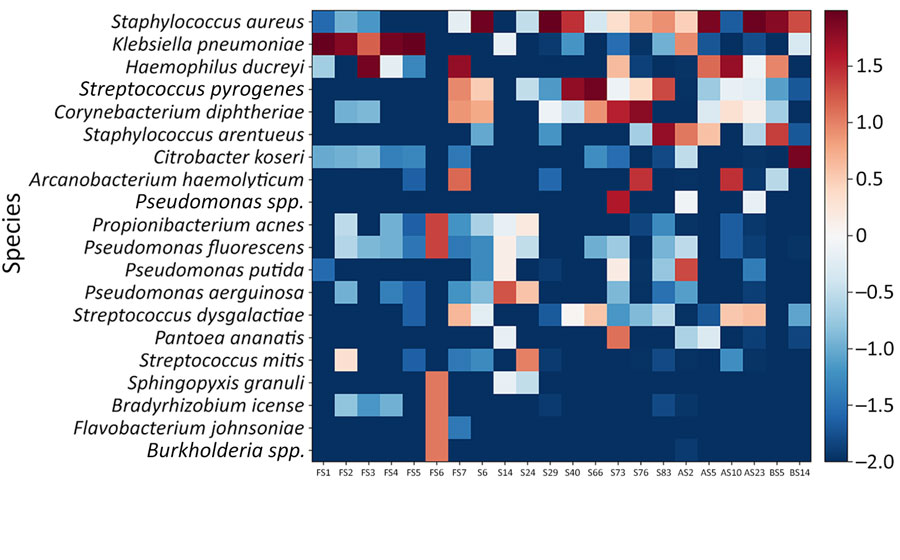
Figure 2. Heatmap of bacterial species investigated from study of Haemophilus ducreyi bacteria causing cutaneous ulcer outbreak in children, Sierra Leone, December 2025. Values are shown as log10(abundance + 0.01)%. Metagenomic analysis based on the DNBSEQ-G99 sequencing platform (MGI Tech, https://www.mgi-tech.com). The heatmap revealed that H. ducreyi, the third most abundant bacterium, was the most suspected causative agent through 22 skin swab samples. The samples were designated as follows: FS, samples collected on November 18, 2025; S, samples collected on December 12, 2025; AS and BS, samples collected on December 18, 2025.
1These authors contributed equally to this article.
Page created: September 21, 2026
Page updated: September 28, 2026
Page reviewed: September 28, 2026
The conclusions, findings, and opinions expressed by authors contributing to this journal do not necessarily reflect the official position of the U.S. Department of Health and Human Services, the Public Health Service, the Centers for Disease Control and Prevention, or the authors' affiliated institutions. Use of trade names is for identification only and does not imply endorsement by any of the groups named above.