Skip directly to site content Skip directly to page options Skip directly to A-Z link Skip directly to A-Z link Skip directly to A-Z link

Disclaimer: Early release articles are not considered as final versions. Any changes will be reflected in the online version in the month the article is officially released.

Volume 32, Number 10—October 2026

Historical Review

Variolation Techniques, Medical Explanations, and Dissemination in Late Imperial China

Linyu Guan1, Shenjia Gu1, Yunhai Pan, Lance E. Rodewald, and Chuanxi FuComments to Author 
Author affiliation: Zhejiang Chinese Medical University, Hangzhou, China (L. Guan, S. Gu, Y. Pan, C. Fu); Chinese Center for Disease Control and Prevention, Beijing, China (L.E. Rodewald)

Main Article

Figure 1

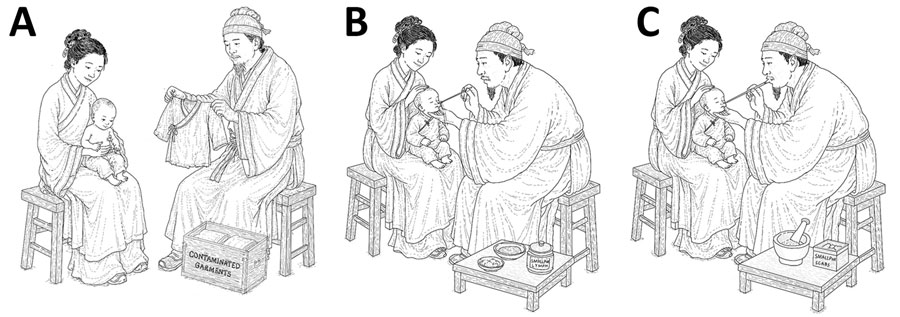
Principal variolation methods described in historical medical texts in study of variolation techniques, medical explanations, and dissemination in late Imperial China. A) Smallpox garment/blanket method, in which a healthy child was exposed to clothing or bedding used by a patient with smallpox. The aim was to induce infection that was expected to be milder and to confer subsequent protection. B) Smallpox lymph method, in which a cotton plug soaked with fluid from fully mature pustules was inserted into one nostril of the recipient. A silk thread was tied to the cotton plug to ensure that it could be safely removed. C) Smallpox scab method (dry inoculum method), in which powdered smallpox scabs were insufflated into the child’s nostril through a slender tube while the mother stabilized the child. Illustrations were hand-drawn reconstructions by an author (S.G.) according to descriptions in historical medical texts from China.

Figure 1. Principal variolation methods described in historical medical texts in study of variolation techniques, medical explanations, and dissemination in late Imperial China. A) Smallpox garment/blanket method, in which a healthy child was exposed to clothing or bedding used by a patient with smallpox. The aim was to induce infection that was expected to be milder and to confer subsequent protection. B) Smallpox lymph method, in which a cotton plug soaked with fluid from fully mature pustules was inserted into one nostril of the recipient. A silk thread was tied to the cotton plug to ensure that it could be safely removed. C) Smallpox scab method (dry inoculum method), in which powdered smallpox scabs were insufflated into the child’s nostril through a slender tube while the mother stabilized the child. Illustrations were hand-drawn reconstructions by an author (S.G.) according to descriptions in historical medical texts from China.

Main Article

1These first authors contributed equally to this article.

Page created: September 05, 2026
Page updated: September 17, 2026
Page reviewed: September 17, 2026
The conclusions, findings, and opinions expressed by authors contributing to this journal do not necessarily reflect the official position of the U.S. Department of Health and Human Services, the Public Health Service, the Centers for Disease Control and Prevention, or the authors' affiliated institutions. Use of trade names is for identification only and does not imply endorsement by any of the groups named above.
file_external