Volume 32, Number 10—October 2026
Historical Review
Variolation Techniques, Medical Explanations, and Dissemination in Late Imperial China

Figure 2
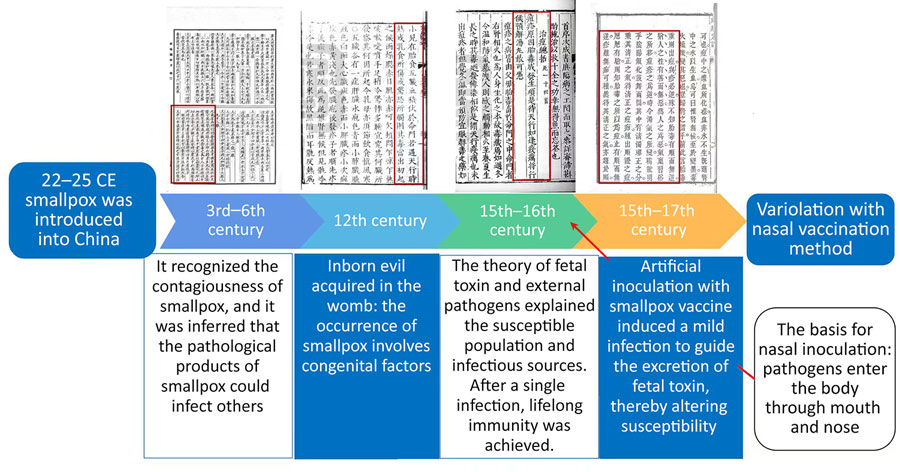
Figure 2. Logical progression underlying intranasal variolation in study of variolation techniques, medical explanations, and dissemination in late Imperial China. Schematic outlines the cognitive evolution of smallpox in traditional Chinese medicine that gave rise to variolation, spanning from the introduction of smallpox (25–55 CE) to recognition of its transmissibility, formulation of fetal toxin etiology, and eventual formalization of intranasal variolation. Developmental trajectory underpins the indigenous originality of variolation in China. Screenshots of ancient medical texts from China are shown at the top, sequentially sourced from references (21), (22), (23), and (7). Direct excerpts from original ancient medical text are outlined in red, serving as the primary source supporting the summary descriptions at the bottom. Schematic is only an analytical simplification and does not imply a unidirectional or deterministic progression.
References
- World Health Organization. Smallpox and its eradication. 1988 [cited 2026 Apr 21]. https://iris.who.int/items/ba4ab312-1c43-4304-8235-969979499717
- Shchelkunova GA, Shchelkunov SN. Smallpox, monkeypox, and other human orthopoxvirus infections. Viruses. 2022;15:103 .DOIPubMedGoogle Scholar
- Parrino J, Graham BS. Smallpox vaccines: past, present, and future. J Allergy Clin Immunol. 2006;118:1320–6 .DOIPubMedGoogle Scholar
- Dinc G, Ulman YI. The introduction of variolation “à la Turca” to the West by Lady Mary Montagu and Turkey’s contribution to this. Vaccine. 2007;25:4261–5 .DOIPubMedGoogle Scholar
- Theves G. Smallpox: an historical review [in German]. Bull Soc Sci Med Grand Duche Luxemb. 1997;134:31–51.PubMedGoogle Scholar
- Ma BY. History of Chinese medical culture, vol. 1 [in Chinese; Zhongguo Yixue Wenhua Shi (中国医学文化史)]. Shanghai: Shanghai People’s Publishing House; 2010. p. 423–533.
- Zhu CG. Conclusive theories on smallpox and rashes [in Chinese; Dou Zhen Ding Lun (痘疹定论)]. Block-printed edition; 1852 [cited 2026 Apr 21]. https://dpul.princeton.edu/eastasian/catalog/m613n1179
- Yu MK. Annotations on the golden mirror ode to smallpox, vol 2 [in Chinese; Dou Ke Jin Jing Fu Ji Jie (痘科金镜赋集解)]. Guangxu Emperor reign, block-printed edition; p 25 [cited 2026 Apr 21]. https://www.shidianguji.com/book/CADAL02035678/chapter/1l7lgzw1rdvl2
- Zhang Y. New treatise on variolation, vol 3 [in Chinese; Zhong Dou Xin Shu (种痘新书)]. Block-printed edition, 1741 [cited 2026 Apr 21]. https://dpul.princeton.edu/eastasian/catalog/td96k515v
- Fan XZ. History of Chinese preventive medical thought [in Chinese; Zhongguo Yufang Yixue Sixiang Shi (中国预防医学思想史)]. Shanghai: East China Medical Life Press; 1953. p. 81–144.
- Leung AKC. “Variolation” and vaccination in late Imperial China, ca 1570–1911. In: Plotkin SA, editor. History of vaccine development. New York: Springer; 2011. p. 5–12.
- Ma BY, Gao X, Hong ZL. History of Sino-foreign medical cultural exchange [in Chinese; Zhongwai Yixue Wenhua Jiaoliu Shi (中外医学文化交流史)]. Shanghai: Wenhui Press; 1993. p. 613.
- Sugandi R. Knowledge Ottoman Turkish medicine: from methods immunization traditional to pioneer world vaccine [cited 2026 Apr 21]. https://pdfs.semanticscholar.org/2543/f626141eda58a870e47e6152d4e5bc1f0057.pdf
- Plotkin SA, Orenstein WA, Offit PA, Edwards KM. Plotkin’s vaccines, 7th edition. Luo FJ, Li CG, Yang XM, translators. Beijing: People’s Medical Publishing House; 2023.
- Zhang L. Zhang’s Comprehensive Medicine [in Chinese; Zhang Shi Yi Tong (张氏医通)]. Li JF, Jian Y, annotators. Beijing: China Traditional Chinese Medicine Press; 1995. p. 329–30.
- Wu Q. The Golden Mirror of Medicine [in Chinese; Yi Zong Jin Jian (医宗金鉴)]. An YZ, Yuan H, editors. Beijing: China Traditional Chinese Medicine Press; 1994. p. 691–92.
- Fu CX. Vaccines and immunization. Beijing: People’s Medical Publishing House; 2020.
- Noble J Jr, Rich JA. Transmission of smallpox by contact and by aerosol routes in Macaca virus. Bull World Health Organ. 1969;40:279–86.PubMedGoogle Scholar
- Zhu YL. Essentials of variolation [in Chinese; Zhong Dou Xin Fa (种痘心法)]. In: Wang YW, editor. Cong Shu Ji Cheng Chu Bian. Shanghai: Commercial Press; 1936. p. 5–6.
- Ge H. Transcendent Master Ge’s emergency-preparedness recipes to keep close at hand, vol 2 [in Chinese; Ge Xian Weng Zhou Hou Bei Ji Fang (葛仙翁肘后备急方)]. Li Shi block-printed edition. Beijing: National Library of China collection; 1574. p. 18.
- Qian Y. Key to the therapeutics of children’s diseases [in Chinese; Xiao Er Yao Zheng Zhi Jue (小儿药证直诀). Yan XZ, compiler; Guo JS, collator. Beijing: People’s Medical Publishing House; 2017.
- Wan Q. Complete medical works of Wan Mizhai [in Chinese; Wan Mi Zhai Yi Xue Quan Shu (万密斋医学全书)]. Fu PF, Yao CS, Wang XP, editors. Beijing: China Traditional Chinese Medicine Press; 1999.
- Hopkins DR. The great killer: smallpox in history. Shen YM, Jiang GN, translators. Shanghai: Shanghai People’s Publishing House; 2005.
- Naraindas H. Preparing for the pox: a theory of smallpox in Bengal and Britain. Asian J Soc Sci. 2003;31:304–39. DOIGoogle Scholar
- Nicholas RW. The goddess Sitala and epidemic smallpox in Bengal. J Asian Stud. 1981;41:21–45.PubMedGoogle Scholar
- Fitchett JR, Heymann DL. Smallpox vaccination and opposition by anti-vaccination societies in 19th century Britain [cited 2026 Apr 21]. https://www.healthchoicevt.com/wp-content/uploads/2016/01/E17.pdf
- Maty M. XVII. A short account of the manner of inoculating the small pox, on the Coast of Barbary, and at Bengal, in the East Indies, extracted from a memoir written in Dutch, by the Reverend Mr. Chais, at the Hague. Philos Trans. 1768;58:128–31. DOIGoogle Scholar
- Ainslie W III. Observations respecting the small-pox and inoculation in eastern countries; with some account of the introduction of vaccination into India. Transactions of the Royal Asiatic Society of Great Britain and Ireland. 1830;2:52–73. DOIGoogle Scholar
- Bhāramiśra. Bhāvaprakāśa. Murthy KRS, translator. Varanasi: Chowkhamba Krishnadas Academy; 2008. p. 632–35.
1These first authors contributed equally to this article.