Volume 32, Number 10—October 2026
Dispatch
Emergence of Genotype 2.3.1 Multidrug-Resistant Salmonella enterica Serovar Typhi Strain, West Africa, 2021–2025


Cite This Article
Citation for Media
Abstract
Since 2021, a genotype 2.3.1, ciprofloxacin-resistant, multidrug-resistant (MDR) Salmonella enterica serovar Typhi strain increasingly has been detected in persons returning from West Africa. This strain locally acquired 2 different MDR plasmids over a ≈25-year period, underwent chromosomal integration of the IncHI1 plasmid MDR region, and finally acquired a gyrA mutation.
Salmonella enterica serovar Typhi is a human-restricted pathogen causing typhoid fever through fecally contaminated food or water (1). In 2021, an estimated 7.1 million typhoid fever cases caused 93,300 deaths worldwide (2). Sporadic antimicrobial resistance (AMR) was first detected in Salmonella Typhi in the 1950s, followed by epidemic multidrug-resistant (MDR) populations in the Americas and South/Southeast Asia during the 1970s–1980s. Those populations initially displayed resistance to chloramphenicol, streptomycin, tetracycline, and sulfonamides and then became resistant to ampicillin and cotrimoxazole, after the acquisition of large IncHI1 plasmids (3–7). One such MDR population, H58 (3), now genotype 4.3.1 (8), emerged in South Asia in the late 1980s and spread across Southeast Asia, Oceania, and East Africa (9,10). This H58 lineage first acquired an IncHI1 MDR plasmid (belonging to plasmid multilocus sequence type [pST] 6), followed by, during the 1990s, a point mutation in the chromosomal DNA gyrase gene, gyrA (often gyrA_S83F), which confers resistance to nalidixic acid (NALR) and has decreased susceptibility to ciprofloxacin (now categorized as resistant to ciprofloxacin [CIPR]) according to established guidelines (Appendix 1). The MDR region initially located on the IncHI1 plasmid became stably integrated into the bacterial chromosome over time in lineage H58, and the IncHI1 plasmid was lost (9). This lineage subsequently became extensively drug-resistant after the acquisition of a new IncY plasmid carrying the extended-spectrum β-lactamase blaCTX-M-15 gene in Pakistan in 2016 (11).
In the 2000s, MDR Salmonella Typhi strains of non–4.3.1 genotypes emerged in West and Central Africa. In West Africa and neighboring Cameroon, the MDR genotypes were 3.1.1 (corresponding to haplotypes H56 and H42 [3] or cluster A [12]) and 2.3.1 (corresponding to H77 [3] or cluster C [12]). Both genotypes had predominantly acquired MDR plasmids of incompatibility group IncHI1 (pST2 with dfrA15 as the class 1 integron gene cassette for 3.1.1 isolates and pST2 with dfrA1-aadA1 for 2.3.1 isolates) (12,13). IncY plasmids in genotype 3.1.1 isolates and IncN (pST3) plasmids in 2.3.1 isolates were less frequent (13,14). Quinolone resistance was initially rare in these MDR genotypes; only 6 (4.7%) NALR isolates (all genotype 3.1.1) were found among 128 Salmonella Typhi isolates that were collected in Nigeria during 2008–2013 (13). However, a recent study showed that the proportion of genotype 3.1.1 NALR isolates reached >75% in Nigeria after 2015 (15). A similar trend has not been documented for genotype 2.3.1.
In France, enteric fevers have been notifiable diseases since 1903. In addition to mandatory reporting, clinical laboratories forward the isolates to the National Reference Center for Escherichia coli, Shigella, and Salmonella at the Institut Pasteur (Paris, France) on a voluntary basis. Most Salmonella Typhi isolates are obtained from travelers or immigrants, most of whom were infected in Asia and Africa. During 2016–2025, the center received 1,603 Salmonella Typhi isolates (1 per patient) for expert analysis (Appendix 1), including 167 of genotype 2.3.1. The median age for those 167 patients was 28 years (range 2–85 years); 64.7% were women and girls and 35.3% men and boys, and 135 (80.8%) had reported traveling to Africa.
We used conventional microbiologic examination and whole-genome sequencing to characterize an emerging MDR-CIPR S. Typhi strain of genotype 2.3.1 isolated from travelers returning to France from West Africa. We also reconstructed its evolutionary history.
Figure 1
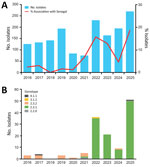
Figure 1. Distribution and genotype of Salmonella enterica serovar Typhi isolates in persons returning to France from Senegal in study of emergence of genotype 2.3.1 multidrug-resistant SalmonellaTyphi strain,...
In 2022, we obtained 35 MDR-CIPR Salmonella Typhi isolates from persons returning from Senegal (Figure 1). All isolates belonged to genotype 2.3.1 and contained AMR genes blaTEM-1, strA, strB, aadA1, sul1, sul2, dfrA1, and tet(B) (this particular combination of AMR genes was thereafter named MDR profile A [MDRA]) and the point mutation gyrA_S83F, thus explaining their AMR phenotype (resistance to ampicillin, streptomycin, sulfonamides, trimethoprim, cotrimoxazole, tetracycline, nalidixic acid and ciprofloxacin [MIC range 0.125–0.25 mg/L]) (Appendix 2). Only 1 similar isolate had previously been documented in the Institut Pasteur registry, obtained from a case linked to Senegal in 2021 (Figure 1). The number of genotype 2.3.1 isolates linked to Senegal decreased from 21 in 2023 to 8 in 2024 but then peaked at 50 in 2025 (Figure 1). All 79 isolates recovered since 2023 were CIPR; 71 also displayed the MDRA profile (Appendix 2). We also identified in our database 52 additional genotype 2.3.1 genomes, obtained since 2022; of those, 39 carry the MDRA-CIPR profile (37 also carry the gyrA_S83F mutation), and 11 originated from persons who had traveled to countries in West Africa (Guinea, Guinea-Bissau, Niger, Nigeria, Mauritania, The Gambia, and Benin) (Appendix 2).
Figure 2
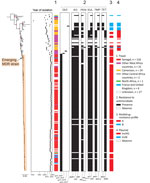
Figure 2. Maximum-likelihood phylogeny of 208 Salmonella enterica serovar Typhi isolates in study of emergence of genotype 2.3.1 MDR SalmonellaTyphi strain, West Africa, 2021–2025. Included are 207 genotype...
We constructed a maximum-likelihood phylogeny of 207 genomes of genotype 2.3.1 (167 from our study and 40 published genomes [15]), including the oldest strain, isolated in Cameroon in 1958 (Appendix 2) from 1,130 single-nucleotide variants. We observed 2 main types of MDR genomes differing in AMR gene content in the phylogenetic tree: MDRA (n = 161) and a second type of MDR genomes, which we named MDRB (n = 11), carrying blaTEM-1–like, strA, strB, sul2, dfrA14, and tet(A). Most of the MDRB genomes clustered in the upper clades of the tree and contained a pST3 IncN plasmid (Figure 2). The MDRA genomes were located in the central and lower clades of the tree. Those in the central part contained the pST2 IncHI1 plasmid, and the oldest MDRA strains carrying that plasmid were from Cameroon in 2004. All 154 CIPR isolates with the gyrA_S83F mutation (collected during 2021–2025 and belonging to the emerging MDR strain) clustered tightly together at the bottom of the tree (Figure 2), of which 144 had the MDRA profile. One published MDRA-CIPR (gyrA_S83F) genome from a strain collected in Nigeria in 2019 (National Center for Biotechnology Information Sequence Read Archive [https://www.ncbi.nlm.nih.gov/sra] accession no. SRR10198914) appeared to be the nearest ancestor of this cluster (Figure 2; Appendix 2).
Figure 3
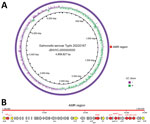
Figure 3. Chromosomal integration of an AMR region derived from an IncHI1 plasmid in study of emergence of genotype 2.3.1 multidrug-resistant Salmonella entericaserovar Typhi strain, West Africa, 2021–2025. A) Circular...
We identified no plasmid in our emerging MDR strain, suggesting that the MDR region of the IncHI1 plasmid had been stably integrated into the chromosome. Long-read sequencing of 2 MDRA-CIPR isolates (202210167 and 202207569) from the emerging MDR strain confirmed that hypothesis, revealing the integration of a 34,664-bp AMR region in the vicinity of chromosomal genes STY2890 and STY2889 (according to reference genome CT18) (Figure 3, panel A). That IS26-flanked AMR region contained all 8 AMR genes seen in MDRA isolates. In addition, long-read sequencing of MDRA isolates IPCP (Cameroon, 2006) and 201607514 (Chad, 2021) showed both contained a conjugative pST2 IncHI1 plasmid (188,859-bp pIPCP-1 in IPCP and 187,575-bp p201607514–2 in 201607514) (Appendix 1), indicating that the chromosome-borne AMR region originated from the pST2 IncHI1 plasmid. The region between nucleotides 2824 and 33844 of the AMR region integrated into the chromosome of the epidemic strain (Figure 3, panel B) was 100% identical to region 53376–84396 of the pIPCP-1 plasmid. The blaTEM-1 β-lactamase gene (flanked by 2 IS26 elements) was on the chromosome of the epidemic strain and the IncHI1 plasmid but was not collinear, suggesting secondary rearrangements in the chromosomal AMR region induced by IS26 elements.
We identified an emerging genotype 2.3.1 MDR Salmonella Typhi lineage in patients returning from sub-Saharan Africa, particularly Senegal. This lineage differs from the globally distributed MDR H58 (4.3.1 and derived) lineage originating from South Asia. Genomic analyses revealed the lineage’s evolution, including AMR acquisition. First identified in Cameroon in the 1950s, it acquired 2 distinct MDR plasmids during the 2000s. The IncHI1 plasmid was subsequentially lost, but its AMR region is now stably integrated into the bacterial chromosome. Since 2019, this lineage has acquired ciprofloxacin resistance through a chromosomal gyrA mutation. That trajectory closely mirrors that of H58, underscoring risk for further resistance development. Continued genomic surveillance is essential to monitor spread and guide control measures to prevent further resistance.
Dr. Njamkepo is a research scientist in the Enteric Bacterial Pathogens Unit of the Institut Pasteur. Her research interests include the genomics of several epidemic bacterial pathogens.
Acknowledgments
We thank all corresponding laboratories of France’s National Reference Center for Escherichia coli, Shigella, and Salmonella for their participation in the surveillance of Salmonella infections. We thank Magali Ravel, Estelle Serre, Véronique Guibert, and Laëtitia Fabre for technical assistance.
This work was supported by the Institut Pasteur and Santé publique France.
References
- Kuehn R, Rahden P, Hussain HS, Karkey A, Qamar FN, Rupali P, et al. Enteric (typhoid and paratyphoid) fever. Lancet. 2025;406:1283–94. DOIPubMedGoogle Scholar
- Murthy S, Hagedoorn NN, Faigan S, Rathan MD, Sharples KJ, Marchello CS, et al. Global typhoid fever incidence: an updated systematic review with meta-analysis. Lancet Infect Dis. 2025;25:1347–62. DOIPubMedGoogle Scholar
- Roumagnac P, Weill FX, Dolecek C, Baker S, Brisse S, Chinh NT, et al. Evolutionary history of Salmonella typhi. Science. 2006;314:1301–4. DOIPubMedGoogle Scholar
- Goldstein FW, Chumpitaz JC, Guevara JM, Papadopoulou B, Acar JF, Vieu JF. Plasmid-mediated resistance to multiple antibiotics in Salmonella typhi. J Infect Dis. 1986;153:261–6. DOIPubMedGoogle Scholar
- Wain J, Diem Nga LT, Kidgell C, James K, Fortune S, Song Diep T, et al. Molecular analysis of incHI1 antimicrobial resistance plasmids from Salmonella serovar Typhi strains associated with typhoid fever. Antimicrob Agents Chemother. 2003;47:2732–9. DOIPubMedGoogle Scholar
- Holt KE, Phan MD, Baker S, Duy PT, Nga TVT, Nair S, et al. Emergence of a globally dominant IncHI1 plasmid type associated with multiple drug resistant typhoid. PLoS Negl Trop Dis. 2011;5:
e1245 . DOIPubMedGoogle Scholar - Parkhill J, Dougan G, James KD, Thomson NR, Pickard D, Wain J, et al. Complete genome sequence of a multiple drug resistant Salmonella enterica serovar Typhi CT18. Nature. 2001;413:848–52. DOIPubMedGoogle Scholar
- Wong VK, Baker S, Connor TR, Pickard D, Page AJ, Dave J, et al.; International Typhoid Consortium. An extended genotyping framework for Salmonella enterica serovar Typhi, the cause of human typhoid. Nat Commun. 2016;7:12827. DOIPubMedGoogle Scholar
- Wong VK, Baker S, Pickard DJ, Parkhill J, Page AJ, Feasey NA, et al. Phylogeographical analysis of the dominant multidrug-resistant H58 clade of Salmonella Typhi identifies inter- and intracontinental transmission events. Nat Genet. 2015;47:632–9. DOIPubMedGoogle Scholar
- Carey ME, Thi Nguyen TN, Tran DHN, Dyson ZA, Keane JA, Pham Thanh D, et al. The origins of haplotype 58 (H58) Salmonella enterica serovar Typhi. Commun Biol. 2024;7:775. DOIPubMedGoogle Scholar
- Klemm EJ, Shakoor S, Page AJ, Qamar FN, Judge K, Saeed DK, et al. Emergence of an extensively drug-resistant Salmonella enterica serovar Typhi clone harboring a promiscuous plasmid encoding resistance to fluoroquinolones and third-generation cephalosporins. MBio. 2018;9:e00105–18. DOIPubMedGoogle Scholar
- Baltazar M, Ngandjio A, Holt KE, Lepillet E, Pardos de la Gandara M, Collard JM, et al. Multidrug-resistant Salmonella enterica serotype Typhi, Gulf of Guinea Region, Africa. Emerg Infect Dis. 2015;21:655–9. DOIPubMedGoogle Scholar
- Wong VK, Holt KE, Okoro C, Baker S, Pickard DJ, Marks F, et al.; International Typhoid Consortium. Molecular surveillance identifies multiple transmissions of typhoid in West Africa. PLoS Negl Trop Dis. 2016;10:
e0004781 . DOIPubMedGoogle Scholar - Ikhimiukor OO, Oaikhena AO, Afolayan AO, Fadeyi A, Kehinde A, Ogunleye VO, et al. Genomic characterization of invasive typhoidal and non-typhoidal Salmonella in southwestern Nigeria. PLoS Negl Trop Dis. 2022;16:
e0010716 . DOIPubMedGoogle Scholar - Carey ME, Dyson ZA, Ingle DJ, Amir A, Aworh MK, Chattaway MA, et al.; Global Typhoid Genomics Consortium Group Authorship. Global diversity and antimicrobial resistance of typhoid fever pathogens: insights from a meta-analysis of 13,000 Salmonella Typhi genomes. eLife. 2023;12:
e85867 . DOIPubMedGoogle Scholar
Figures
Cite This ArticleOriginal Publication Date: September 21, 2026
Table of Contents – Volume 32, Number 10—October 2026
| EID Search Options |
|---|
 Advanced Article Search – Search articles by author and/or keyword.
|
 Articles by Country Search – Search articles by the topic country.
|
 Article Type Search – Search articles by article type and issue.
|
Please use the form below to submit correspondence to the authors or contact them at the following address:
François-Xavier Weill, Institut Pasteur, Université Paris Cité, Unité des Bactéries pathogènes entériques, 28 Rue du Docteur Roux, 75724 Paris CEDEX 15, France
Top