Disclaimer: Early release articles are not considered as final versions. Any changes will be reflected in the online version in the month the article is officially released.
Volume 32, Number 11—November 2026
Research Letter
Disseminated Trimethoprim/Sulfamethoxazole–Resistant Nocardiosis in Renal Transplant Recipient, India
Sandeep Rao Kordcal, Md Tariq Maula, Vivek Malleshappa Suguna, Adil Rashid Khan, Rahul Ranjan, Stanzin Spalkit, Aruna Nambirajan, Gagandeep Singh, Neeraj Nischal, Immaculata Xess, and Manish Soneja
Figure 2
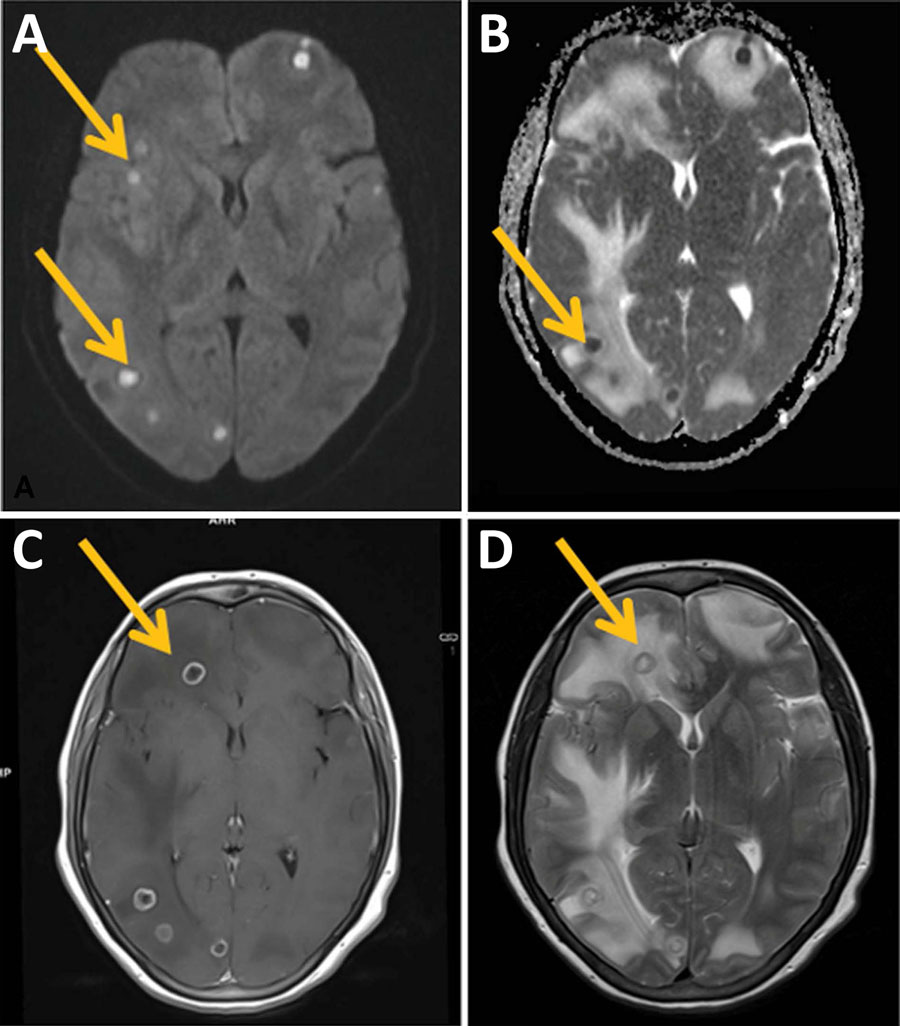
Figure 2. Brain magnetic resonance imaging in renal transplant recipient with disseminated trimethoprim/sulfamethoxazole–resistant nocardiosis, India. A) Diffusion-weighted image showing multiple foci of central diffusion restriction (arrows). B) Apparent diffusion coefficient map showing corresponding signal change (arrow). C) Axial T1-weighted postgadolinium image showing ring-enhancing supratentorial lesions (arrow). D) Axial T2-weighted image showing lesions with central hyperintensity, a hypointense rim, and perilesional edema (arrow).
Page created: September 11, 2026
Page updated: October 15, 2026
Page reviewed: October 15, 2026
The conclusions, findings, and opinions expressed by authors contributing to this journal do not necessarily reflect the official position of the U.S. Department of Health and Human Services, the Public Health Service, the Centers for Disease Control and Prevention, or the authors' affiliated institutions. Use of trade names is for identification only and does not imply endorsement by any of the groups named above.