Skip directly to site content Skip directly to page options Skip directly to A-Z link Skip directly to A-Z link Skip directly to A-Z link

Disclaimer: Early release articles are not considered as final versions. Any changes will be reflected in the online version in the month the article is officially released.

Volume 32, Number 12—December 2026

Dispatch

Typhoid Fever–Like Manifestation of Scrub Typhus in Patient with Myelodysplastic Syndrome, China, 2025

Yu Li, Weihua Wang, Xuejun Gao, and Yu-feng GuComments to Author 
Author affiliation: Yantai Yuhuangding Hospital, Yantai, China

Main Article

Figure 1

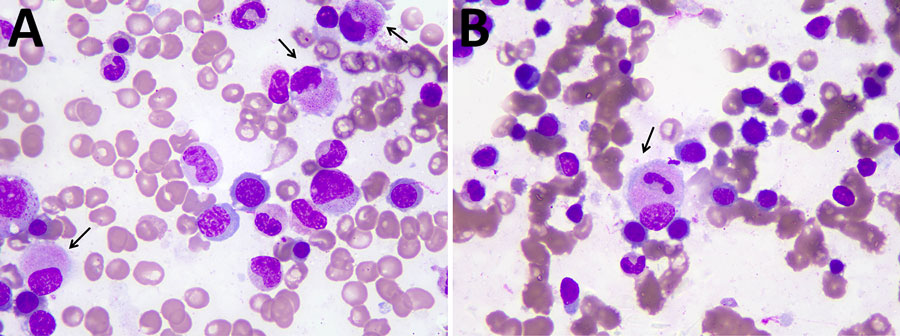
Bone marrow morphology in samples from a 79-year-old man with scrub typhus and myelodysplastic syndrome, Shandong Province, China, 2025. A) High-power view showing a macrophage with abundant cytoplasm filled with fine eosinophilic granules (arrow), morphologically resembling the typhoid cells classically described in Salmonella enterica serovar Typhi bone marrow infection. B) A macrophage exhibiting phagocytosis of a neutrophil (arrow). The findings were initially interpreted as evidence of typhoid fever but were ultimately attributed to Orientia tsutsugamushi infection, confirmed by targeted next-generation sequencing. (\Wright-Giemsa stains; original magnification ×1,000.

Figure 1. Bone marrow morphology in samples from a 79-year-old man with scrub typhus and myelodysplastic syndrome, Shandong Province, China, 2025. A) High-power view showing a macrophage with abundant cytoplasm filled with fine eosinophilic granules (arrow), morphologically resembling the typhoid cells classically described in Salmonella enterica serovar Typhi bone marrow infection. B) A macrophage exhibiting phagocytosis of a neutrophil (arrow). The findings were initially interpreted as evidence of typhoid fever but were ultimately attributed to Orientia tsutsugamushi infection, confirmed by targeted next-generation sequencing. (\Wright-Giemsa stains; original magnification ×1,000.

Main Article

Page created: August 26, 2026
Page updated: October 23, 2026
Page reviewed: October 23, 2026
The conclusions, findings, and opinions expressed by authors contributing to this journal do not necessarily reflect the official position of the U.S. Department of Health and Human Services, the Public Health Service, the Centers for Disease Control and Prevention, or the authors' affiliated institutions. Use of trade names is for identification only and does not imply endorsement by any of the groups named above.
file_external