Skip directly to site content Skip directly to page options Skip directly to A-Z link Skip directly to A-Z link Skip directly to A-Z link

Volume 32, Number 2—February 2026

Dispatch

Autochthonous Rat Lungworm Angiostrongylus cantonensis Infections in Accidental and Definitive Hosts, San Diego, California, USA

Shotaro NakagunComments to Author , Carlo G. Gonzalez Vera, Alexis Wohl, Deana L. Clifford, Garrett A. Fraess, Jordyn R. Nylander, Estefanía Montero, Javier Asin, Steven V. Kubiski, and Rachel E. Burns
Author affiliation: Author affiliations: San Diego Zoo Wildlife Alliance, San Diego, California, USA (S. Nakagun, C.G. Gonzalez Vera, G.A. Fraess, J.R. Nylander, S.V. Kubiski, R.E. Burns); San Diego Humane Society’s Project Wildlife, San Diego (A. Wohl); California Department of Fish and Wildlife, Rancho Cordova, California, USA (D.L. Clifford); Universidad Cardenal Herrera-CEU, CEU Universities, Valencia, Spain (E. Montero); California Animal Health and Food Safety Laboratory, University of California, Davis, San Bernardino, California, USA (J. Asin)

Main Article

Figure 3

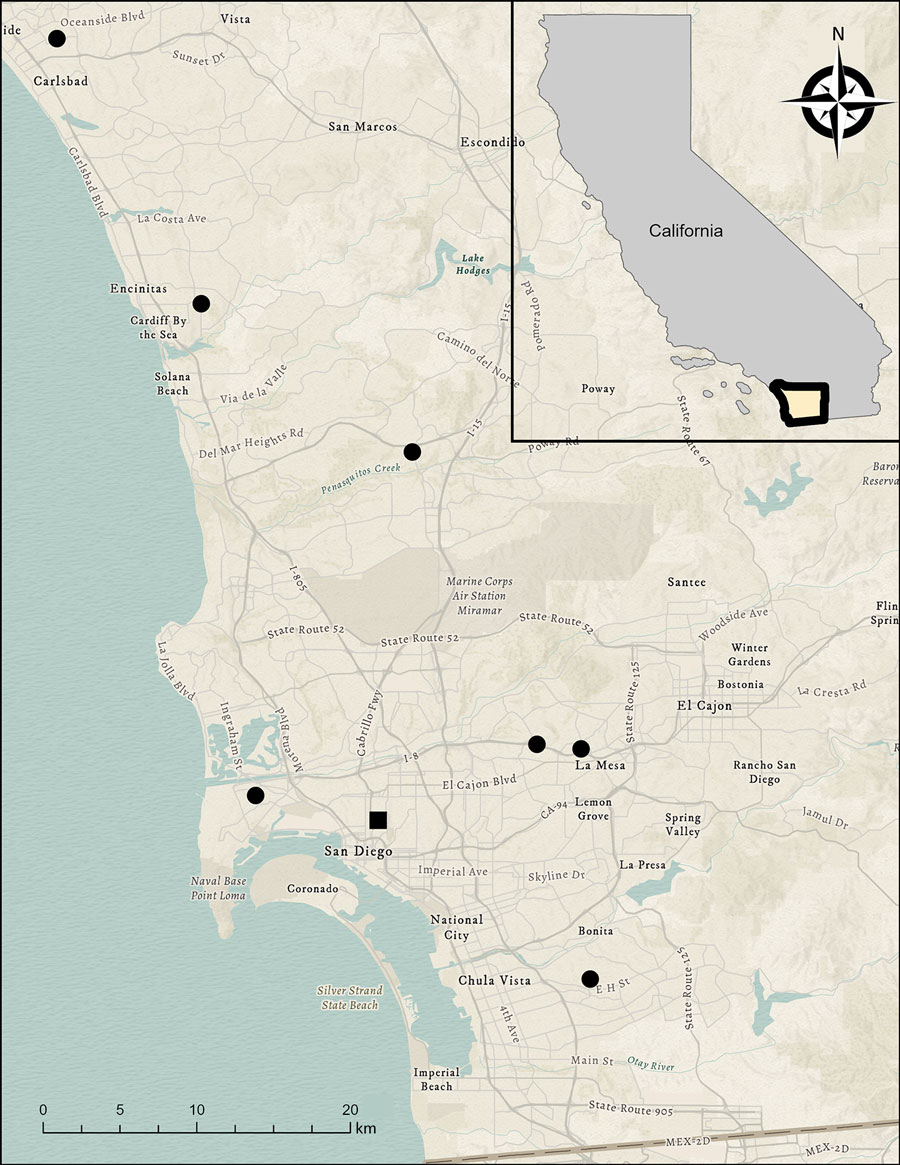
Distribution of Virginia opossums (Didelphis virginiana) identified with autochthonous rat lungworm Angiostrongylus cantonensis infections, San Diego, California, USA, 2023–2025. Black dots indicate opossum cases, which ranged over ≈68 km from north to south. The location of the San Diego Zoo, where cases of angiostrongyliasis were identified in a wallaby and rats, is included for reference (black square). Inset shows location of study area in California. Sources: Airbus Defence and Space, CGIAR, Danish Geodata Agency, Esri, Food and Agriculture Organization of the United Nations, Federal Emergency Management Agency, Garmin, General Services Admission, Geoland, Intermap, National Aeronautics and Space Administration, National Center for Ecological Analysis and Synthesis, National Geospatial-Intelligence Agency, National Land Service, National Mapping Agency, National Oceanic and Atmospheric Administration, ©OpenStreetMap contributors, Ordnance Survey, Rijkswaterstaat, Robinson Projection, TomTom, US Geological Society, Vantor, and the Geographic Information Systems user community.

Figure 3. Distribution of Virginia opossums (Didelphis virginiana) identified with autochthonous rat lungworm Angiostrongylus cantonensis infections, San Diego, California, USA, 2023–2025. Black dots indicate opossum cases, which ranged over ≈68 km from north to south. The location of the San Diego Zoo, where cases of angiostrongyliasis were identified in a wallaby and rats, is included for reference (black square). Inset shows location of study area in California. Sources: Airbus Defence and Space, CGIAR, Danish Geodata Agency, Esri, Food and Agriculture Organization of the United Nations, Federal Emergency Management Agency, Garmin, General Services Admission, Geoland, Intermap, National Aeronautics and Space Administration, National Center for Ecological Analysis and Synthesis, National Geospatial-Intelligence Agency, National Land Service, National Mapping Agency, National Oceanic and Atmospheric Administration, ©OpenStreetMap contributors, Ordnance Survey, Rijkswaterstaat, Robinson Projection, TomTom, US Geological Society, Vantor, and the Geographic Information Systems user community.

Main Article

Page created: January 29, 2026
Page updated: February 19, 2026
Page reviewed: February 19, 2026
The conclusions, findings, and opinions expressed by authors contributing to this journal do not necessarily reflect the official position of the U.S. Department of Health and Human Services, the Public Health Service, the Centers for Disease Control and Prevention, or the authors' affiliated institutions. Use of trade names is for identification only and does not imply endorsement by any of the groups named above.
file_external