Volume 32, Number 2—February 2026
Research
Leptotrombidium imphalum Chiggers as Vector for Scrub Typhus in Human Settlements, India, 2022–2023
Carol S. Devamani, Neal Alexander, Rawadee Kumlert, Benjamin L. Makepeace, Serge Morand, Mary Cameron, Alexandr A. Stekolnikov, Winsley Rose, Daniel Chandramohan, Punam Mangtani, Kundavaram P.P. Abhilash, and Wolf-Peter Schmidt
Figure 4
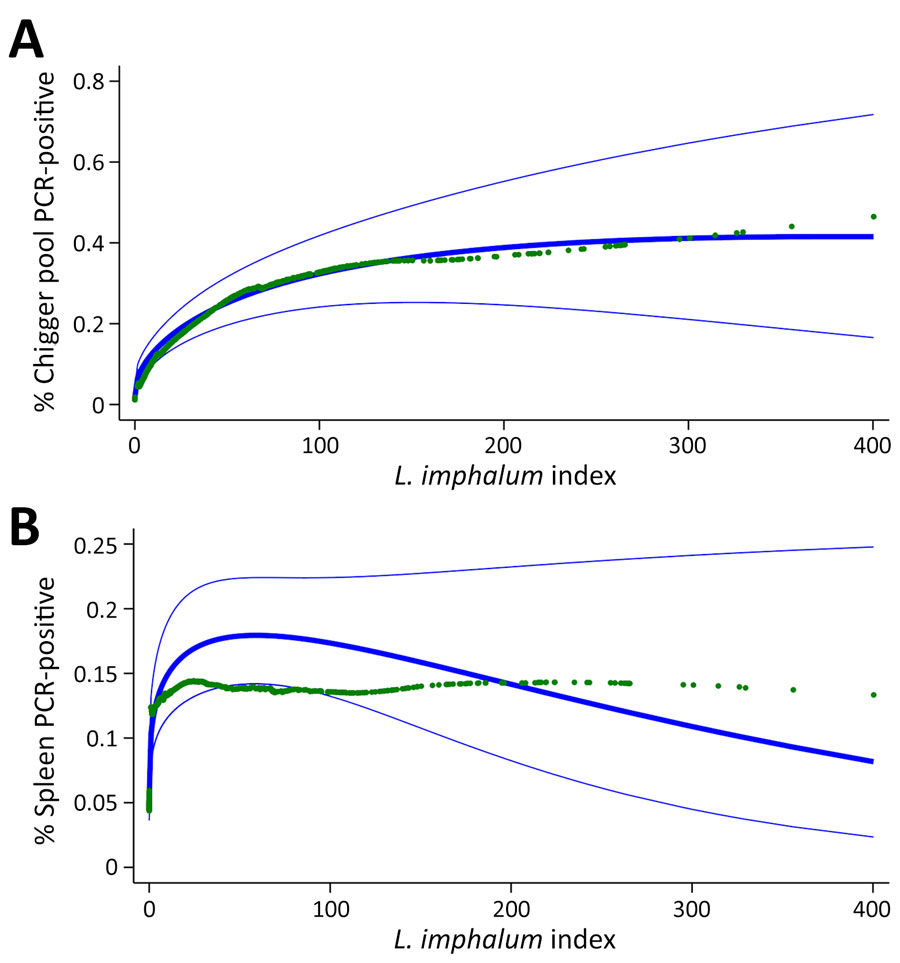
Figure 4. Association between Leptotrombidium imphalum index and the prevalence of Orientia infection in study of L. imphalum chiggers as vector for scrub typhus in human settlements, India, 2022–2023. A) Association between prevalence in the chigger pool collected from the host and chigger index. B) Association between prevalence determined from host spleen tissue and chigger index. Blue lines show predicted prevalence (thick) with 95% CI (thin). Green markers show locally weighted scatterplot smoothing of Orientia prevalence by L. imphalum index using a bandwidth of 0.4.
Page created: January 20, 2026
Page updated: February 19, 2026
Page reviewed: February 19, 2026
The conclusions, findings, and opinions expressed by authors contributing to this journal do not necessarily reflect the official position of the U.S. Department of Health and Human Services, the Public Health Service, the Centers for Disease Control and Prevention, or the authors' affiliated institutions. Use of trade names is for identification only and does not imply endorsement by any of the groups named above.