Volume 32, Number 3—March 2026
Research Letter
Cutaneous Paraconiothyrium cyclothyrioides Infection in Lung Transplant Recipient, Georgia, USA
 , Stephanie Thomas, Lucy S. Witt, Elizabeth Sajewski, Shawn R. Lockhart, Stephanie M. Pouch, Justin Cheeley, Jamie B. MacKelfresh, and Jeremy A.W. Gold
Figure 2
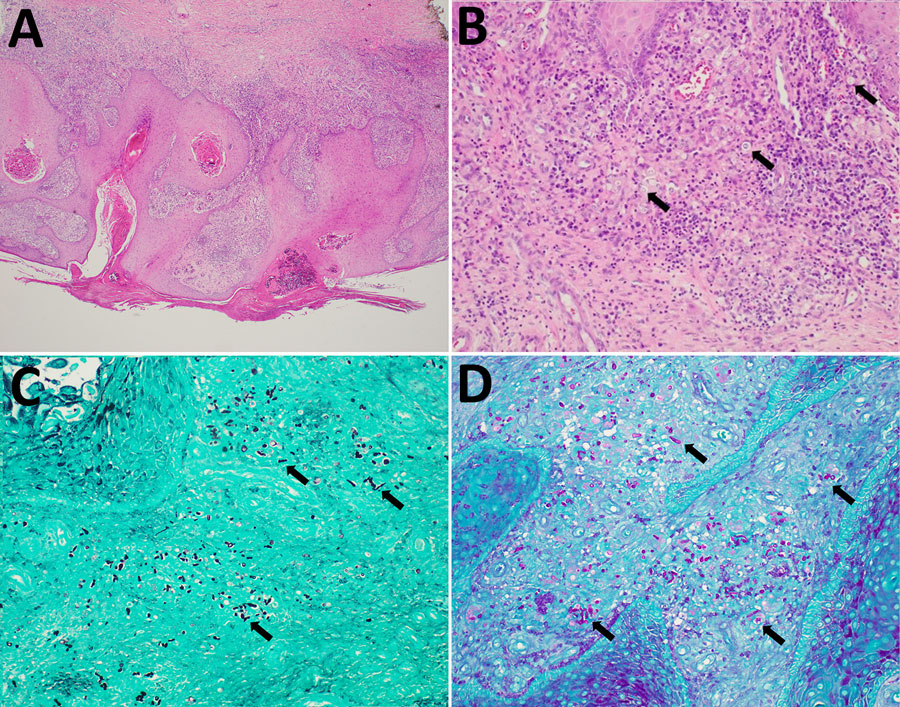
Figure 2. Histologic (A, B) and histochemical (C, D) findings from case of cutaneous Paraconiothyrium cyclothyrioides in lung transplant recipient, Georgia, USA. A) Skin biopsy from right shin revealed psuedoepitheliomatous hyperplasia of the epidermis overlying a mixed dermal inflammatory infiltrate. Hematoxylin and eosin stain; original magnification ×40. B) Polymorphic fungal elements (arrows) seen within the superficial dermis. Hematoxylin and eosin stain; original magnification ×200. C) Numerous fungal hyphal elements and yeast-like forms (arrows) highlighted within the dermis. Grocott methenamine silver stain; original magnification ×200. D) Fungal hyphal elements and yeast-like forms (arrows) noted by Periodic acid–Schiff stain; original magnification ×200.