Volume 32, Number 3—March 2026
Research Letter
Two Cases of Posttraumatic Kosakonia Infection, Argentina, 2023
Claudia Barberis , Maria Sol Haim, Paula Zomero, Germán Traglia, Alejandro Ellis, Roxana Cittadini, Tomás Poklépovich, Marisa Almuzara, and Carlos Vay
, Maria Sol Haim, Paula Zomero, Germán Traglia, Alejandro Ellis, Roxana Cittadini, Tomás Poklépovich, Marisa Almuzara, and Carlos Vay
Figure
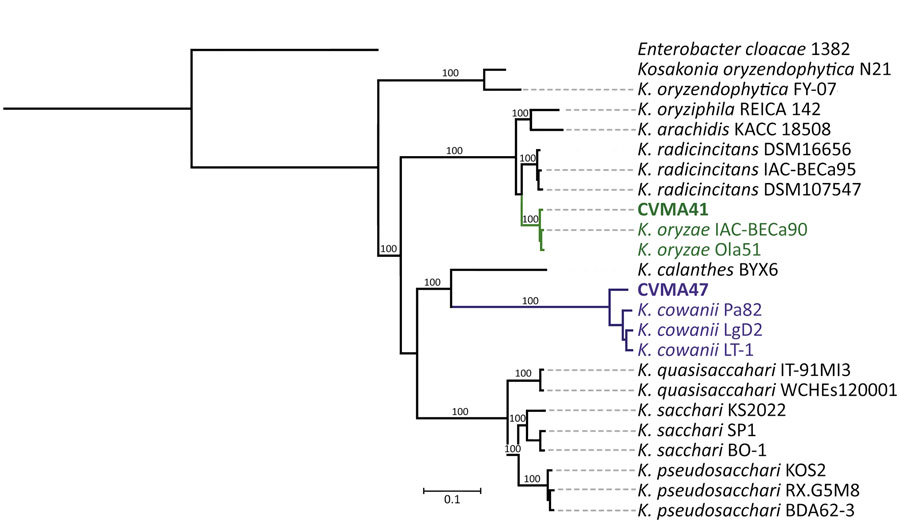
Figure. Data from a study of 2 cases of posttraumatic Kosakonia infection, Argentina, 2023. Maximum-likelihood phylogeny calculated using 1,214,977 single-nucleotide variants from a core-gene alignment of 3,232 genes from genomes of Kosakonia-described species with 1,000 bootstraps. Green indicates CVMA41 clusters, violet indicates CVMA47 clusters. Tree rooted in an Enterobacter cloacae genome included as an outgroup. Scale bar indicates substitutions per site.
Page created: March 09, 2026
Page updated: March 20, 2026
Page reviewed: March 20, 2026
The conclusions, findings, and opinions expressed by authors contributing to this journal do not necessarily reflect the official position of the U.S. Department of Health and Human Services, the Public Health Service, the Centers for Disease Control and Prevention, or the authors' affiliated institutions. Use of trade names is for identification only and does not imply endorsement by any of the groups named above.