Volume 32, Number 4—April 2026
Dispatch
Guillain-Barré Syndrome and Visual Impairment Associated with Emerging Oropouche Virus Lineage, Brazil, 2024
 , Fernanda Martins Maia Carvalho, Antonio Silva Lima Neto, Ana Maria Cabral Maia, Matheus Andrighetti Rossi, Milena Sales Pitombeira, Paula Camila Alves de Assis Pereira Matos, Tania Mara Silva Coelho, Lauro Vieira Perdigão Neto, Lívia Mendes de Almeida, Felipe Gomes Naveca, Carla Santos de Oliveira, Fernanda de Bruycker-Nogueira, Ana Maria Bispo de Filippis, Kleber Giovanni Luz, André Ricardo Ribas Freitas, and Luciano Pamplona de Góes Cavalcanti
Figure 2
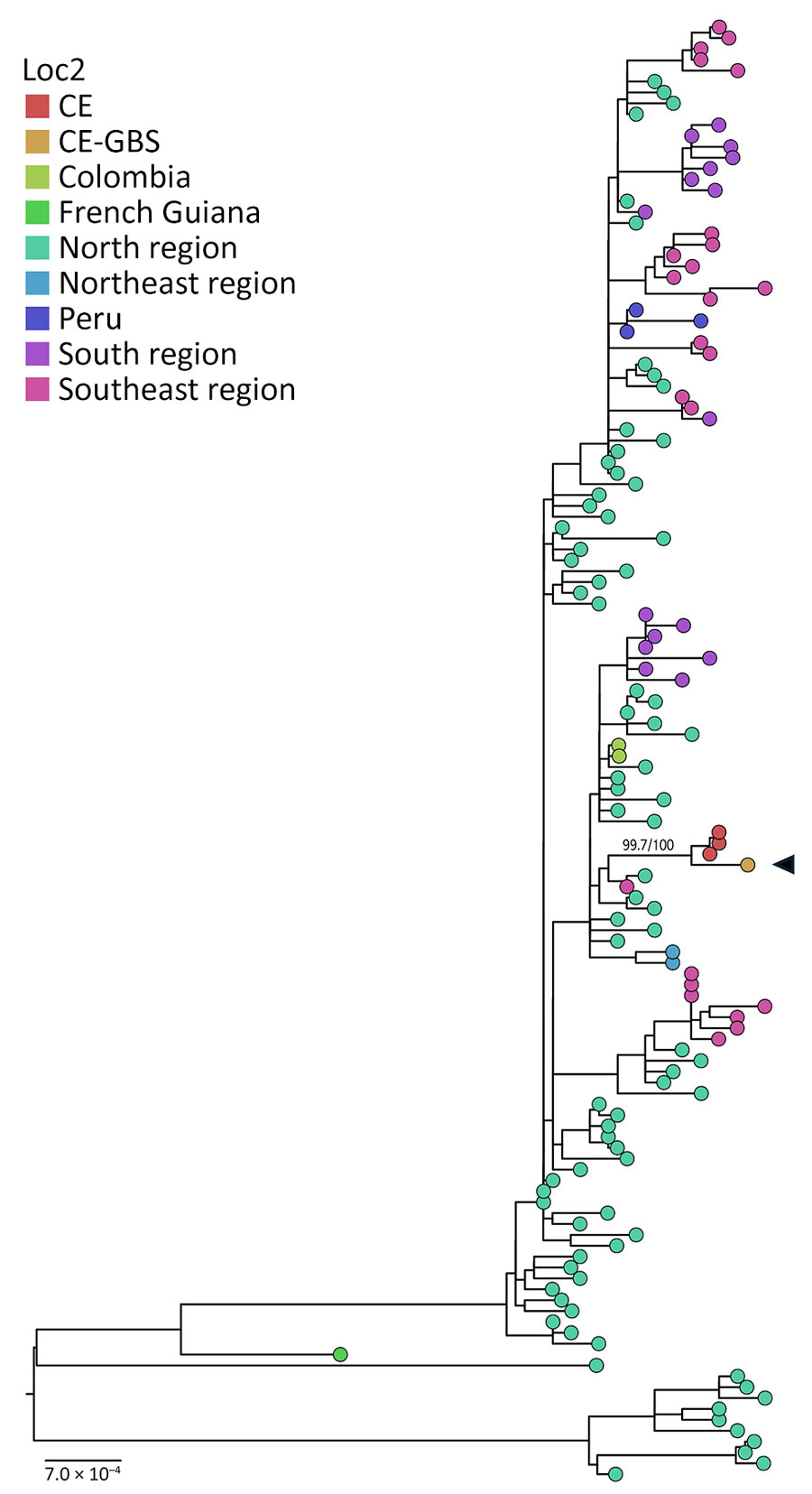
Figure 2. Maximum-likelihood tree of Oropouche virus concatenated segments from study of Guillain-Barré syndrome and visual impairment associated with emerging Oropouche virus lineage, Brazil, 2024. Black arrow indicates sequence from study patient. A reference dataset containing concatenated segments (large, medium, and small) of the recent Oropouche virus outbreak (2022–2024) representing different regions in Brazil and sequences obtained from Peru and Colombia were aligned using MAFFT version 7.490 (https://mafft.cbrc.jp/alignment/software/source.html) embedded in Geneious Prime 2025.0.3 (https://www.geneious.com). Subsequently, we used that alignment for phylogenomic reconstruction by maximum-likelihood using IQ-TREE multicore version 2.1.1 COVIDedition for Mac OS X 64-bit (http://www.iqtree.org). MODEL-FINDER (https://iqtree.github.io/ModelFinder) was used for evolutionary model choice, and 2,000 ultra-fast bootstraps and 2,000 SH-aLRT replicates were run to access the branches’ support (support for the CE clade is shown). The maximum-likelihood tree was edited with FigTree version 1.4.4 (https://tree.bio.ed.ac.uk/software/figtree). Scale bar indicates nucleotide substitutions per site. CE, Ceará state; CE-GBS, Ceará–Guillain-Barré syndrome.