Skip directly to site content Skip directly to page options Skip directly to A-Z link Skip directly to A-Z link Skip directly to A-Z link

Volume 32, Number 4—April 2026

Dispatch

Cardiomyopathy Caused by Coxsackievirus Strain A9 in Previously Healthy Child, Northeastern France, 2024

Anne-Laure Lebreil1, Maxime Bisseux1, Audrey Mirand, Marie Glenet, Yohan N’Guyen, Norhan Taha, Pierre Mauran, Cecile Henquell, and Laurent AndreolettiComments to Author 
Author affiliation: INSERM UMR-S 1320, University of Reims Champagne-Ardenne, Reims, France (A.-L. Lebreil, M. Glenet, Y. N’Guyen, L. Andreoletti); National Reference Center for Enteroviruses and Parechoviruses, CHU Clermont-Ferrand, Clermont-Ferrand, France (M. Bisseux, A. Mirand, C. Henquell); UMR CNRS 6023, Université Clermont Auvergne, Clermont-Ferrand (M. Bisseux, A. Mirand, C. Henquell); University Hospital Centre of Reims, Reims (Y. N’Guyen, L. Andreoletti); American Memorial Hospital, Reims University Hospital, Reims (N. Taha, P. Mauran).

Main Article

Figure 2

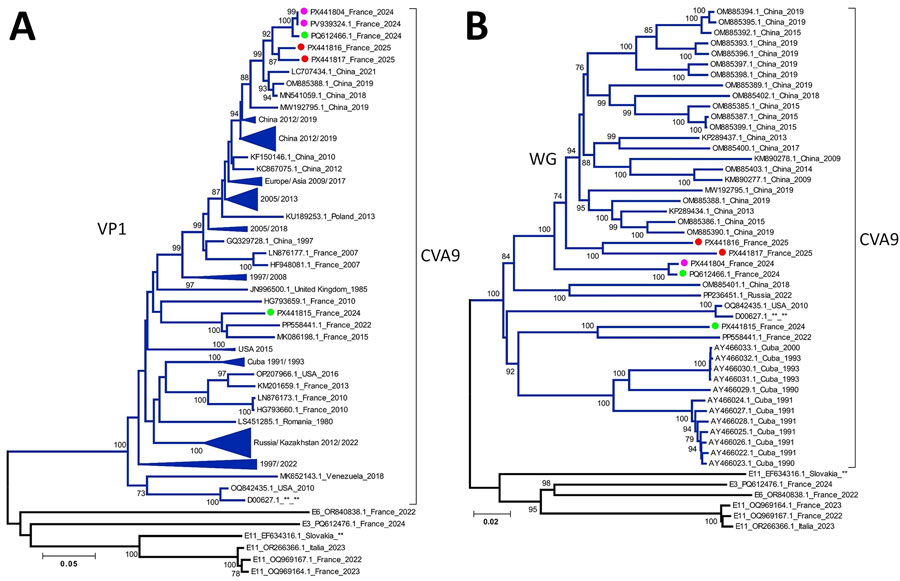
Phylogenetic analysis of CVA9 sequences from samples collected from a pediatric patient with severe inflammatory cardiomyopathy caused by CVA9, northeastern France, 2024, and reference sequences. A) All available CVA9 sequences from GenBank containing the complete VP1 (1D) gene (with a maximum of 25 missing bases at either end) aligned with CVA9 sequences obtained in this study and in France during 2024–2025. B) All available CVA9 sequences from GenBank containing the complete genome sequence (entire open reading frame with <60 bases missing from the 5′ UTR) aligned with CVA9 sequences obtained in this study and in France during 2024–2025, along with selected echovirus reference strains. We conducted sequence alignment by using BioEdit version 7.2.5 (https://thalljiscience.github.io/page2.html) and constructed phylogenetic trees by using the neighbor-joining method and the Tamura-Nei substitution model in MEGA 5 (http://www.megasoftware.net) We assessed the robustness of tree nodes with 1,000 bootstrap replicates; only bootstrap values >70% are shown. Pink circles indicate sequences generated in this study, red circles indicate CVA9 isolates from France in 2025, and green circles indicate CVA9 isolates from France in 2024. Sequences with close phylogenetic relationships were grouped into clusters, annotated with the country of origin and the range of isolation years. Clusters without specific geographic annotation contained sequences isolated from multiple continents. Branch numbers indicate bootstrap values. Scale bars represent substitutions per site. CVA9, coxsackievirus A9; VP, viral protein; WG, whole-genome.

Figure 2. Phylogenetic analysis of CVA9 sequences from samples collected from a pediatric patient with severe inflammatory cardiomyopathy caused by CVA9, northeastern France, 2024, and reference sequences. A) All available CVA9 sequences from GenBank containing the complete VP1 (1D) gene (with a maximum of 25 missing bases at either end) aligned with CVA9 sequences obtained in this study and in France during 2024–2025. B) All available CVA9 sequences from GenBank containing the complete genome sequence (entire open reading frame with <60 bases missing from the 5′ UTR) aligned with CVA9 sequences obtained in this study and in France during 2024–2025, along with selected echovirus reference strains. We conducted sequence alignment by using BioEdit version 7.2.5 (https://thalljiscience.github.io/page2.html) and constructed phylogenetic trees by using the neighbor-joining method and the Tamura-Nei substitution model in MEGA 5 (http://www.megasoftware.net) We assessed the robustness of tree nodes with 1,000 bootstrap replicates; only bootstrap values >70% are shown. Pink circles indicate sequences generated in this study, red circles indicate CVA9 isolates from France in 2025, and green circles indicate CVA9 isolates from France in 2024. Sequences with close phylogenetic relationships were grouped into clusters, annotated with the country of origin and the range of isolation years. Clusters without specific geographic annotation contained sequences isolated from multiple continents. Branch numbers indicate bootstrap values. Scale bars represent substitutions per site. CVA9, coxsackievirus A9; VP, viral protein; WG, whole-genome.

Main Article

1These authors contributed equally to this article.

Page created: March 12, 2026
Page updated: April 15, 2026
Page reviewed: April 15, 2026
The conclusions, findings, and opinions expressed by authors contributing to this journal do not necessarily reflect the official position of the U.S. Department of Health and Human Services, the Public Health Service, the Centers for Disease Control and Prevention, or the authors' affiliated institutions. Use of trade names is for identification only and does not imply endorsement by any of the groups named above.
file_external