Volume 32, Number 4—April 2026
Research Letter
Rickettsia lanei Rickettsiosis, Oregon, USA, 2025
Stephen G. Ladd-Wilson , Richard W. Fawcett, Sarah Y. Park, Shivkumar Venkatasubrahmanyam, Martin S. Lindner, Scott Davis, Alanna Spry, Joseph Singleton, Sandor E. Karpathy, and Christopher D. Paddock
, Richard W. Fawcett, Sarah Y. Park, Shivkumar Venkatasubrahmanyam, Martin S. Lindner, Scott Davis, Alanna Spry, Joseph Singleton, Sandor E. Karpathy, and Christopher D. Paddock
Figure 1
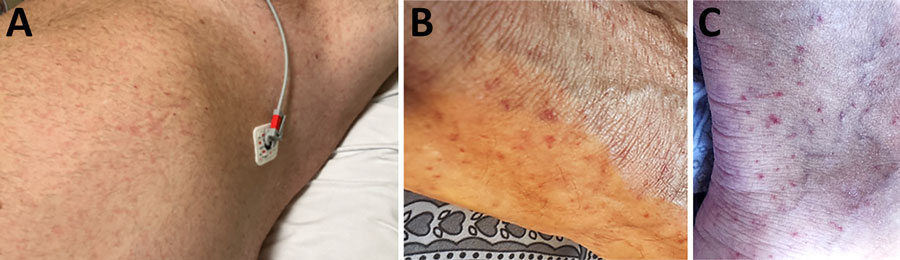
Figure 1. Rash lesions on a patient with Rickettsia lanei rickettsiosis, Oregon, USA. A) Pink blanching macules involving the trunk. B, C) Scattered petechiae on the lateral aspect of the foot (B) and posterior aspect of the ankle (C).
Page created: February 20, 2026
Page updated: April 15, 2026
Page reviewed: April 15, 2026
The conclusions, findings, and opinions expressed by authors contributing to this journal do not necessarily reflect the official position of the U.S. Department of Health and Human Services, the Public Health Service, the Centers for Disease Control and Prevention, or the authors' affiliated institutions. Use of trade names is for identification only and does not imply endorsement by any of the groups named above.