Volume 32, Number 4—April 2026
Research Letter
Rickettsia lanei Rickettsiosis, Oregon, USA, 2025
 , Richard W. Fawcett, Sarah Y. Park, Shivkumar Venkatasubrahmanyam, Martin S. Lindner, Scott Davis, Alanna Spry, Joseph Singleton, Sandor E. Karpathy, and Christopher D. Paddock
Figure 2
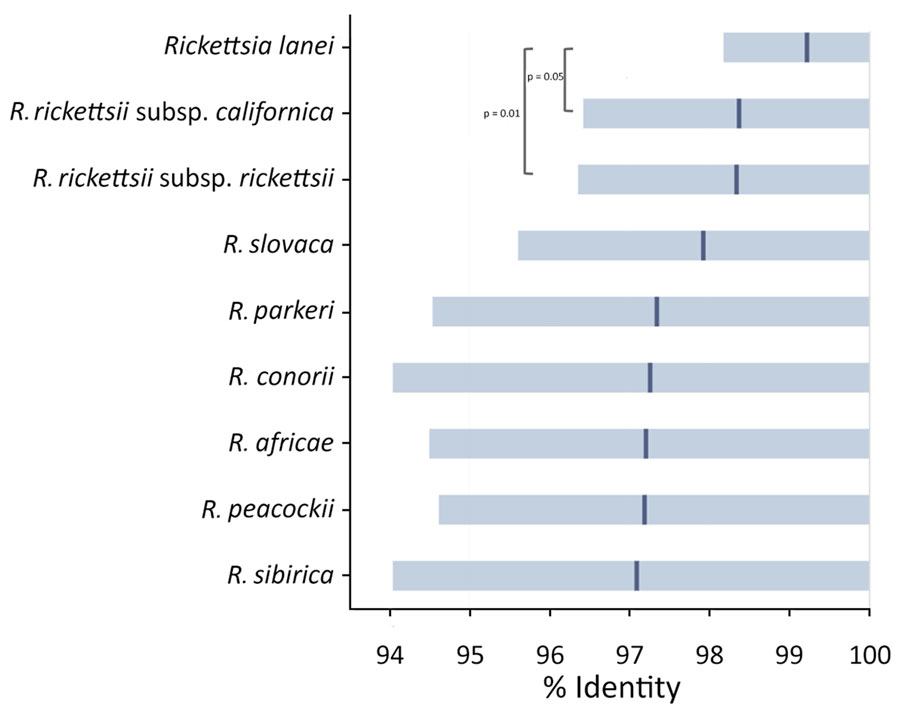
Figure 2. Sequence similarity of microbial cell-free DNA amplified and sequenced from a patient in Oregon, USA, to multiple Rickettsia spp. The sequences showed highest sequence similarity (99.2% mean identity) to the recently published R. lanei genome assembly (GenBank accession no. CP172233). Means (dark blue lines) and 10th–90th percentiles (light blue shading) of BLAST percentage identity of 967 sequencing reads were calculated for the most similar genome assemblies of related Rickettsia species in a custom microbial sequence database. p values indicated for significant differences between R. lanei and R. rickettsii subsp. californica and R. rickettsii subsp. rickettsii. p values of <10–6 were obtained by nonparametric (Wilcoxon signed-rank) and parametric (Student t) tests. For each pair, we compared the distribution of percentage identity values, penalized for partial alignment, and with lack of alignment filled in with a subthreshold value of 75%.