Volume 32, Number 5—May 2026
Dispatch
Exposure in Horses to Human Tick-Borne Relapsing Fever Agent Borrelia persica, Israel, 2025
Dor Shwartz , Lior Haras, Yaarit Nachum-Biala, Sharon Tirosh-Levy, Amir Steinman, and Gad Baneth
, Lior Haras, Yaarit Nachum-Biala, Sharon Tirosh-Levy, Amir Steinman, and Gad Baneth
Figure 4
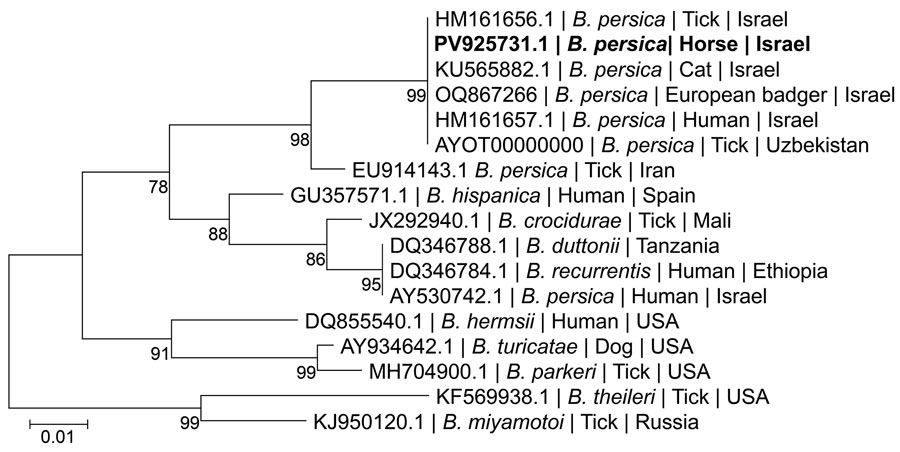
Figure 4. Maximum-likelihood phylogram comparing 224 bp DNA fragment sequences of the glpQ gene from the positive horse sequences from other B. persica and other Borrelia spp. GenBank accessions. Bold indicates new sequence derived from this study . GenBank accession number, species of infected host, and country of origin is provided for each sequence. The Tamura 3-parameter model was used in the construction of this phylogram with bootstrap performed on 1,000 replicates; values >70% are indicated. Scale bar represents the number of nucleotide substitutions per site; branch numbers indicate bootstrap support values, expressed as percentages.
Page created: March 31, 2026
Page updated: May 07, 2026
Page reviewed: May 07, 2026
The conclusions, findings, and opinions expressed by authors contributing to this journal do not necessarily reflect the official position of the U.S. Department of Health and Human Services, the Public Health Service, the Centers for Disease Control and Prevention, or the authors' affiliated institutions. Use of trade names is for identification only and does not imply endorsement by any of the groups named above.