Volume 32, Number 5—May 2026
Dispatch
Exposure in Horses to Human Tick-Borne Relapsing Fever Agent Borrelia persica, Israel, 2025
Dor Shwartz , Lior Haras, Yaarit Nachum-Biala, Sharon Tirosh-Levy, Amir Steinman, and Gad Baneth
, Lior Haras, Yaarit Nachum-Biala, Sharon Tirosh-Levy, Amir Steinman, and Gad Baneth
Figure 2
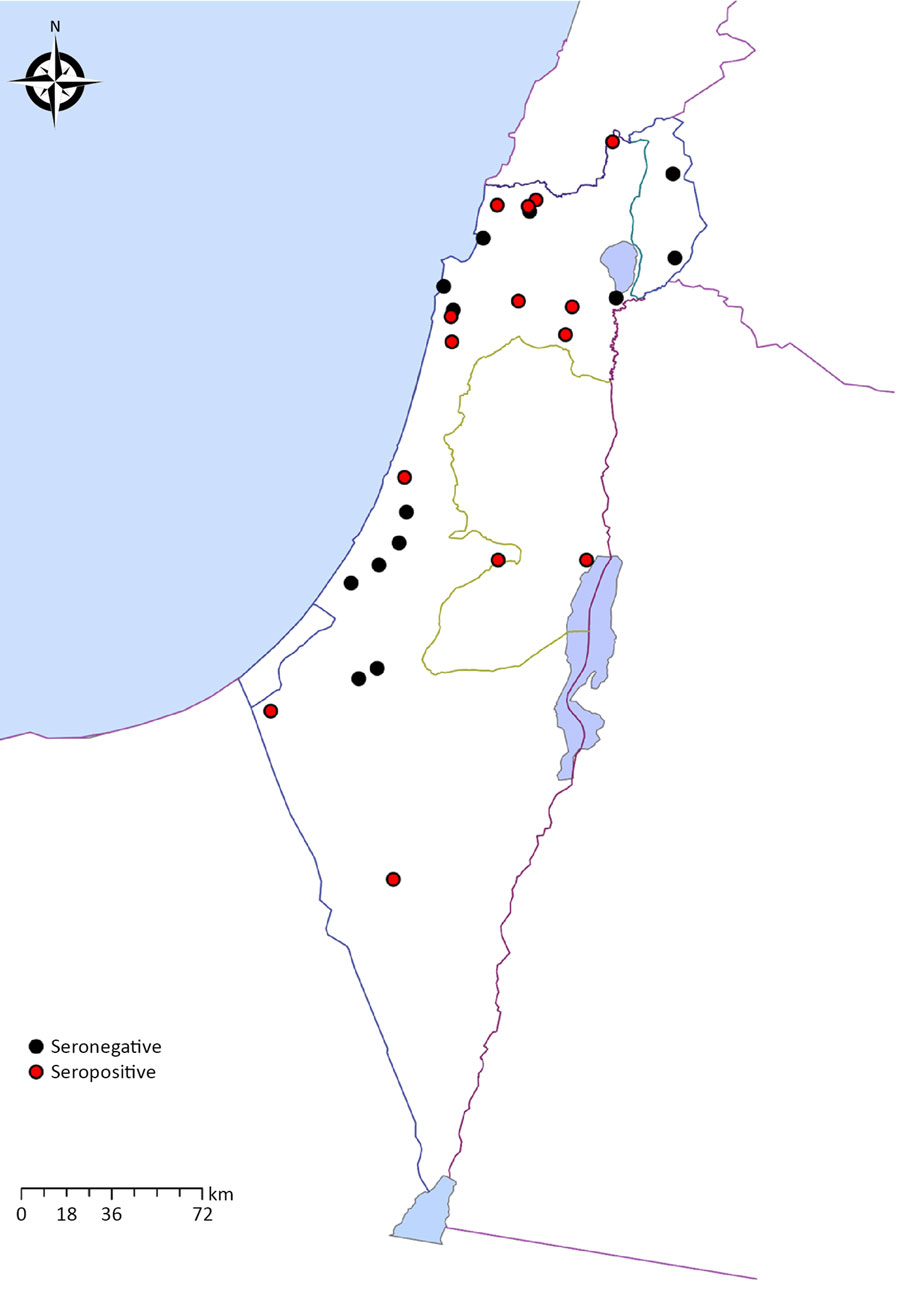
Figure 2. Geographic distribution of sampled horses in study of horses exposed to human tick-borne relapsing fever agent Borrelia persica in Israel that indicates the seroprevalence. Red circles represent the locations of seropositive horses; black circles denote seronegative horse locations.
Page created: March 31, 2026
Page updated: May 07, 2026
Page reviewed: May 07, 2026
The conclusions, findings, and opinions expressed by authors contributing to this journal do not necessarily reflect the official position of the U.S. Department of Health and Human Services, the Public Health Service, the Centers for Disease Control and Prevention, or the authors' affiliated institutions. Use of trade names is for identification only and does not imply endorsement by any of the groups named above.