Volume 32, Number 5—May 2026
Research Letter
Human Respiratory Syncytial Virus in Vaccinated and Unvaccinated Adults, Georgia, USA, 2024–2025


Cite This Article
Citation for Media
Abstract
We analyzed respiratory syncytial virus genome sequences from adults in Georgia, USA, during 2024–2025. We found multiple co-circulating lineages of both A and B subtypes. We identified few mutations in F protein antigenic sites in this population with low vaccine uptake, highlighting the need for ongoing genomic surveillance.
Respiratory syncytial virus (RSV) is a leading cause of respiratory tract infections in infants, older adults, and immunocompromised persons (1). Vaccines are available for adults on the basis of age and underlying conditions (2). In the United States during 2024–2025, 47.5% of adults >75 years of age and 38.1% of adults 60–74 years of age with high-risk conditions received RSV vaccinations (3). RSV vaccines target the fusion (F) protein at conserved epitopes; however, vaccination might create selective pressure for immune escape mutations.
Subtypes RSV-A and RSV-B have been classified into lineages (4), enabling surveillance for immune escape variants that might arise across diverse viral genetic backgrounds. US studies during 2022–2024 identified few substitutions in antigenic sites, none of which were clearly associated with vaccination (5–7). We analyzed RSV sequences during 2024–2025 to assess virus diversity under a changing immune landscape.
Our study included 182 vaccinated and unvaccinated adults within the Emory Healthcare system, in Georgia, USA (Appendix 1); 68.7% were female, 30.7% were male, and the median age was 61 years (Appendix 1 Table 1). Nearly all (98%) persons reported symptoms, including fever (31%), cough (93%), and dyspnea (25%). Hospitalization occurred in 13%, intensive care unit admission in 2%, and death in 3% (Appendix 1 Table 3).
Ninety-six (53%) persons were eligible for RSV vaccination on the basis of age (≥75 years) or age 50–74 years with underlying conditions (2); however, only 17 (18% of eligible persons) received vaccinations. We did not perform statistical analyses because of the small sample size, but observed that vaccinated persons were older and had more underlying conditions, which likely contributed to their higher rates of hospitalization and intensive care admission (Appendix 1 Table 1). We detected similar numbers of RSV-A (n = 93) and RSV-B (n = 83) cases. We successfully sequenced 71% of RSV-A samples and 76% of RSV-B samples (Appendix 1 Table 2), generally corresponding to those with quantitative reverse transcription PCR cycle threshold values <31 (Appendix 1 Figure 1).
Figure
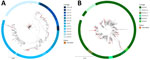
Figure. Maximum-likelihood phylogenetic trees of respiratory syncytial virus (RSV) A and RSV-B sequences from adults with RSV infection in Georgia, USA, 2024–2025. A) RSV-A sequences mainly clustered within lineages A.D.3.1 and...
Among RSV-A sequences, lineage A.D.3.1 was predominant (n = 27; 29%), followed by A.D.5.2 (n = 14; 15%) and A.D.1.5 (n = 9; 10%) (Appendix 1 Table 4). Lineage A.D.3.1 was more frequent in our study than previously reported (8,9). Among RSV-B sequences, most were lineage B.D.E.1 (n = 48; 58%), consistent with other studies (4). Among 17 vaccinated persons, 14 had RSV sequences with >75% coverage; those sequences represented multiple lineages, with no clear differences in lineage distribution between vaccinated and unvaccinated persons (Appendix 1 Table 4). Phylogenetic analysis showed that sequences from our study were distributed across phylogenetic trees (Figure; Appendix 1 Figure 2), although we observed clusters of Georgia sequences (Appendix 1 Table 4). Sequences from vaccinated persons did not show distinct clustering.
We evaluated mutations in F protein antigenic sites Ø–V for 125 sequences with >95% F gene coverage, 13 of which came from vaccinated persons. Across all persons, we identified a total of 25 nonsynonymous substitutions in antigenic sites (Table; Appendix 1 Figures 3, 4). Only 1 substitution was unique to vaccinated persons, K65R in antigenic site Ø in 1 RSV-A sequence. K65R phenotypic effects are unknown, but other substitutions at this site have been associated with nirsevimab resistance (10). We found another substitution, S377N, in 43% of vaccinated and 5% of unvaccinated persons, a finding also noted in a report of 2 postvaccine infections during 2023–2024 (6), but phenotypic effects of that substitution are unknown. The other substitutions occurred at the same or higher frequency in unvaccinated compared with vaccinated persons.
Among all persons, several substitutions (e.g., I59V and K470R) in RSV-A occurred at higher frequencies than previously reported (5). For RSV-B, 9 of the 13 substitutions were characteristic of the B.D.E.1 lineage (4). R42K, detected in nearly half of our samples, was also frequently detected in prior reports (6); however, F54L, detected in all our sequences, was previously rarely reported. We identified 3 substitutions not reported in prior studies: N63S in site Ø, and K445R and N466S in site IV (5–7,9). Mutations at antigenic sites 384 of RSV-A and 191 of RSV-B, rarely noted in cases of postvaccine infection reported during 2023–2024 (6), were widely circulating in our cohort by 2024–2025. Although not likely to be a direct result of immune pressure, these findings highlight ongoing drift in the F protein that might have future consequences for vaccine effectiveness. We also analyzed within-sample minor variants in F and identified only 1 substitution in antigenic site G71E in 37% of reads from an unvaccinated person with RSV-A (Appendix 1 Table 5).
Our analyses demonstrated that RSV strains circulating in Georgia during the 2024–25 season were diverse and resembled strains circulating across the United States and globally. We did not find evidence of vaccine-driven evolution; however, a primary limitation of this study was the small number of vaccinated persons. Continued large-scale RSV genomic surveillance will be critical for detecting emerging immune-escape variants and understanding viral evolution in the postvaccine era.
Dr. Rachida is an associate scientist at Emory University School of Medicine, Atlanta, Georgia, USA. His research focuses on molecular tracking of viruses in wastewater samples. Dr. Ahmed is an associate scientist at Emory University School of Medicine. His work focuses on developing and applying next-generation sequencing methods for viral genomic analysis.
Acknowledgments
All raw sequencing data (cleaned of human reads) are available in the National Center for Biotechnology Information (NCBI) under BioProject no. PRJNA1369004, and assembled virus genome sequences are available in NCBI GenBank (accession nos. listed in Appendix 1 Table 2).
This project has been funded in whole or in part with Federal funds from the Centers for Disease Control and Prevention (CDC) Pathogen Genomics Centers of Excellence under contract no. NU50CK000626 (CDC Pathogens Genomics Centers of Excellence, PGCoE). S.R. was supported by Insight Net cooperative agreement CDC-RFA-FT-23-0069 from the CDC’s Center for Forecasting and Outbreak Analytics. This study was supported in part by the Emory Integrated Genomics Core, which is subsidized by the Emory University School of Medicine and is one of the Emory Integrated Core Facilities.
CHATGPT version 5.1 (OpenAI, https://openai.com) was used to review grammar for portions of the text during early drafts. All conceptualization, initial writing, final editing, and generation of figures and tables were done manually.
References
- Tin Tin Htar M, Yerramalla MS, Moïsi JC, Swerdlow DL. The burden of respiratory syncytial virus in adults: a systematic review and meta-analysis. Epidemiol Infect. 2020;148:
e48 . DOIPubMedGoogle Scholar - Britton A, Roper LE, Kotton CN, Hutton DW, Fleming-Dutra KE, Godfrey M, et al. Use of respiratory syncytial virus vaccines in adults aged ≥60 years: updated recommendations of the Advisory Committee on Immunization Practices—United States, 2024. MMWR Morb Mortal Wkly Rep. 2024;73:696–702. DOIPubMedGoogle Scholar
- US Centers for Disease Control and Prevention. RSVVaxView. Weekly RSV vaccination dashboard. [cited 2024 Oct 23]. https://www.cdc.gov/rsvvaxview/dashboard/index.html
- Goya S, Ruis C, Neher RA, Meijer A, Aziz A, Hinrichs AS, et al. Standardized phylogenetic classification of human respiratory syncytial virus below the subgroup level. Emerg Infect Dis. 2024;30:1631–41. DOIPubMedGoogle Scholar
- Holland LA, Holland SC, Smith MF, Leonard VR, Murugan V, Nordstrom L, et al. Genomic sequencing surveillance to identify respiratory syncytial virus mutations, Arizona, USA. Emerg Infect Dis. 2023;29:2380–2. DOIPubMedGoogle Scholar
- Lauring AS, Edson C, Surie D, Dawood FS, Self WH, Lucero-Obusan C, et al. IVY Network. Genomic characterization of RSV in the US by vaccination status. JAMA. 2025;333:1540–3. DOIPubMedGoogle Scholar
- LaVerriere E, Behar S, Sher-Jan C, Liang YM, Sagar M, Connor JH. Genomic epidemiology of respiratory syncytial virus in a New England hospital system, 2024. Open Forum Infect Dis. 2025;12:
ofaf334 . DOIPubMedGoogle Scholar - Evans D, Kunerth H, Mumm E, Namugenyi S, Plumb M, Bistodeau S, et al. Genomic epidemiology of human respiratory syncytial virus, Minnesota, USA, July 2023–February 2024. Emerg Infect Dis. 2024;30:2414–8. DOIPubMedGoogle Scholar
- Yunker M, Fall A, Norton JM, Abdullah O, Villafuerte DA, Pekosz A, et al. Genomic evolution and surveillance of respiratory syncytial virus during the 2023–2024 season. Viruses. 2024;16:1122. DOIPubMedGoogle Scholar
- Fourati S, Reslan A, Bourret J, Casalegno JS, Rahou Y, Chollet L, et al.; POLYRES investigators. Genotypic and phenotypic characterisation of respiratory syncytial virus after nirsevimab breakthrough infections: a large, multicentre, observational, real-world study. Lancet Infect Dis. 2025;25:301–11. DOIPubMedGoogle Scholar
Figure
Table
Cite This ArticleOriginal Publication Date: May 04, 2026
1These authors contributed equally to this article.
Table of Contents – Volume 32, Number 5—May 2026
| EID Search Options |
|---|
 Advanced Article Search – Search articles by author and/or keyword.
|
 Articles by Country Search – Search articles by the topic country.
|
 Article Type Search – Search articles by article type and issue.
|
Please use the form below to submit correspondence to the authors or contact them at the following address:
Anne Piantadosi, Woodruff Memorial Research Building, 101 Woodruff Cir, Atlanta, GA 30322, USA
Top