Volume 32, Number 5—May 2026
Dispatch
Clinical, Molecular, and Zoonotic Perspectives on Human Cases of Cryptosporidium sp. OTUi

Figure 1
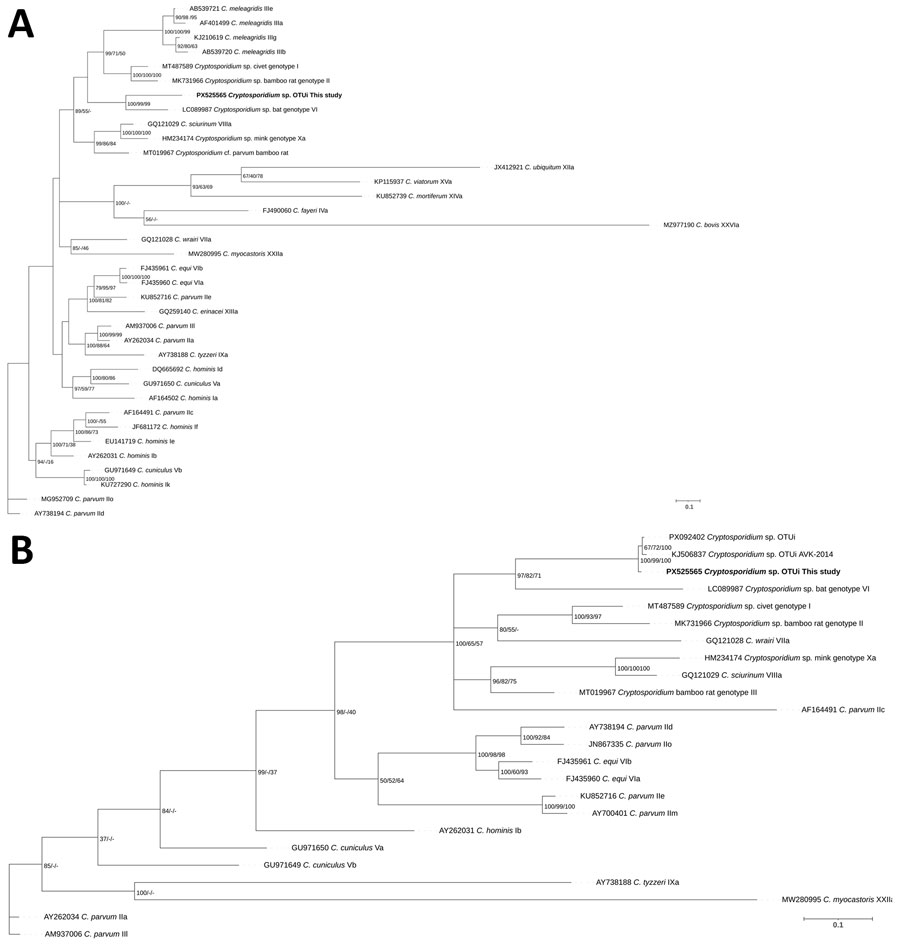
Figure 1. Phylogenetic trees inferred by using Bayesian analysis on the basis of partial nucleotide sequences of the gp60 gene of Cryptosporidium sp. OTUi (GenBank accession no. PX525565) obtained from a woman in Denmark who had traveled to Indonesia (bold text) in a study of the clinical, molecular, and zoonotic perspectives on human cases of Cryptosporidium sp. OTUi. A) Analysis including reference sequences (n = 35) retrieved from GenBank. B) Because sequences from previous human cases in Australia (GenBank accession nos. KJ506837 and PX092402) were shorter, we used a reduced alignment, including relevant reference sequences (n = 23). For Bayesian analyses, substitution models were selected on the basis of the lowest Akaike information criterion score, using a general time reversible with invariable site plus discrete gamma model substitution. We performed Bayesian inference by using MrBayes v3.2.7 (13) with 5 million generations, 4 chains, and sampling every 1,000 generations. The first 25% of trees were discarded as burn-in. We assessed convergence was assessed by SD of split frequencies <0.01 and a potential scale reduction factor of 1.0. Posterior probabilities and bootstrap support values from maximum-likelihood and neighbor-joining analyses are shown to the right of the nodes. Scale bars indicate substitutions per site.
References
- Larsen TG, Ethelberg S, Nielsen HL, Hartmeyer GN, Nielsen L, Zangenberg M, et al. From rare to recognized: enhanced detection uncovers Cryptosporidium endemicity and species diversity in Denmark. Emerg Microbes Infect. 2025;14:
2529893 . DOIPubMedGoogle Scholar - Alves M, Xiao L, Sulaiman I, Lal AA, Matos O, Antunes F. Subgenotype analysis of Cryptosporidium isolates from humans, cattle, and zoo ruminants in Portugal. J Clin Microbiol. 2003;41:2744–7. DOIPubMedGoogle Scholar
- Koehler AV, Whipp M, Hogg G, Haydon SR, Stevens MA, Jex AR, et al. First genetic analysis of Cryptosporidium from humans from Tasmania, and identification of a new genotype from a traveller to Bali. Electrophoresis. 2014;35:2600–7. DOIPubMedGoogle Scholar
- Babineau M, Koehler AV, Sait ML, Mercoulia K, Dougall S, McAllister J, et al. Large-scale molecular epidemiological survey of Giardia and Cryptosporidium in Victoria, Australia (2020-2024), reveals novel subtypes and outbreak-associated lineages. J Clin Microbiol. 2026;0:
e0155825 . DOIPubMedGoogle Scholar - Stensvold CR, Larsen TG, Grüttner J, Nielsen L, Engberg J, Lebbad M. Rodent-adapted Cryptosporidium infection in humans: seven new cases and review of the literature. One Health. 2024;18:
100682 . DOIPubMedGoogle Scholar - Lebbad M, Winiecka-Krusnell J, Stensvold CR, Beser J. High diversity of Cryptosporidium species and subtypes identified in cryptosporidiosis acquired in Sweden and abroad. Pathogens. 2021;10:523. DOIPubMedGoogle Scholar
- Xu L, Fukuda Y, Murakoshi F, Alviola P, Masangkay J, Recuenco FC, et al. Molecular characterization and zoonotic risk assessment of Cryptosporidium spp. in Philippine bats. Food Waterborne Parasitol. 2024;38:
e00249 . DOIPubMedGoogle Scholar - Yang L, Wang Q, Xu L, Tu C, Huang X, He B. Detection and characterization of a novel norovirus in bats, China. Virol Sin. 2018;33:100–3. DOIPubMedGoogle Scholar
- Nowak K, Fahr J, Weber N, Lübke-Becker A, Semmler T, Weiss S, et al. Highly diverse and antimicrobial susceptible Escherichia coli display a naïve bacterial population in fruit bats from the Republic of Congo. PLoS One. 2017;12:
e0178146 . DOIPubMedGoogle Scholar - Luby SP, Rahman M, Hossain MJ, Blum LS, Husain MM, Gurley E, et al. Foodborne transmission of Nipah virus, Bangladesh. Emerg Infect Dis. 2006;12:1888–94. DOIPubMedGoogle Scholar
- Khan MS, Hossain J, Gurley ES, Nahar N, Sultana R, Luby SP. Use of infrared camera to understand bats’ access to date palm sap: implications for preventing Nipah virus transmission. EcoHealth. 2010;7:517–25. DOIPubMedGoogle Scholar
- Barbosa AD, Egan S, Feng Y, Xiao L, Ryan U. How significant are bats as potential carriers of zoonotic Cryptosporidium and Giardia? Curr Res Parasitol Vector Borne Dis. 2023;4:
100155 . DOIPubMedGoogle Scholar - Huelsenbeck JP, Ronquist F. MRBAYES: Bayesian inference of phylogenetic trees. Bioinformatics. 2001;17:754–5. DOIPubMedGoogle Scholar