Volume 32, Number 5—May 2026
Research Letter
Genomic Surveillance of Lassa Virus through In-Country Sequencing, Guinea
 , Joon Klaps1, Kékoura Ifono1, Fara Raymond Koundouno, Youssouf Sidibé, Sarah Ryter, Moussa Conde, Saa Lucien Millimono, Mette Hinrichs, Julia Hinzmann, Nils Peter Petersen, Mia Le, Annick Renevey, Ehizojie Ehiremen Emua, Philippe Lemey, Simon Dellicour, Stephan Günther, N’Faly Magassouba2, Sophie Duraffour2, Liana Eleni Kafetzopoulou2, and Sanaba Boumbaly2
Figure 2
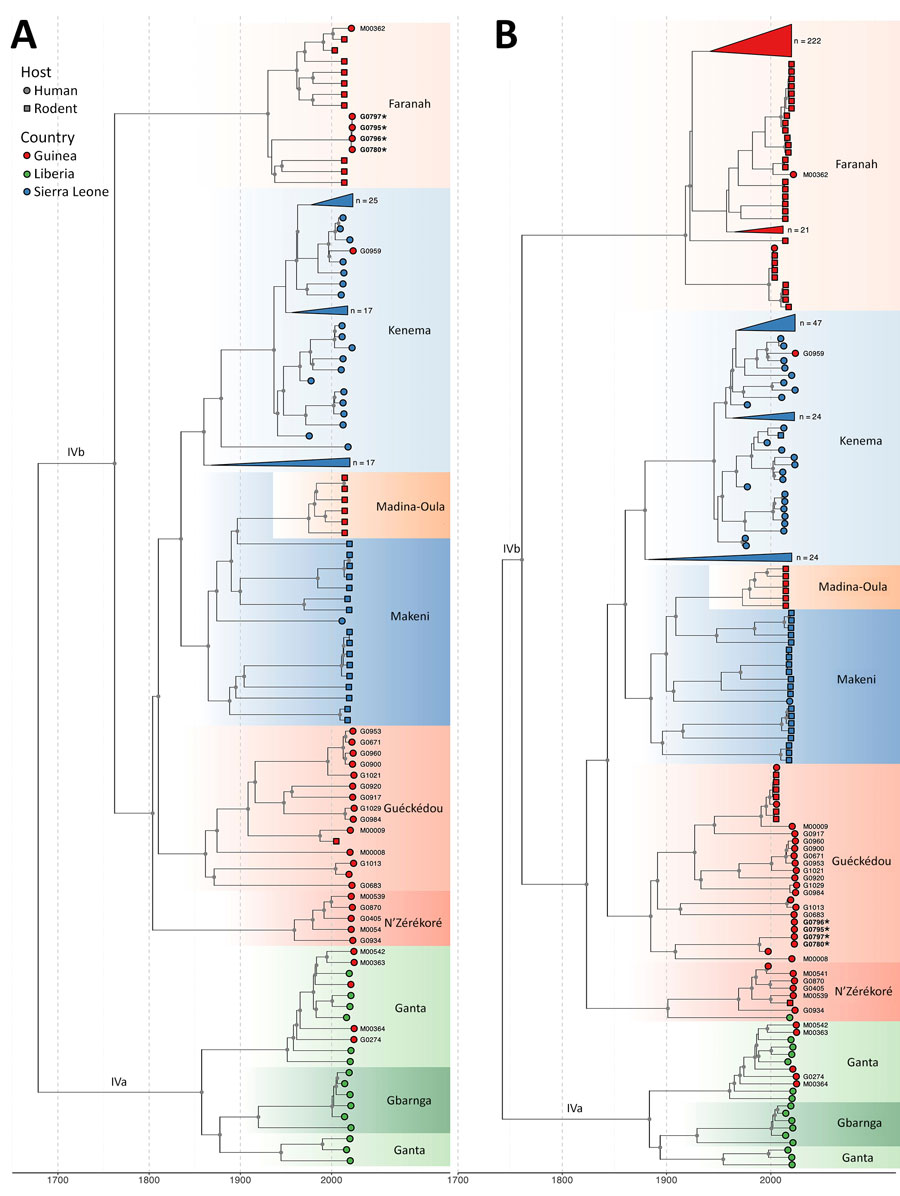
Figure 2. Temporal evolution of the large and small segments of Lassa virus from study of genomic surveillance of Lassa virus through in-country sequencing, Guinea. Time-scaled maximum clade credibility trees are shown for the large (A) and small (B) segments. Tips are colored by country of origin. Sublineages are annotated and colored by their predominant geographic location (e.g., Kenema, Faranah, Ganta). Clades that fall outside the sequence diversity of interest (i.e., clades that have no association with the sequences reported in this article) are collapsed and annotated with the total number of sequences they include. Gray dots indicate internal nodes with a clade credibility of >80%. Sequences reported in this manuscript have their sample identification codes indicated next to their respective tip. We detected 2 cocirculating sublineages of Lassa virus in N’Zérékoré: a locally established IVb lineage (M00539, M00541, G0405, G0870, G0934), and the IVa lineage linked to the region of Ganta in Liberia (M00363, M00542, M00364, G0274). The sample from Guéckédou (G0959) grouped within the Kenema, Sierra Leone, Lassa virus cluster, reflecting its travel-linked origin. Strains that form the nosocomial transmission chain with reassorted genomes have been highlighted in bold and are indicated with a star.
1These first authors contributed equally to this article.
2These senior authors contributed equally to this article.