Volume 32, Number 6—June 2026
Perspective
Limitations of Global Surveillance for Neisseria gonorrhoeae Antimicrobial Resistance
Sebastiaan J. van Hal , Helen Fifer, and Monica M. Lahra
, Helen Fifer, and Monica M. Lahra
Figure
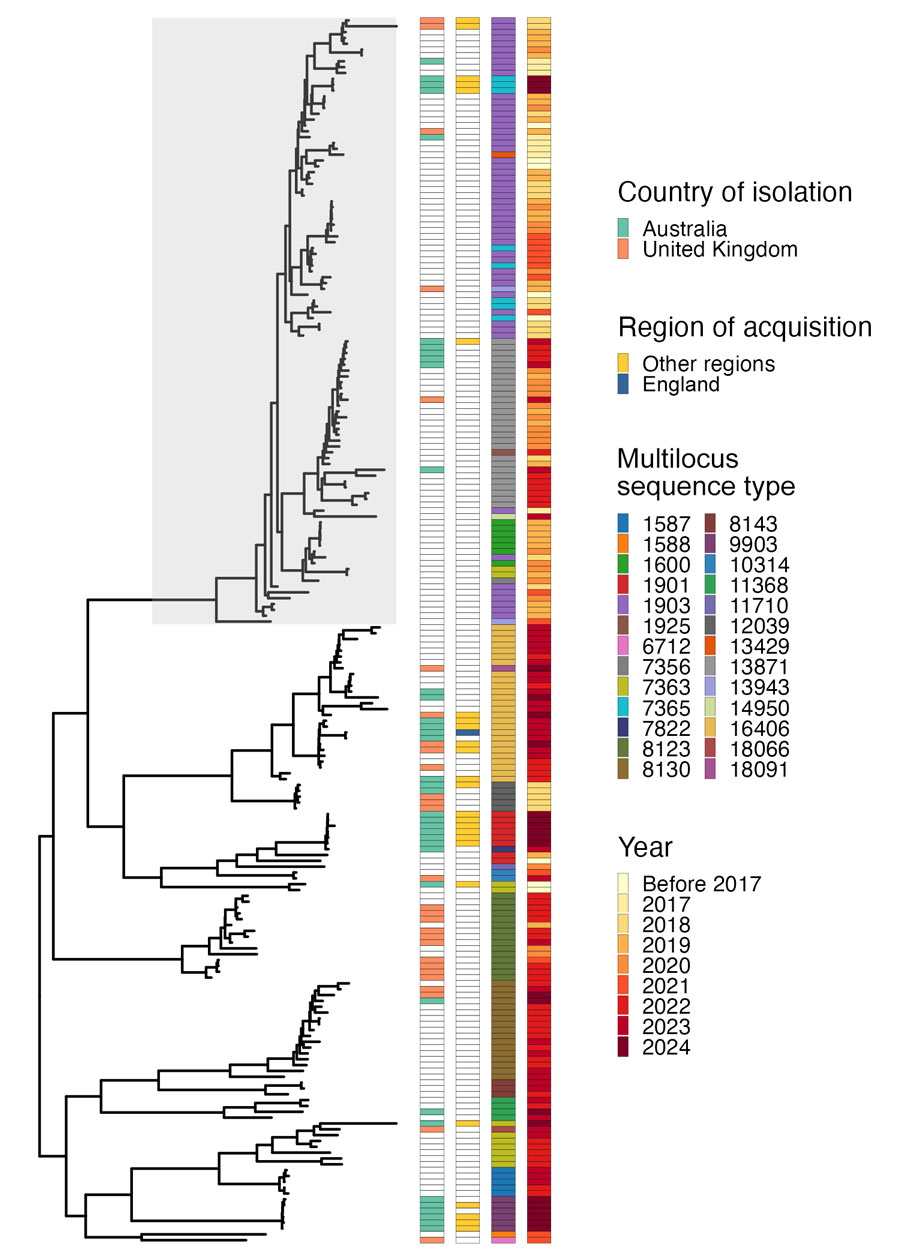
Figure. Maximum-likelihood phylogenetic tree of 212 ceftriaxone-resistant Neisseria gonorrhoeae isolates harboring penA 60.001 allele. Gray shading indicates original FC428 clone that emerged in 2015 in Japan and shows most new isolates clustering away from this clone. Columns at right shows isolates detected in England and Australia, reported regions where infections were acquired in Asia (countries include Cambodia, China, Indonesia, Japan, Thailand, Singapore, and Vietnam), multilocus sequence type, and year of isolation. Sequence types and isolate years demonstrate variation over time and genomic diversity.
Page created: May 20, 2026
Page updated: June 01, 2026
Page reviewed: June 01, 2026
The conclusions, findings, and opinions expressed by authors contributing to this journal do not necessarily reflect the official position of the U.S. Department of Health and Human Services, the Public Health Service, the Centers for Disease Control and Prevention, or the authors' affiliated institutions. Use of trade names is for identification only and does not imply endorsement by any of the groups named above.