Volume 32, Number 6—June 2026
Perspective
Limitations of Global Surveillance for Neisseria gonorrhoeae Antimicrobial Resistance
 , Helen Fifer, and Monica M. Lahra
Cite This Article
Citation for Media
Abstract
Neisseria gonorrhoeae bacteria cause ≈82 million infections annually worldwide. As antimicrobial resistance (AMR) accelerates, the actual prevalence of antimicrobial-resistant infections remains obscured because of fragmented, heterogeneous, and often absent surveillance systems. The efficacy of ceftriaxone, widely used as first-line therapy, is increasingly threatened by the expansion of strains harboring the mosaic penA 60.001 allele, first documented in 2015 and now recognized globally as the dominant determinant of AMR. Our systematic search of the published literature identified 212 such isolates; nearly half were detected after 2022 in England and Australia, and epidemiologic data frequently linked acquisition of infection to the Asia-Pacific region. The substantially higher case numbers reported in those countries reflect the strength of their gonococcal AMR surveillance systems and more timely public data sharing. Our findings suggest that underreporting of the actual prevalence of ceftriaxone resistance is likely and that the opportunity for action is limited.
Neisseria gonorrhoeae bacteria are a priority pathogen for the World Health Organization (WHO) and cause an estimated 82 million new infections annually worldwide. Optimal disease control strategies remain unclear in light of increasing reports of antimicrobial resistance (AMR) and very limited global surveillance. A systematic review of surveillance systems for monitoring gonococcal AMR from 2022 found no evidence of a current surveillance system for gonorrhea in 148 countries, and only 6 countries (Australia, England, Wales, Scotland, Canada, and New Zealand) had gonococcal surveillance systems that were comprehensive and national. Those systems include all culture-based diagnoses of antimicrobial-susceptible gonorrhea infections and cover >50% of jurisdictions in their respective countries (1).
Historically, N. gonorrhoeae bacteria have developed resistance to every first-line therapeutic agent (2), including ceftriaxone, the current first-line treatment; newer agents such as gepotidacin and zoliflodacin show promise as alternatives. However, the longevity of the newer agents remains uncertain, particularly in settings where circulating N. gonorrhoeae isolates harbor the parC D86N mutation, 1 of 2 observed mutations required to develop resistance to the newer agents (3). In 2015, the emergence and subsequent spread of the ceftriaxone-resistant N. gonorrhoeae FC428 clone (i.e., strains harboring the ceftriaxone-resistance determinant) heralded the beginning of an era of increasing uncertainty regarding future antimicrobial drug management strategies (4,5). More than a decade later, the mosaic penA allele 60.001 persists as the prevailing determinant of ceftriaxone resistance (6).
We searched the published literature in June 2025 to identify reports of ceftriaxone-resistant N. gonorrhoeae bacteria harboring the penA 60.001 allele with linked genomic sequence data, to gain a contemporary understanding of AMR. We limited the search to isolates carrying penA 60.001 because other resistance-associated alleles, including the emerging penA 237.001 allele, remain relatively rare (7), whereas penA 60.001 has been consistently detected through routine surveillance across diverse settings. Although ceftriaxone-resistant N. gonorrhoeae has been reported by Canada, Japan, China, and WHO programs, the corresponding MICs and genomic sequencing data were not available (8–12).
We collated a total of 440 ceftriaxone-resistant isolates and defined resistance as an MIC >0.25 mg/L, regardless of the original susceptibility testing method used. Of the 440 isolates, 296 (67.3%) harbored the penA 60.001 allele, and genomic data were available for 212 (48.2%) isolates. Fifty percent (106/212) of all cases of ceftriaxone-resistant N. gonorrhoeae infection had been reported since 2022; 48% (51/106) of those were detected in England (n = 19) and Australia (n = 32). The remaining cases were detected in the Asia-Pacific region (n = 49), other countries in Europe (n = 4), and North America (n = 2) (7,13–18).
Figure
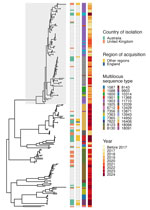
Figure. Maximum-likelihood phylogenetic tree of 212 ceftriaxone-resistant Neisseria gonorrhoeae isolates harboring penA60.001 allele. Gray shading indicates original FC428 clone that emerged in 2015 in Japan and shows...
We constructed a phylogenetic tree, as previously described (6), following a mapping approach that used reference strain FA1090 (GenBank accession NC_002964.2) and masked recombination by using Gubbins version 2.12 (19). The phylogenetic analysis confirmed that the penA 60.001 allele associated with ceftriaxone resistance is predominantly in the Asia-Pacific region and that most cases detected elsewhere were linked to contact or travel in that region (Figure). The analysis also indicated that ceftriaxone resistance continues to evolve and has only a minority of recent isolates still clustering within the original FC428 clone. This trend of resistance evolution within multiple different clonal backbones signals an expanding and growing problem that is unlikely to be contained, portending serious challenges for therapy.
Of note, most gonococcal infections are diagnosed by using molecular testing, and culture rates vary substantially across countries. Nevertheless, outside of the Asia-Pacific region, most reported cases of ceftriaxone-resistant N. gonorrhoeae infection are reported from England and Australia. One plausible explanation for the higher detection rates in those countries is the strength and coverage of their surveillance systems and the close integration of culture-based testing and antimicrobial susceptibility testing.
Gonococcal AMR in England and Wales is monitored through the Gonococcal Resistance to Antimicrobials Surveillance Programme, a sentinel surveillance system covering ≈2% of total yearly gonorrhea diagnoses (20). In addition, all cases of gonorrhea, regardless of infection site, have a sample taken for culture, and all ceftriaxone-resistant isolates in England are referred to the national Sexually Transmitted Infections Reference Laboratory for confirmation and follow-up (21). The number of ceftriaxone-resistant infections is reported on a quarterly basis. In Australia, culture is similarly recommended when feasible, and isolates are forwarded to the relevant jurisdictional Neisseria reference laboratories for antimicrobial susceptibility testing and follow-up. Australia’s jurisdictional Neisseria reference laboratories form a network, the National Neisseria Network, which is supported by the federal government and is responsible for the national surveillance system. National AMR surveillance data, derived from ≈24% of total annual cases, are publicly reported.
In contrast, even in countries with established surveillance systems, the low number of detected resistant isolates may primarily reflect underascertainment, resulting from the limited scope of culture-based surveillance, which typically tests or reports only a small fraction of cases through sentinel programs mainly targeting symptomatic men. Such restricted sampling might also explain why WHO-associated surveillance initiatives, including the Enhanced Gonococcal Antimicrobial Surveillance Programme in South-East Asia, have not detected higher rates of ceftriaxone resistance to date, except in Cambodia and Vietnam (9,22). Similarly, actual prevalence of antimicrobial-resistant N. gonorrhoeae infections in China remains unclear because accessible publications are largely regional and describe heterogeneous sampling strategies, limiting national-level interpretation (8,23). Alternatively, the routine public reporting of gonococcal AMR in China, especially when linked to genomic analyses, remains uncommon. As a result, antimicrobial-resistant cases may be identified locally but not reported widely.
Relying on the identification of treatment failure as an alternative signal of resistance is subject to many limitations. Only a small number of treatment failures have been reported globally, and those that have are almost exclusively in high-income countries, reflecting surveillance bias and underreporting. Detection of treatment failure is further complicated by inconsistent definitions of treatment failure, variability in treatment regimens, limited follow-up, and restricted access to culture-based diagnostics. As a result, AMR surveillance and treatment failure reporting probably underestimate the actual prevalence of ceftriaxone-resistant infections (24).
Therefore, for myriad reasons, the actual prevalence of gonococcal AMR is underestimated, which has prompted calls to expand AMR surveillance systems (10). However, such expansion is not always feasible, given social and political barriers, constraints in funding and laboratory capacity, and logistical challenges of scaling culture-based and antimicrobial susceptibility testing. In the absence of comprehensive global surveillance, data from England and Australia act as a canary in the coal mine, providing early warning of sentinel events. Furthermore, those datasets represent the best available evidence and should be used to model actual AMR prevalence and help guide international policy and intervention strategies.
The trajectory of N. gonorrhoeae AMR expansion is such that the window of opportunity for effective intervention is rapidly closing. Even with limited available global gonococcal AMR surveillance data, ceftriaxone resistance is high in some parts of the Asia-Pacific region; recent reports indicate resistance estimates of >20% (when applying an MIC >0.25 mg/L threshold) in some settings (7,8,25). The surveillance systems in England and Australia are signaling that ceftriaxone-resistant N. gonorrhoeae are transmitting globally and are originating from countries that report no ceftriaxone resistance. Furthermore, resistant isolates remain undetected in countries without comprehensive surveillance, meaning that the global gonococcal AMR prevalence exceeds current assumptions.
Dr. van Hal is an infectious diseases physician and clinical microbiologist at the Royal Prince Alfred Hospital Sydney in Australia. His primary research interests include antimicrobial resistance, Neisseria infections, and pathogen genomics.
Acknowledgments
The WHO Collaborating Center for Sexually Transmitted Infections and Antimicrobial Resistance, New South Wales Health Pathology, is the jurisdictional Neisseria Reference Laboratory responsible for gonococcal AMR surveillance, and the coordinating laboratory for the Australian Gonococcal Surveillance Programme, supported by the Government of Australia’s Department of Health and Aged Care.
H.F. has received funding to attend a GSK Advisory Board meeting.
References
- Medland NA, Zhang Y, Gunaratnam P, Lewis DA, Donovan B, Whiley DM, et al. Surveillance systems to monitor antimicrobial resistance in Neisseria gonorrhoeae: a global, systematic review, 1 January 2012 to 27 September 2020. Euro Surveill. 2022;27:
2100917 . DOIPubMedGoogle Scholar - Fifer H, Johnson A. The continuing evolution of antibiotic resistance in Neisseria gonorrhoeae: past, present and future threats to effective treatment. J Antimicrob Chemother. 2025;80:1213–9. DOIPubMedGoogle Scholar
- Mukherjee A, Blomqvist SOP, Helekal D, Das AA, Palace SG, Grad YH. Genetic background modulates zoliflodacin and gepotidacin cross-resistance and fitness in Neisseria gonorrhoeae. J Infect Dis. 2026;•••:
jiag174 . DOIPubMedGoogle Scholar - van der Veen S. Global transmission of the penA allele 60.001–containing high-level ceftriaxone-resistant gonococcal FC428 clone and antimicrobial therapy of associated cases: a review. Infect Microbes Dis. 2023;5:13–20. DOIGoogle Scholar
- Lee K, Nakayama SI, Osawa K, Yoshida H, Arakawa S, Furubayashi KI, et al. Clonal expansion and spread of the ceftriaxone-resistant Neisseria gonorrhoeae strain FC428, identified in Japan in 2015, and closely related isolates. J Antimicrob Chemother. 2019;74:1812–9. DOIPubMedGoogle Scholar
- van Hal SJ, Sherry N, Coombs G, Mowlaboccus S, Whiley DM, Lahra MM. Emergence of an extensively drug-resistant Neisseria gonorrhoeae clone. Lancet Infect Dis. 2024;24:e547–8. DOIPubMedGoogle Scholar
- Laumen JGE, Hieu VN, Nhung PH, Vandelannoote K, Nguyen TT, Nguyen TT, et al. High prevalence of ceftriaxone-resistant Neisseria gonorrhoeae in Hanoi, Vietnam, 2023–2024. J Infect Dis. 2025;232:e73–7. DOIPubMedGoogle Scholar
- Zhu X, Xi Y, Gong X, Chen S. Ceftriaxone-resistant gonorrhea—China, 2022. MMWR Morb Mortal Wkly Rep. 2024;73:255–9. DOIPubMedGoogle Scholar
- Lan PT, Nguyen HT, Golparian D, Thuy Van NT, Maatouk I, Unemo M, et al.; EGASP-Vietnam WGS Study Group. The WHO Enhanced Gonococcal Antimicrobial Surveillance Programme (EGASP) identifies high levels of ceftriaxone resistance across Vietnam, 2023. Lancet Reg Health West Pac. 2024;48:
101125 . DOIPubMedGoogle Scholar - Unemo M, Lahra MM, Cole MJ, Marcano Zamora D, Jacobsson S, Galarza P, et al. WHO global gonococcal antimicrobial surveillance programmes, 2019–22: a retrospective observational study. Lancet Microbe. 2025;6:
101181 . DOIPubMedGoogle Scholar - Shimuta K, Ohama Y, Yoshida A, Nakayama SI, Ohnishi M, Kawahata T, et al.; Antibiotic-Resistant Gonorrhea Study Group. Emergence of a ceftriaxone-resistant Neisseria gonorrhoeae strain harbouring penA-60.001 in a novel genetic background (MLST 9903) in Japan, 2018–2024. Sex Transm Infect. 2025;sextrans-2025-056694. DOIPubMedGoogle Scholar
- Walsh TM, Plitt SS, Dingle TC, Charlton CL. Surveillance of antimicrobial resistance in Neisseria gonorrhoeae in Alberta from 2016–2022. Antibiotics (Basel). 2025;14:1119. DOIPubMedGoogle Scholar
- 13. Lahra ME, van Hal S, Hogan TR. Australian Gonococcal Surveillance Programme annual report, 2023. Commun Dis Intell. 2018;2025:1–16. DOIPubMedGoogle Scholar
- Fifer H, Doumith M, Rubinstein L, Mitchell L, Wallis M, Singh S, et al. Ceftriaxone-resistant Neisseria gonorrhoeae detected in England, 2015–24: an observational analysis. J Antimicrob Chemother. 2024;79:3332–9. DOIPubMedGoogle Scholar
- Maubaret C, Caméléna F, Mrimèche M, Braille A, Liberge M, Mainardis M, et al. Two cases of extensively drug-resistant (XDR) Neisseria gonorrhoeae infection combining ceftriaxone-resistance and high-level azithromycin resistance, France, November 2022 and May 2023. Euro Surveill. 2023;28:
2300456 . DOIPubMedGoogle Scholar - Pleininger S, Indra A, Golparian D, Heger F, Schindler S, Jacobsson S, et al. Extensively drug-resistant (XDR) Neisseria gonorrhoeae causing possible gonorrhoea treatment failure with ceftriaxone plus azithromycin in Austria, April 2022. Euro Surveill. 2022;27:
2200455 . DOIPubMedGoogle Scholar - Jolley KA, Maiden MC. BIGSdb: Scalable analysis of bacterial genome variation at the population level. BMC Bioinformatics. 2010;11:595. DOIPubMedGoogle Scholar
- Sánchez-Busó L, Yeats CA, Taylor B, Goater RJ, Underwood A, Abudahab K, et al. A community-driven resource for genomic epidemiology and antimicrobial resistance prediction of Neisseria gonorrhoeae at Pathogenwatch. Genome Med. 2021;13:61. DOIPubMedGoogle Scholar
- Croucher NJ, Page AJ, Connor TR, Delaney AJ, Keane JA, Bentley SD, et al. Rapid phylogenetic analysis of large samples of recombinant bacterial whole genome sequences using Gubbins. Nucleic Acids Res. 2015;43:
e15 . DOIPubMedGoogle Scholar - United Kingdom Health Security Agency. GRASP report: data to September 2025. 2025 Nov [cited 2026 Apr 20]. https://www.gov.uk/government/publications/gonococcal-resistance-to-antimicrobials-surveillance-programme-grasp-report/grasp-report-data-to-september-2025
- Fifer H, Ismail MA, Soni S, Nwaosu U, Sadiq ST, Milligan A, et al. British Association of Sexual Health and HIV UK national guideline for the management of infection with Neisseria gonorrhoeae, 2025. Int J STD AIDS. 2025;36:826–40. DOIPubMedGoogle Scholar
- Ouk V, Pham CD, Wi T, van Hal SJ, Lahra MM; EGASP Cambodia Working Group. The Enhanced Gonococcal Surveillance Programme, Cambodia. Lancet Infect Dis. 2023;23:e332–3. DOIPubMedGoogle Scholar
- Lin X, Chen W, Yu Y, Lan Y, Xie Q, Liao Y, et al. Emergence and genomic characterization of Neisseria gonorrhoeae isolates with high levels of ceftriaxone and azithromycin resistance in Guangdong, China, from 2016 to 2019. Microbiol Spectr. 2022;10:
e0157022 . DOIPubMedGoogle Scholar - Fagan L, Alexander S, Fifer H. The invisible tide of Neisseria gonorrhoeae treatment failures: a review and commentary. Clin Infect Dis. 2026;81(Supplement_5):S223–30. DOIPubMedGoogle Scholar
- Ouk V, Say HL, Virak M, Deng S, Frankson R, McDonald R, et al.; EGASP Cambodia Working Group. World Health Organization Enhanced Gonococcal Antimicrobial Surveillance Programme, Cambodia, 2023. Emerg Infect Dis. 2024;30:1493–5. DOIPubMedGoogle Scholar
Figure
Cite This ArticleOriginal Publication Date: May 20, 2026
Table of Contents – Volume 32, Number 6—June 2026
| EID Search Options |
|---|
 Advanced Article Search – Search articles by author and/or keyword.
|
 Articles by Country Search – Search articles by the topic country.
|
 Article Type Search – Search articles by article type and issue.
|
Please use the form below to submit correspondence to the authors or contact them at the following address:
Sebastiaan J. van Hal, Department of Infectious Diseases and Microbiology, NSW Health Pathology, Royal Prince Alfred Hospital, Sydney, NSW 2050, Australia
Top