Skip directly to site content Skip directly to page options Skip directly to A-Z link Skip directly to A-Z link Skip directly to A-Z link

Disclaimer: Early release articles are not considered as final versions. Any changes will be reflected in the online version in the month the article is officially released.

Volume 32, Number 7—July 2026

Research Letter

Ancylostoma ceylanicum Hookworm, Rural Papua New Guinea, 2020

Jessica L. Scott, Daniel Pelowa, Wayne Melrose, Jeffrey M. Warner, and Catherine M. RushComments to Author 
Author affiliation: James Cook University College of Medicine and Dentistry, Townsville, Queensland, Australia (J.L. Scott, W. Melrose, J.M. Warner, C.M. Rush); James Cook University Australian Institute of Tropical Health and Medicine, Townsville (J.L. Scott, J.M. Warner, C.M. Rush); Balimo District Hospital, Balimo, Papua New Guinea (D. Pelowa)

Main Article

Figure

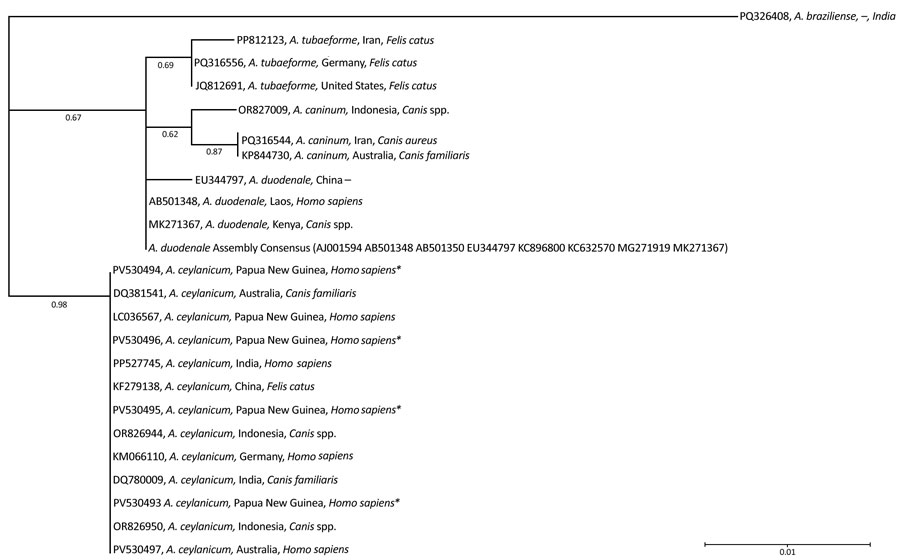
Phylogenetic analysis of Ancylostoma spp. in study of A. ceylanicum hookworm, rural Papua New Guinea, 2020. Analysis is based on the internal transcribed spacer sequence regions 1 and 2 and conducted with the maximum-likelihood method, using the Kimura 2-parameter model. Model selection was based on penalized-likelihood information criteria. The phylogenetic tree was visually adjusted using Interactive Tree of Life version 7.2.2 (https://itol.embl.de). Values at branch nodes indicate bootstrap support values (1,000 replicates). A. braziliense was used as an outgroup to root the tree. GenBank accession numbers are shown; asterisks (*) denote sequences identified in this study (accession nos. PV530493–96). We used A. ceylanicum (accession no. PV530497) as a positive control. Dash (–) indicates that no information was available for a particular attribute of the strain. Scale bar represents 0.01 substitutions per site.

Figure. Phylogenetic analysis of Ancylostoma spp. in study of A. ceylanicum hookworm, rural Papua New Guinea, 2020. Analysis is based on the internal transcribed spacer sequence regions 1 and 2 and conducted with the maximum-likelihood method, using the Kimura 2-parameter model. Model selection was based on penalized-likelihood information criteria. The phylogenetic tree was visually adjusted using Interactive Tree of Life version 7.2.2 (https://itol.embl.de). Values at branch nodes indicate bootstrap support values (1,000 replicates). A. braziliense was used as an outgroup to root the tree. GenBank accession numbers are shown; asterisks (*) denote sequences identified in this study (accession nos. PV530493–96). We used A. ceylanicum (accession no. PV530497) as a positive control. Dash (–) indicates that no information was available for a particular attribute of the strain. Scale bar represents 0.01 substitutions per site.

Main Article

Page created: May 28, 2026
Page updated: June 23, 2026
Page reviewed: June 23, 2026
The conclusions, findings, and opinions expressed by authors contributing to this journal do not necessarily reflect the official position of the U.S. Department of Health and Human Services, the Public Health Service, the Centers for Disease Control and Prevention, or the authors' affiliated institutions. Use of trade names is for identification only and does not imply endorsement by any of the groups named above.
file_external