Volume 32, Number 7—July 2026
Research Letter
Ancylostoma ceylanicum Hookworm, Rural Papua New Guinea, 2020


Cite This Article
Citation for Media
Abstract
We conducted a cross-sectional study of zoonotic hookworm Ancylostoma ceylanicum in humans in Western Province, Papua New Guinea, confirmed by internal transcribed spacer sequencing. Overall hookworm prevalence was 54.9%; A. ceylanicum hookworms were present in 3.3% of specimens. One Health approaches are needed for hookworm control in Papua New Guinea.
Hookworm infections pose a major public health challenge in Papua New Guinea (PNG). Historic national estimates suggest that up to three quarters of the population may be infected (1); a 2025 study reported prevalence >80% for the anthropophilic hookworm species Necator americanus in Madang Province (2). In 2018, the zoonotic hookworm Ancylostoma ceylanicum was confirmed in a migrant worker returning from Manus Island by using molecular methods (3). However, since that initial report, no data have been published on the prevalence of A. ceylanicum hookworm among local populations in PNG. We report molecular evidence of locally acquired A. ceylanicum infections in a rural community in PNG, alongside a high overall prevalence of hookworm infection.
We conducted a cross-sectional study in collaboration with the Balimo District Hospital (Balimo, PNG) during January 2020. We recruited community members >16 years of age through convenience sampling from Balimo, which is situated in the Delta Fly District of the Western Province of PNG (Appendix Figure 1). We preserved fecal specimens in sodium-acetate 5% formalin (SAF) and separately in guanidinium thiocyanate within 8 hours of submission. We examined SAF-preserved specimens for hookworm ova by microscopy, using direct unconcentrated and ethyl acetate–concentrated fecal smears.
We extracted genomic DNA from guanidinium thiocyanate–preserved fecal specimens using the Zymo Quick-DNA Fecal/Soil Microbe Miniprep Kit (Zymo Research Corporation, https://www.zymoresearch.com). We detected 3 hookworm species, N. americanus, A. ceylanicum, and A. duodenale, using TaqMan quantitative PCR (qPCR) (Integrated DNA Technologies, https://sg.idtdna.com) (Appendix Table). We Sanger sequenced all Ancylostoma qPCR-positive samples targeting the internal transcribed spacer region, using custom primers (forward 5′-GAATGCCGCCTTACTGCTTG-3′ and reverse 5′-CGATTCAGCAGCAACAACGAG-3′) (Appendix).
Figure
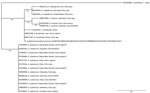
Figure. Phylogenetic analysis of Ancylostoma spp. in study of A. ceylanicumhookworm, rural Papua New Guinea, 2020. Analysis is based on the internal transcribed spacer sequence regions 1...
Among the 122 participants who submitted a fecal specimen, microscopy detected hookworm ova in 28 (22.9%), whereas qPCR identified 64 (52.5%) as positive. Combining both methods yielded an overall hookworm prevalence of 54.9% (67/122) (Table). Three (4.5%) samples that tested positive by microscopy were negative by qPCR. N. americanus was the predominant hookworm species detected by qPCR, identified in 64 (52.5%) participants. We detected Ancylostoma spp. hookworm in 4 (3.3%) samples; all Ancylostoma-positive participants were also infected with N. americanus. All sequences identified in this study (GenBank accession nos. PV530493–6) formed a distinct cluster with A. ceylanicum sequences, including the positive template control isolate (accession no. PV530497) and the PNG isolate previously identified from the migrant worker (accession no. LC036567), confirming all 4 cases as A. ceylanicum hookworm (Figure). We detected no A. duodenale cases (Appendix Figure 2).
This study provides molecular evidence of A. ceylanicum hookworm in a rural community in Western Province, PNG. Our findings further support the recognition of A. ceylanicum as the second most common human hookworm in the Asia-Pacific region (4); however, in our study it accounted for only a small proportion of the overall hookworm burden compared with N. americanus.
The absence of A. duodenale hookworm prompts reconsideration of earlier hookworm surveys in PNG. Previous studies relied on larval culture for species identification; however, the close morphologic similarity between A. duodenale and A. ceylanicum larvae might have led to misclassification, raising the possibility that A. ceylanicum infections were historically present but attributed to A. duodenale. Whether that is the case or that A. ceylanicum hookworm was more recently introduced remains unclear. A study in Madang Province found neither A. ceylancium nor A. duodenale hookworm despite high hookworm prevalence, indicating geographic variation could also exist (2). Conditions in Balimo, including free-roaming dogs that serve as household guardians, may favor potential zoonotic transmission of A. ceylanicum hookworms. At the time of our study, veterinary services and deworming programs were absent, creating opportunities for parasite persistence at the human–animal–environment interface. Nevertheless, without concurrent sampling of local dogs and cats, the contribution of animal reservoirs and the directionality of transmission remain unclear.
Delayed specimen processing might have resulted in lysis of hookworm ova, thereby reducing the sensitivity of microscopy in our study. Furthermore, hookworm ova are morphologically similar to those of Strongyloides fuelleborni subspecies fuelleborni, which is known to occur in the region (5); strongyloidiasis has been detected in the same community in which we conducted our study (6). That overlap in egg morphology might represent one of several factors contributing to the discrepancy observed between microscopy-positive and qPCR-negative specimens. In addition, the modest sample size and convenience sampling of participants >16 years of age limit the generalizability of our findings to the wider community and surrounding areas. Given that untreated hookworm infection can persist long term, prevalence estimates may also be influenced by chronic infections within the sampled population.
In summary, the presence of A. ceylanicum hookworms in this region requires a One Health approach to addressing both human infections and animal reservoirs. Traditional deworming programs targeting only humans are insufficient for preventing reinfection and achieving sustainable elimination where zoonotic transmission may occur.
Ms. Scott is a PhD candidate at James Cook University, Australia, with a background in biomedical sciences. Her primary research interests are intestinal parasitic infections and tuberculosis co-infections.
Acknowledgments
We thank the participants and community members of the Balimo region, whose invaluable contribution was fundamental to this research. We thank Angela Slatcher for her technical guidance in participant recruitment and specimen processing.
Approval for this study was obtained from the Middle Fly District Health Service, Evangelical Church of PNG Health Services, James Cook University Human Research Ethics Committee (H6432 and H8015), and the PNG Medical Research Advisory Committee (MRAC 19.21). Informed consent was obtained from all participants.
J.L.S. has been supported through the Australian Government Research Training Program Scholarship. Primary funding provided by the HOT NORTH—Pilot Project was awarded to C.M.R. and J.M.W.
During the preparation of this work, J.L.S. used Claude Opus (Claude 3.5 Sonnet) and Grammarly for Microsoft Office (version 6.8.263) to check grammar and spelling. After using this tool, the author reviewed and edited the content as needed and takes full responsibility for the publication's content.
References
- Kline K, McCarthy JS, Pearson M, Loukas A, Hotez PJ. Neglected tropical diseases of Oceania: review of their prevalence, distribution, and opportunities for control. PLoS Negl Trop Dis. 2013;7:
e1755 . DOIPubMedGoogle Scholar - Tobon Ramos JA, Maure T, Carias L, Lew D, Goss C, Samuel A, et al. Impact of mass drug administration with ivermectin, diethylcarbamazine, and albendazole for lymphatic filariasis on hookworm and Strongyloides stercoralis infections in Papua New Guinea. PLoS Negl Trop Dis. 2025;19:
e0012851 . DOIPubMedGoogle Scholar - Yoshikawa M, Ouji Y, Hirai N, Nakamura-Uchiyama F, Yamada M, Arizono N, et al. Ancylostoma ceylanicum, novel etiological agent for traveler’s diarrhea—report of four Japanese patients who returned from Southeast Asia and Papua New Guinea. Trop Med Health. 2018;46:6. DOIPubMedGoogle Scholar
- Tenorio JCB, Tabios IKB, Inpankaew T, Ybañez AP, Tiwananthagorn S, Tangkawattana S, et al. Ancylostoma ceylanicum and other zoonotic canine hookworms: neglected public and animal health risks in the Asia-Pacific region. Anim Dis. 2024;4:11. DOIGoogle Scholar
- Zhao H, Haidamak J, Noskova E, Ilik V, Pafčo B, Ford R, et al. Insights into infant strongyloidiasis, Papua New Guinea. Emerg Infect Dis. 2025;31:1793–801. DOIPubMedGoogle Scholar
- Scott J, Emeto TI, Melrose W, Warner J, Rush C. Seroepidemiology of Strongyloides spp. infection in Balimo, Western Province, Papua New Guinea. Am J Trop Med Hyg. 2023;108:346–52. DOIPubMedGoogle Scholar
Figure
Table
Cite This ArticleOriginal Publication Date: June 23, 2026
Table of Contents – Volume 32, Number 7—July 2026
| EID Search Options |
|---|
 Advanced Article Search – Search articles by author and/or keyword.
|
 Articles by Country Search – Search articles by the topic country.
|
 Article Type Search – Search articles by article type and issue.
|
Please use the form below to submit correspondence to the authors or contact them at the following address:
Catherine Rush, Australian Institute of Tropical Health & Medicine, James Cook University, Mount Stuart St, Bldg 48 Rm 104, Douglas, Townsville, QLD 4811, Australia
Top